
Collective Intelligence: The Emergence of the Global Brain in the Web 2.0 Era
Collective Intelligence in Knowledge Management
This paper explores the conceptual framework of Collective Intelligence (CI) within the context of Web 2.0, defining it as a Complex Adaptive System (CAS). It examines how social software—such as Blogs, Wikis, and Social Bookmarking—facilitates the emergence of group-level intelligence and knowledge management via the Internet.
TL;DR
This paper positions Collective Intelligence (CI) as the defining feature of the Web 2.0 era. By viewing the Internet as a Complex Adaptive System (CAS), the authors argue that social softwares like Wikis and Blogs are not just tools, but platforms where individual intelligence aggregates into a "Global Brain." The core value lies in the shift from centralized knowledge storage to dynamic, emergent knowledge management driven by social tagging, RSS flows, and programmable mash-ups.
The Motivation: Moving Beyond Centralized Knowledge
Before the explosion of Social Software, the Internet was largely a repository of static information (Web 1.0). The authors identify a critical gap: the inability of "read-only" environments to foster Swarm Intelligence. Drawing inspiration from biological systems like ant colonies, the researchers suggest that human communities possess the capacity to evolve toward higher-order complexity through collaboration—provided they have the right communication technologies.
The central question is: How do individual, uncoordinated actions on the web result in coherent, intelligent group behaviors?
Methodology: CI as a Complex Adaptive System (CAS)
The authors don't just describe "social apps"; they provide a robust theoretical framework by categorizing Collective Intelligence as a Complex Adaptive System.
The 7 Pillars of the CI Mechanism
The paper induces seven basic characteristics that allow CI to emerge:
- Aggregation: Collecting individual inputs (e.g., Wikipedia entries).
- Tagging: Using "Folksonomies" to organize data organically.
- Nonlinearity: Small individual interactions leading to massive, unpredictable group shifts.
- Information Flows: Facilitated by RSS to keep the system active and diversiform.
- Diversity: Ensuring a wide range of individual perspectives.
- Selectivity: The ability of agents to choose peers and information.
- Building Blocks: Utilizing Programmable Web (APIs) to create complex "Mash-ups" from simpler components.
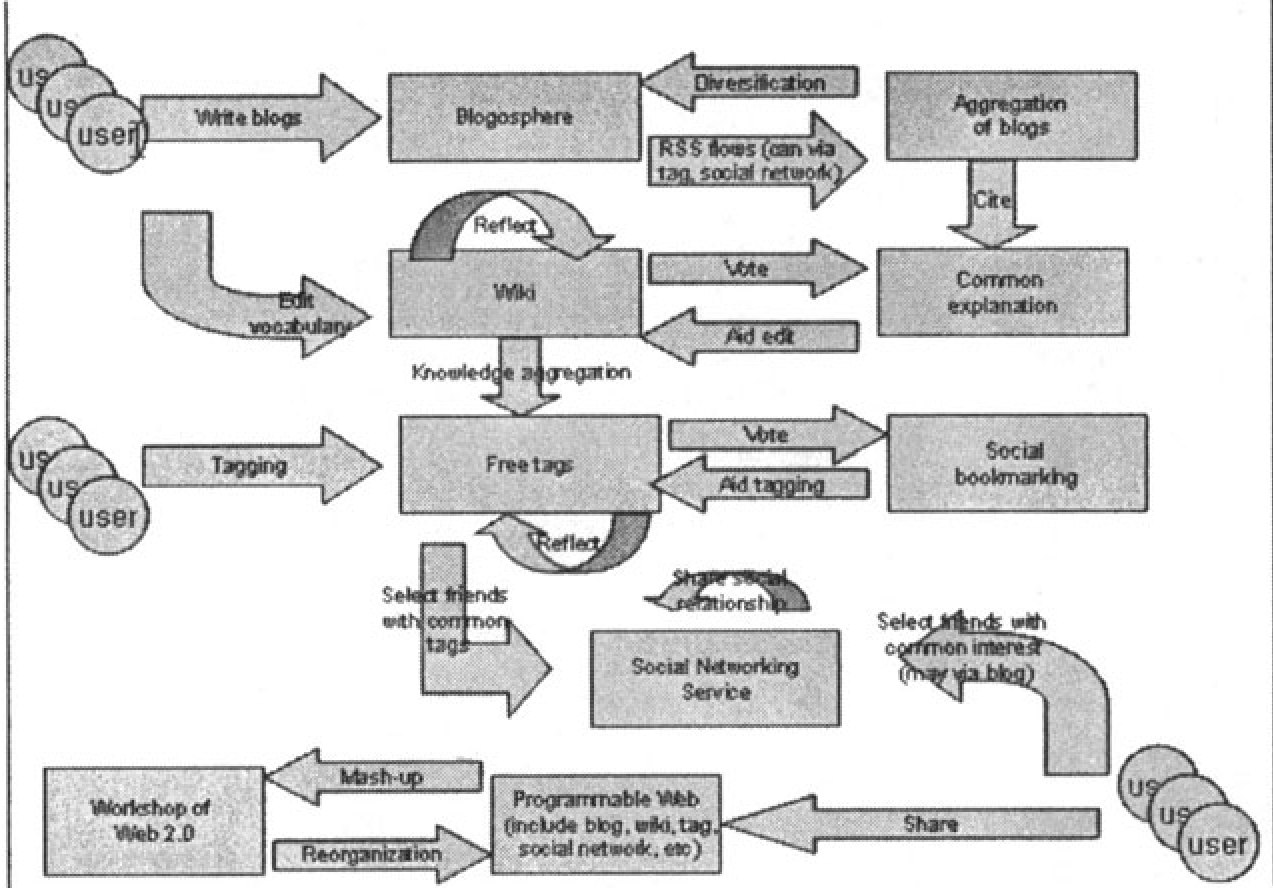 Figure 1: The interaction between individual intelligence and the emergence of collective knowledge through social platforms.
Key Insights from Social Software
The paper breaks down how different technologies contribute to this "Mass Intelligence":
- Blogs (The Fuel): By opening production to non-programmers, blogs created the "critical mass" necessary for the blogosphere.
- Wikis (The Consensus): Wikipedia is presented as the ultimate example of emergence where "common vocabulary" stabilizes through constant voting and modification.
- Folksonomy (The Order): Unlike rigid taxonomies, social bookmarking (like del.icio.us) allows order to emerge from "free tagging" by the masses.
Critical Analysis & Conclusion
The authors conclude that Collective Intelligence is the new Knowledge Management. Instead of a database, knowledge is now a living, breathing process stored on the platform of the Internet.
Limitations & Future Work
While the paper provides an excellent qualitative framework, it remains high-level regarding the specific Data Mining and Semantic Web algorithms required to optimize these systems. The "Physical Intuition" here is that as we move toward a more "Programmable Web," the barriers between individual knowledge silos will dissolve, leading to a more "vivid" and adaptive Internet.
Takeaway for Today's AI Landscape
Though written in the mid-2000s, this paper’s focus on Aggregation and Nonlinearity prefigures the current era of LLMs, which are essentially the ultimate "aggregation" of human collective intelligence. The next frontier, as the authors suggest, is the marriage of this social emergence with the Semantic Web—creating a web that doesn't just store data, but "understands" the collective wisdom it holds.