
PLEM: Solving Knowledge Overload with Web 2.0 Collective Intelligence
Harnessing Collective Intelligence in Personal Learning Environments
The paper introduces PLEM, a Web 2.0-driven service designed for Personal Learning Environments (PLEs). It utilizes social filtering and collective intelligence (ranking/voting from Twitter, Facebook, etc.) to act as a knowledge filter that helps self-directed learners discover high-quality "knowledge nodes" and combat information overload.
TL;DR
The research addresses the "Knowledge Overload" crisis in self-directed learning. By moving beyond traditional "knowledge-push" systems (like Moodle or Blackboard), the authors introduce PLEM, a platform that leverages the "Wisdom of Crowds." It aggregates social signals from across the web—Facebook likes, Twitter mentions, and Digg votes—to rank and recommend the best learning resources and experts for a learner's Personal Learning Environment (PLE).
Background: From Knowledge-Push to Knowledge-Pull
Traditional Technology Enhanced Learning (TEL) has long been dominated by the Learning Management System (LMS). However, the authors argue that LMS models are "one-size-fits-all" and treat learners as passive recipients (Knowledge-Push).
The industry is shifting toward Personal Learning Environments (PLE), where the learner is the architect. But this freedom comes with a price: Information Overload. In a world of unlimited choices, how does a learner know which book, video, or expert is actually worth their time?
PLEM Architecture: Tapping the Global Brain
The core "Insight" of this paper is that quality is social. Instead of relying on a central authority to curate content, the authors propose using Collective Intelligence.
The Filtering Mechanism
PLEM doesn't just look at what happens inside its own platform; it uses a Mashup Concept to pull data from the wider Web 2.0 ecosystem.
- Explicit Knowledge: Books, blogs, and videos.
- Tacit Knowledge: Subject matter experts and mentors.
Every time someone tweets a link, "likes" a resource on Facebook, or bookmarks a page, PLEM counts it as a "vote" for that knowledge node.
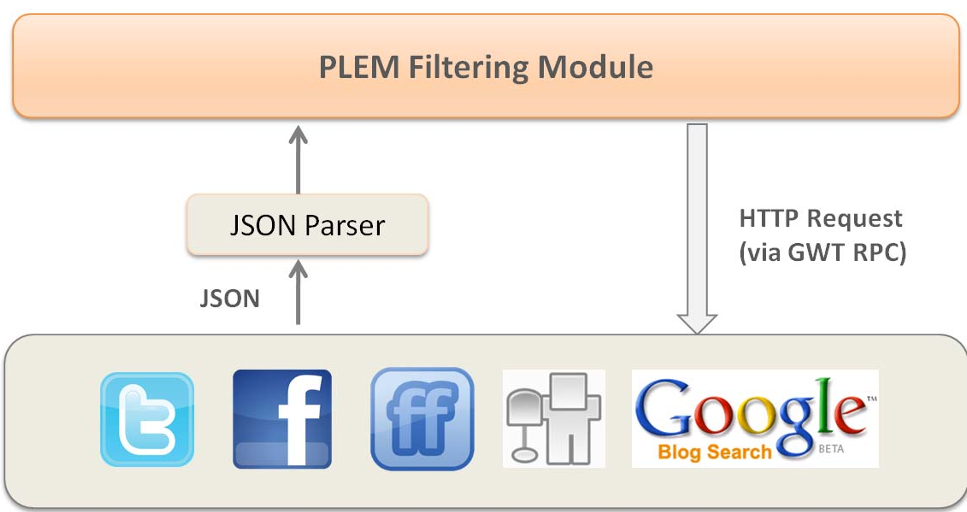 Figure: The PLEM Filtering Module aggregating social signals to rank learning elements.
Technical Implementation
The system is built on a standard Model-View-Controller (MVC) pattern using the Google Web Toolkit (GWT). It communicates with third-party APIs (Google, Twitter, Facebook) via JSON and asynchronous RPCs to update the popularity ranking in real-time.
Experimental Results: Does it Actually Work?
The authors evaluated PLEM using the DeLone and McLean I/S Success Model, focusing on system quality, information quality, and user satisfaction.
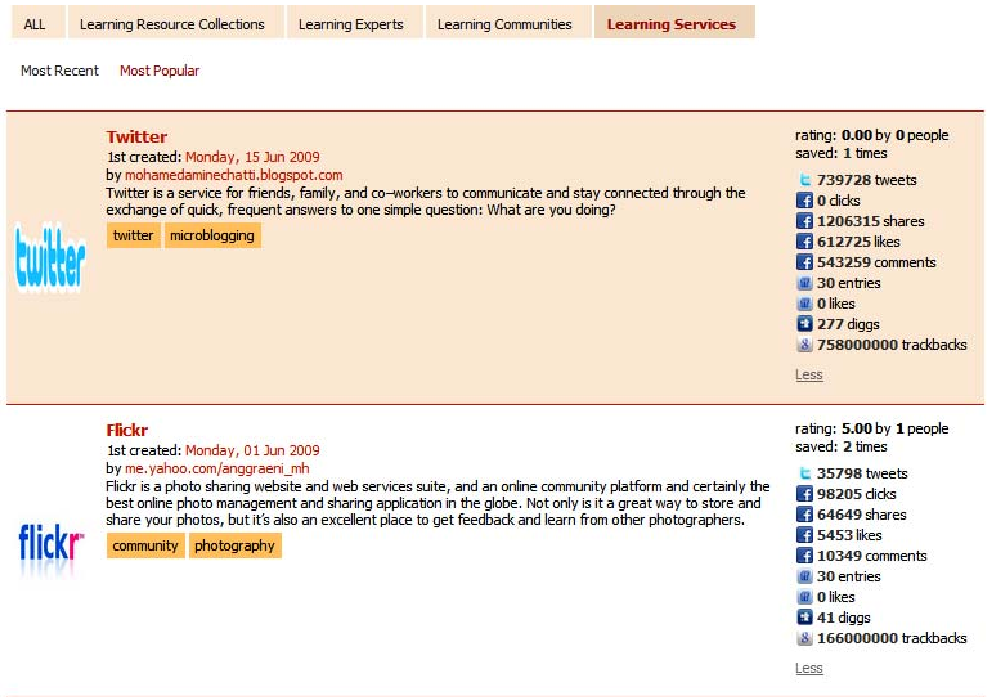 Figure: The I/S Success Model used to measure PLEM's impact.
Key Findings:
- User Satisfaction: The system achieved a 65.9% satisfaction score. While the UI was praised for being "simple and intuitive," users noted that the system needs better error handling and a more "attractive presentation."
- Relevance: Most evaluators found the social-ranking results to be "appropriate." They confirmed that social signals (saves, rates, votes) are valid indicators of a resource's learning value.
- Suitability: 16 out of 22 participants explicitly agreed that PLEM is a viable knowledge filter for self-directed learners.
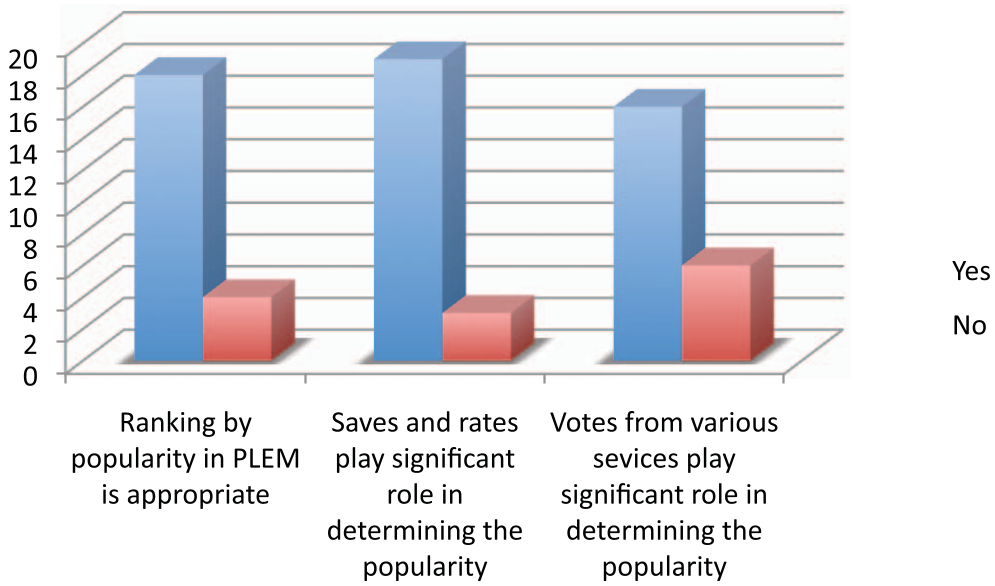 Figure: Statistical feedback showing user agreement on the effectiveness of social ranking.
Deep Insight & Future Outlook
The "Magic" of PLEM lies in its Inductive Bias: the assumption that social engagement correlates with educational quality. While this holds true for "popularity," it raises a critical question: Is the most popular resource always the most accurate?
Limitations:
- The Cold Start Problem: As noted by one evaluator, the system requires a critical mass of users to be truly effective.
- Web 2.0 Volatility: Relying on third-party APIs (like the now-deprecated Digg or changed Twitter APIs) makes the system fragile to the shifting sands of the social media landscape.
Final Takeaway: This paper serves as a blueprint for the "Social Semantic Web." It proves that for learning to be truly personalized, it must be interconnected. The future of PLEs isn't just about tools; it's about the Social Filtering layer that sits on top of those tools, helping us navigate the noise to find the signals that matter.