
Collective Intelligence in Retail: Decoding Consumer Intent with Ant Colony Optimization
Collective Intelligence-Based Sequential Pattern Mining Approach for Marketing Data
This paper introduces an Ant Colony Optimization (ACO) based sequential pattern mining approach for analyzing consumer behavior in retail environments using video stream data. By modeling touched goods as nodes in a graph and frequent transitions as pheromone-laden edges, it successfully visualizes consumer purchase patterns and brand relationships with high adaptability.
TL;DR
Understanding why a customer picks up a toothbrush but doesn't buy it is the "holy grail" of offline marketing. This paper proposes a sequential pattern mining approach based on Ant Colony Optimization (ACO). By treating consumer movements as ant trails, the researchers managed to visualize complex brand and product relationships while filtering out the "noise" of ambiguous human behavior.
Context: Beyond the POS Data
For decades, Point of Sale (POS) data was the primary lens for marketing. However, POS only tells you what was bought, not what was considered. With the advent of video analytics, we can now track the sequence of goods a consumer touches. This "Sequential Action" data is a goldmine for understanding intent, yet it is notoriously noisy and ambiguous.
Problem & Motivation: The Chaos of Human Shopping
Traditional algorithms like Apriori or GSP are too rigid. They struggle with:
- Temporal Evolution: Patterns change over time.
- Ambiguity: A consumer might pick up Item A, then Item B (a distraction), then Item C. Traditional models might miss the A → C connection.
- Noise: Repeatedly picking up and putting down the same item shouldn't be counted as a meaningful transition.
The authors argue that ACO is the perfect fit because its evaporation mechanism handles dynamic changes, and its pheromone accumulation captures the collective "wisdom" of many consumers.
Methodology: The ACO Mining Framework
The researchers modeled the store as a Virtual Graph (), where nodes are products and edges are transitions.
The Core Loop
- Accumulation: As a consumer moves from item to item , pheromone is added to the edge.
- Evaporation: Over time (or as more consumers are processed), pheromones evaporate at a rate . This ensures that old or infrequent patterns fade away, leaving only the "strongest" consumer paths.
Addressing Ambiguity (The Three Extensions)
To make the system "human-ready," the authors added three clever features:
- Continuous Touch Pruning: If a user touches the same item repeatedly, it's treated as a single event.
- Transitive Easing: If a consumer touches , pheromones are also added to . This captures the "hidden intent" even if was a random distraction.
- Node Pheromone (The Mediator): Some items act as "weak ties" that bridge different categories. The authors introduced a threshold to save these "mediator" nodes even if their specific edges are weak.
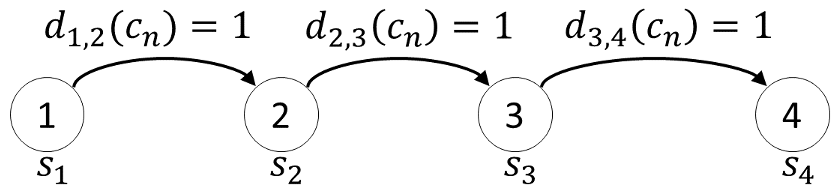 Fig 1: Illustration of adding pheromones to non-adjacent nodes to handle behavior ambiguity.
Experiments & Results: The Toothbrush Case Study
The team tested their approach on real marketing data (1,552 consumers) from a drugstore's toothbrush section. Using Cytoscape for visualization, they found:
- Initial Findings: Without extensions, the graph clustered items purely by physical characteristics (e.g., extra-soft brushes).
- Advanced Insights: With the "Easing Transitive Relations" extension, the clusters shifted to represent Manufacturers. This suggests that while customers look at a specific type of brush, their sequential loyalty or comparison often stays within a specific brand's ecosystem.
- The Power of Growth: By introducing Node Pheromones, they restored "tooth powder" to the graph, showing it was a vital secondary purchase that basic algorithms often overlooked.
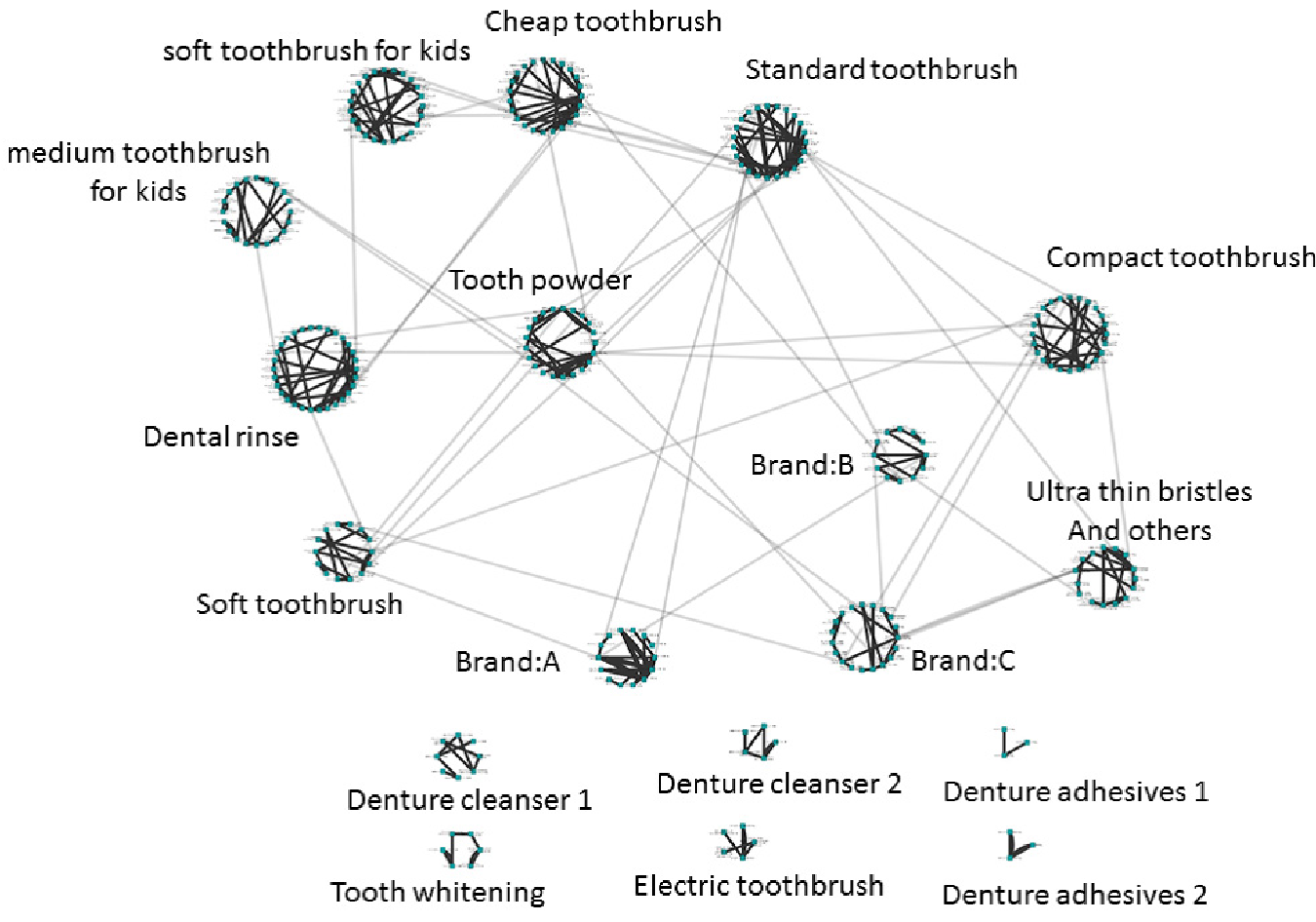 Fig 2: Visualization of consumer communities. The transition from individual item patterns (left) to brand-level clusters (right) via algorithm extensions.
Critical Analysis & Conclusion
This work stands out for its high readability. Unlike "Black Box" models like SVM or Neural Networks, an ACO-derived graph is intuitive for a human marketer to look at and understand why products are linked.
Limitations:
- The study is limited to a single product category (toothbrushes).
- It relies on pre-tagged video data (segmentation and tagging are assumed to be perfect).
Future Outlook: The true potential lies in Hierarchical Mining. Imagine a model that tracks the sequence of sections a shopper visits (Drinks → Snacks → Checkout) and then dives into the sequence of items within those sections. Combining this "Meta-level" behavior with the current "Item-level" behavior could revolutionize retail floor planning.