
Collective Intelligence in Web Search: Merging Folksonomy with Personalized Ranking
Collective Intelligence-Based Web Page Search: Combining Folksonomy and Link-Based Ranking Strategy
The paper proposes a novel web search framework that integrates Folksonomy (user-generated tagging) with a modified Link-based Ranking algorithm. This "Collective Intelligence" approach enhances search relevance by categorizing pages via crowd-sourced tags while prioritizing results through user-click behavior and personalized preference values.
TL;DR
In an era of information explosion, finding truly relevant web pages is a "needle in a haystack" problem. This paper presents a search system that leverages Collective Intelligence by combining the social tagging power of Folksonomy with a Behavior-refined PageRank algorithm. By analyzing how groups tag content and how individuals click through links, the system creates a search experience that is both community-aware and personally relevant.
Problem & Motivation: The Fatigue of Irrelevant Search
Despite the complexity of modern search engines, approximately 50% of retrieved web pages are reported as irrelevant to the user's specific context.
- Folksonomy's Flaw: While tags (labels like "news", "music") help categorize the web, they are often "flat" and lack hierarchy. Pure folksonomy searches prioritize the most popular tags, ignoring the actual quality or relevance of the linked content.
- Link-based Limits: Traditional link-based ranking (like original PageRank) treats all links with similar weight, failing to distinguish between a link that is rarely clicked and one that is a primary traffic driver for users.
The authors' insight is simple: Search should be driven by how people describe pages (tags) and how they actually use them (clicks).
Methodology: The Core Architecture
The proposed system architecture is divided into a Management Layer and a Resource Layer, using a "Bus Line" framework to facilitate data flow.
1. Folksonomy-based Categorization
The system group pages by analyzing the frequency of user-assigned tags. If "Group A" and "Group B" both tag a page as "news" more frequently than "portal," the page is indexed under the "news" category.
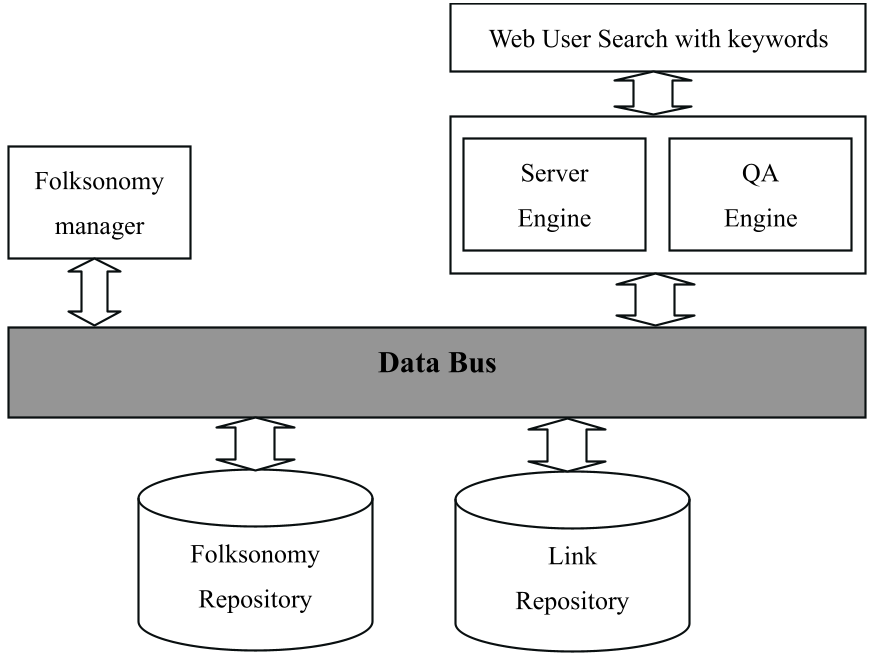 Figure: The three-layer architecture spanning data management and resource storage.
2. The Modified PageRank Algorithm
The real "secret sauce" lies in the mathematical refinement of PageRank. Instead of just counting edges in a graph, the authors introduce:
- Click Frequency (): The probability of jumping from page to is weighted by the total number of actual user clicks.
- Personalized Value (): A factor that reflects a specific user's preference based on their historical interaction.
The final relevance score () is calculated as: Where (usually 0.85) is the damping factor representing the chance of a user continuing to click.
Experiments & Results
The prototype system was tested using a "news" keyword query. The system analyzed five primary pages (P1-P5) and their neighbors (P6-P8).
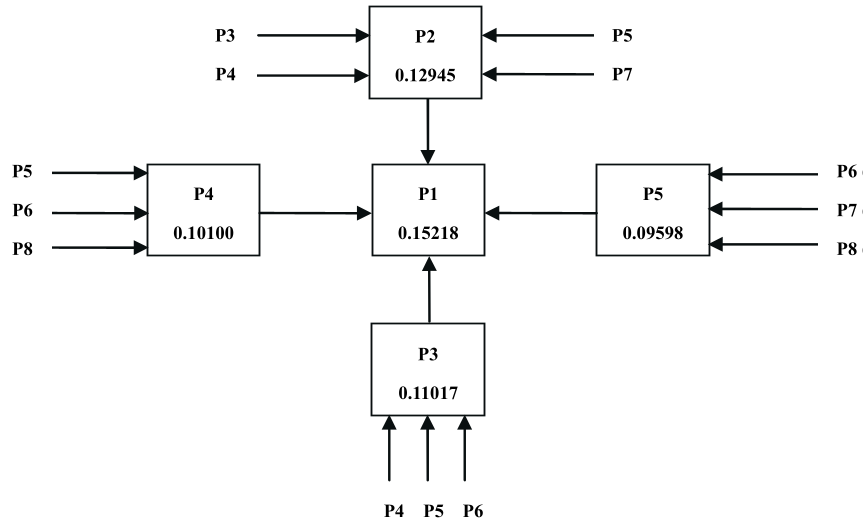 Figure: The experimental link structure and the resulting PageRank propagation.
Key Findings:
- Precision: By integrating click-stream data, the ranking shifted to favor pages that users historically found more useful, rather than just the most "tagged" ones.
- Efficiency: P1 emerged as the most authoritative source with a PR of 0.152, while P5, despite having the same "news" tag, was ranked lower (0.095) due to weaker link/click authority.
Critical Analysis & Conclusion
Takeaway
This work highlights that Collective Intelligence is more than just the sum of its parts. By using tags for breadth (finding the right bucket) and click-link analysis for depth (finding the best item in that bucket), the system significantly reduces the "noise" in search results.
Limitations & Future Work
One major limitation acknowledged by the authors is the lack of semantic understanding. The system currently treats "news" and "journalism" as different tags (the synonym problem). Future improvements aim to incorporate WordNet or similar ontologies to resolve polysemy and synonyms, and to integrate geographic location data to further localize search relevance.
In conclusion, this hybrid approach moves us closer to a search engine that "understands" preference through the lens of human behavior.