
Collective Sound Checks: Orchestrating Social Interaction through the Mobile Web
Collective Sound Checks: Exploring Intertwined Sonic and Social Affordances of Mobile Web Applications
This paper introduces "Collective Sound Checks," a framework for spontaneous group music-making using mobile web applications. Leveraging HTML5 technologies (Web Audio API, Device Motion), it transforms smartphones into motion-controlled instruments that facilitate collaborative sonic environments without requiring professional musical training.
TL;DR
Researchers from IRCAM have developed a suite of mobile web applications that turn groups of people into spontaneous orchestras. By utilizing the motion sensors in everyday smartphones and the accessibility of the mobile web, Collective Sound Checks explores how sound can act as a bridge for social interaction, allowing non-musicians to engage in complex, collaborative performances.
Problem: The Barrier to Collective Music
Most digital musical instruments are designed for individual mastery. When collaboration does happen, it usually requires specialized hardware, a centralized server, or a group of highly trained performers (like the Stanford Mobile Phone Orchestra).
The authors identify a gap: How can we facilitate spontaneous, collaborative sound experiences among strangers using the devices already in their pockets? The challenge lies in overcoming technical fragmentation (different phone types) and the social "inertia" of people in public spaces.
Methodology: From Interaction to Mediation
The core insight of this work is that technology should not be the end of the interaction, but the mediator. The authors developed a platform using HTML5, Web Audio API, and Device Motion, ensuring that anyone with a browser could join instantly.
They designed interaction "Scenarios" that utilize Sonic Affordances—the idea that a sound suggests a specific movement or social behavior:
- The Cinematic Hook (Drone): By mapping rotation to low-frequency modulation, they found users naturally mimicked "lightsaber" battles.
- The Spatial Metaphor (Birds): Using "chirp" sounds to encourage a non-verbal "Twittering" conversation across a large physical space.
- The Physical Model (Rainstick): Simulating a sliding mass that requires users to tilt their phones in sequence, naturally forming a coordinated circle.
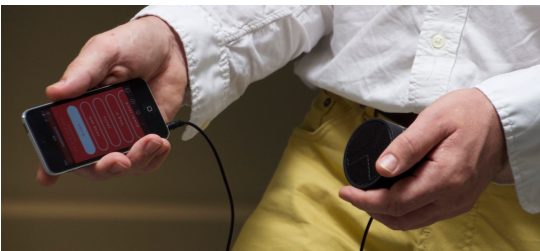 Figure: A participant uses an external handheld speaker to amplify the web-based sonic interaction.
Experiments & Results: Play in the Wild
Conducted at Studio 13/16 at the Centre Pompidou, the workshops revealed several key findings:
- Democratization of Performance: By providing a "common beat" via the network (in the Shaker scenario), even users with no rhythmic training could participate in a "band" setting.
- Social Organization: In The Matrix scenario, where one user controls the sounds emitted by others' phones, the researchers observed the emergence of "audience" and "performer" roles, as well as the passing of techniques from one temporary performer to the next.
- Engagement: The "low floor, high ceiling" design allowed teenagers to jump in instantly but stay for over an hour to refine their "performance skills."
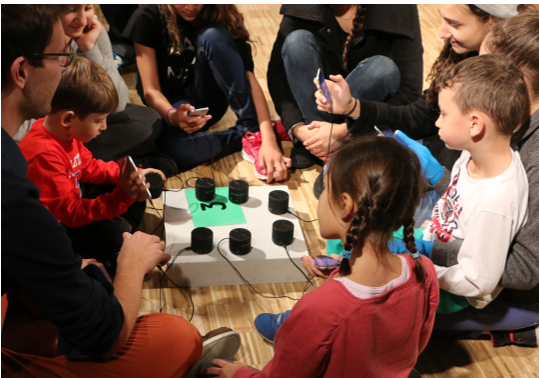 Figure: Participants collaborating in a distributed soundscape.
Critical Insight & Conclusion
The significance of Collective Sound Checks lies in its shift from HCI (Human-Computer Interaction) to Computer-Mediated Interaction.
Key Takeaways:
- Ubiquity over Power: Choosing the Mobile Web (HTML5) over native apps is a strategic move to prioritize social "reach" and spontaneity over raw processing power.
- Physics as a Guide: Using physical models (like the Rainstick) provides an intuitive "instruction manual" that doesn't require text.
Limitations & Future Work:
The authors acknowledge that while these scenarios excel at sound production, they are only beginning to explore "gamification"—introducing rules and challenges that could move these from "sound checks" to full-fledged "musical games." Future iterations aim to include "extra-musical" challenges to further blend social play with sonic creativity.
Final Thought: As we live in an era of "pocket supercomputers," this research proves that our devices can be used to bring people together in physical space rather than just isolating them in digital bubbles.