
CoDec & CoGc: Unmasking Collusive Spammers via Business Competition and MRF
Collusion-aware detection of review spammers in location based social networks
This paper introduces CoDec and CoGc, a dual-layer mechanism designed to detect individual review spammers and collusive spammer groups in Location-Based Social Networks (LBSNs). By leveraging a Markov Random Field (MRF) built on multi-view anomalous features—including user-user collusion and location-location competition—the approach achieves state-of-the-art performance on Yelp datasets.
Executive Summary
TL;DR: Modern review spammers no longer rely on high-frequency, "noisy" attacks. Instead, they operate in professionalized, low-density groups to avoid detection. This paper proposes CoDec, a Markov Random Field-based framework that integrates multi-view features—notably collusive relations between users and competitive relations between locations—to boost detection accuracy in sparse networks.
Background: Within the LBSN (Location-Based Social Network) ecosystem (e.g., Yelp, Dianping), fake reviews distort business fairness. The paper occupies a critical niche: moving beyond simple behavioral heuristics to a sophisticated relational model that captures the economic motivations (competition) behind spam.
The "Camouflage" Problem: Why Traditional Detectors Fail
Most existing spam detectors search for "heavy hitters"—users who post hundreds of reviews. However, professional spammers use multiple accounts to maintain a low spam density, blending seamlessly with honest users.
Prior work typically failed because:
- Graph density methods (like FRAUDAR) look for dense subgraphs, but collusive spammers purposely keep their graph connections sparse.
- Tensor methods lose granular temporal data due to time-binning.
- Isolation: Most models treat users as independent islands, ignoring the "hidden hand" of store competition.
Methodology: The Power of Markov Random Fields (MRF)
The core innovation lies in the Review Network Model, which consists of three types of edges:
- User-User (Collusion): Linking users who review the same location within a specific time window (identified as 40 days in this study).
- User-Location (Review): The standard interaction representing the post itself.
- Location-Location (Competition): A novel edge connecting stores that are physically close, belong to the same category, and share suspicious reviewers.
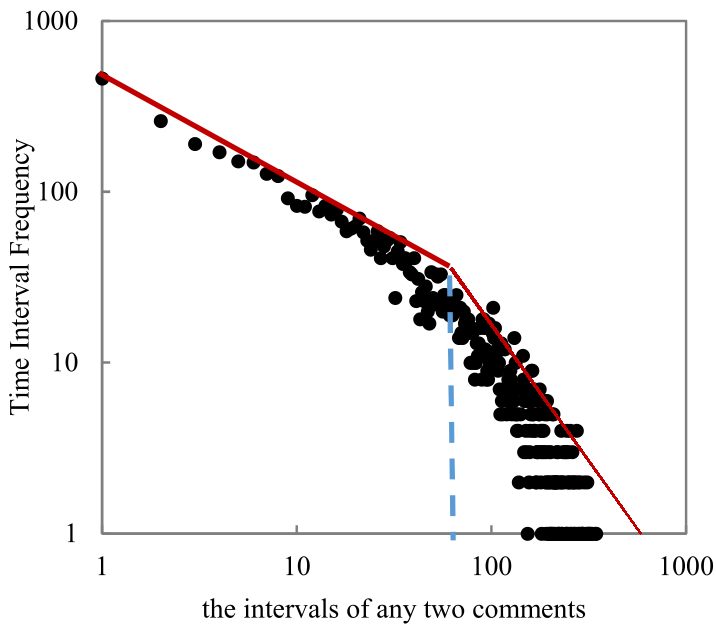 Figure: The MRF-based review graph capturing the interplay between users (Va-Vf) and locations (Vi-Vk).
The authors formulate this as an inference problem. By using Loopy Belief Propagation (LBP), the "spamminess" of a user propagates through the graph. If a user reviews a suspicious location, their spam probability increases; similarly, if a location is reviewed by known spammers, its suspicion level rises.
Multi-View Feature Engineering
The model integrates features from five dimensions:
- Individual User: Activity, social sparsity, and trajectory anomalies.
- Target Location: Content similarity (review templates) and check-in vs. review distribution gaps.
- Relationship-based: Score polarity (consistent 5-star or 1-star patterns) and time synchronization.
Experimental Results & SOTA Comparison
The authors tested CoDec on a real-world Yelp dataset from the Phoenix area.
- Performance: CoDec achieved an AP of 95.75%, significantly outperforming SpEagle (66.02%) and HoloScope (65.5%).
- Precision@K: For the top 500 detected users, CoDec maintained nearly 100% precision, proving its reliability for automated filtering systems.
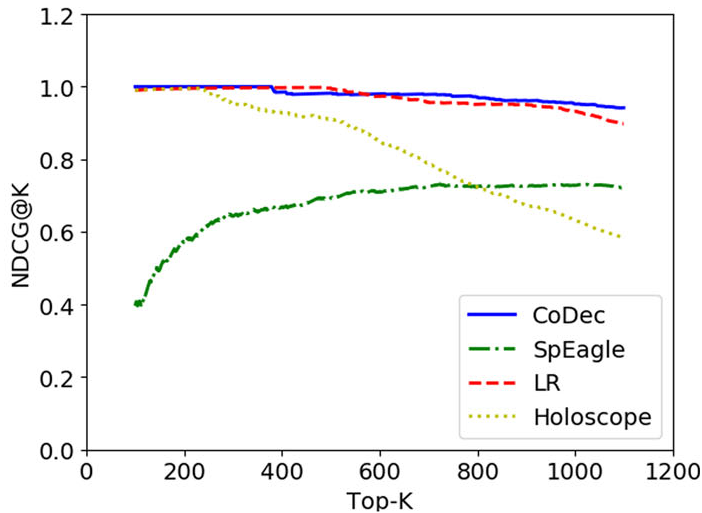 Figure: The contribution of different features. Notably, user-user collusion and individual attributes were the strongest indicators of spam.
Discovering the "Groups"
Beyond identifying individuals, the CoGc algorithm (Hierarchical Agglomerative Clustering) successfully grouped spammers. By analyzing the "spammer-location" diagram, the authors visualized how these groups coordinate attacks on specific competitive clusters of locations.
Critical Insight & Conclusion
The most profound takeaway is the effectiveness of location competition as a feature. Spammer activity is rarely random; it is driven by the economic need to either "boost" a store or "sink" a competitor. By modeling the LBSN not just as a social graph, but as a competitive marketplace, the authors provide a more realistic lens for fraud detection.
Limitations: While powerful, the MRF approach and LBP iteration may face scalability challenges with billion-scale graphs, and the definition of a "competitive location" (10km radius) might need adjustment for varying urban densities (e.g., Rural vs. NYC).