
Beyond Proximity: Leveraging Flow Networks for Precision Mobile Crowdsourcing
The use of colocation and flow networks in mobile crowdsourcing
This paper introduces a novel geo-casting approach for mobile crowdsourcing that leverages Colocation and Flow Networks to match in situ tasks with workers. By identifying "communities of spaces" through complex network analysis of human mobility patterns, the method significantly outperforms traditional Euclidean proximity-based task assignment.
TL;DR
Mobile crowdsourcing often fails because it assumes "nearness" equals "availability." This paper challenges that assumption by replacing static geographic circles with dynamic Flow and Colocation Networks. By analyzing how millions of people actually move through Tokyo, the authors demonstrate that targeting "communities of spaces" derived from mobility patterns leads to significantly higher task completion relevance than simple GPS-based proximity.
The Blind Spot of Euclidean Distance
In the world of in situ crowdsourcing—where a task must be performed at a specific physical coordinate—the standard operating procedure is to "geo-fence" a request. If you need a photo of a Tokyo garden, you ping everyone within a 500-meter radius.
However, this ignores the physical intuition of movement:
- The False Positive: A person 100 meters away might be on a high-speed train moving away from the target.
- The False Negative: A person 2 kilometers away might be on a bus specifically headed toward the target site.
The authors argue that human movement is not random; it follows spatiotemporal regularities shaped by urban infrastructure. To capture this, they move away from geometry and toward Network Science.
Methodology: Mapping the Pulse of the City
The researchers proposed two distinct network models to capture the "connectivity" of urban spaces:
1. Colocation Networks
This model treats spaces as "connected" if the same people visit them within the same time window. It’s a dual-hypergraph approach where spaces are linked by the "human bridges" that traverse them.
2. Flow Networks
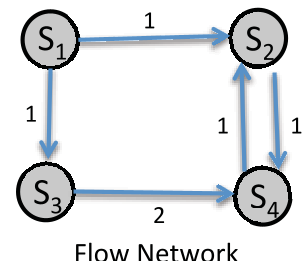
This is a more granular, directed approach. It tracks the actual transitions from point A to point B. If 5,000 people move from Shinjuku to Shibuya between 10 AM and 11 AM, a strong directed edge is formed between those two "nodes."
Community Detection (Infomap)
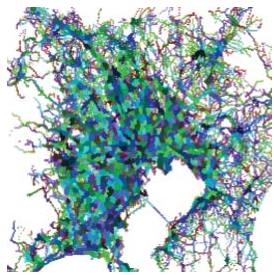
Instead of arbitrary grid squares, the authors apply the Infomap algorithm—a random-walk based clustering technique—to these networks. This partitions the city into "Communities of Spaces." A task generated in one part of a community is sent to workers anywhere within that same community, effectively following the natural "flow" of the city's inhabitants.
Experimental Insights: Flow Over Proximity
The study utilized the Tokyo Person Trip Survey, a massive dataset covering 60 million mobility samples. The "Ground Truth" for success was whether a worker requested at 11:00 AM actually visited the task location by 11:59 AM.
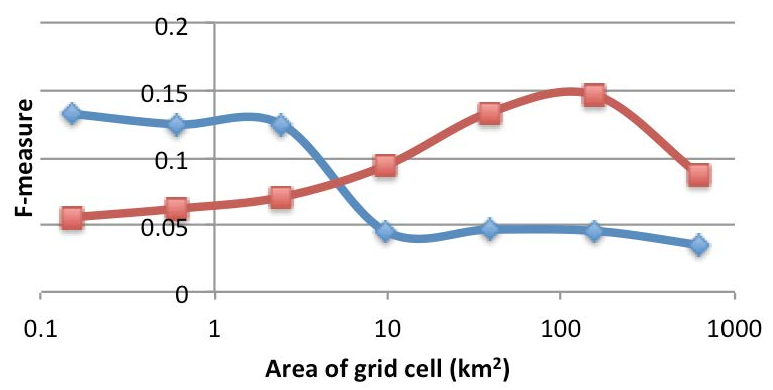
- Recall Power: Both Colocation and Flow networks consistently outperformed Euclidean proximity in Recall. This means the network-based approach finds many "hidden" eligible workers that simple circles miss.
- Precision and Scale: For larger grid cells (macroscopic tasks), the proposed models showed significantly higher Precision.
- The Winner: The Flow Network approach emerged as the most robust, yielding the best F-measure (the balance between Precision and Recall).
Critical Analysis & Future Outlook
The power of this work lies in its Inductive Bias: it assumes that the city’s layout and transit systems dictate worker availability more than raw distance does.
Limitations
- Granularity: The study excludes pedestrians and cyclists due to the macroscopic nature of the dataset. Mobility patterns on foot are vastly different from train-based flows.
- Temporal Half-life: Mobility patterns change. A "flow community" at 8:00 AM (commute in) looks nothing like one at 8:00 PM (leisure/home).
The Future of Situated Crowdsourcing
This research paves the way for "Mobility-Aware" task platforms. Imagine an Uber-like system for micro-tasks that knows you are taking the subway to a specific district and pings you for a task only because your path, not just your position, makes you the perfect candidate. By moving from where you are to where you are going, crowdsourcing becomes a seamless part of the urban flow.