
Hybrid Intelligence: Bridging Human Heuristics and Machine Learning for Superior Emotion Recognition
A Combined Rule-Based & Machine Learning Audio-Visual Emotion Recognition Approach
This paper presents a hybrid multimodal emotion recognition system that integrates rule-based heuristics with machine learning to enhance recognition accuracy across audio and visual streams. By utilizing dimensionality reduction (BDPCA, LSLDA) and a novel Optimized Kernel-Laplacian RBF (OKL-RBF) neural classifier, the system achieves SOTA performance on the eNTERFACE’05 and RML databases.
TL;DR
Recognizing human emotions accurately requires more than just raw data; it requires understanding the "physics" of how we express feelings. This paper introduces a framework that mirrors human logic by using rule-based heuristics to narrow down emotion categories and machine learning (OKL-RBF) to finalize the classification. The result? A significant jump in accuracy to over 90% on standard benchmarks.
Background: The Limits of "Black Box" Fusion
In the quest for affective human-computer interaction (HCI), researchers have often hit a wall: should we treat emotion recognition as a pure data problem (Machine Learning) or a logic problem (Rule-Based)? Traditional ML often treats all emotions (Anger, Sadness, Surprise, etc.) as equal classes in a high-dimensional space, ignoring the psychological reality that some emotions are much more similar in "pitch" or "energy" than others.
The Problem & Insight
The core challenge identified by Seng et al. is Uncertainty in Integration. Using one global feature set to separate all six universal emotions is inherently suboptimal.
The Insight: Use psychological motivations to group emotions first. For instance, the Teager Energy Operator (TEO) is uniquely effective at identifying "Disgust." Why force a complex neural network to learn this from scratch when a simple "IF-THEN" rule based on TEO can filter it out immediately?
Methodology: A Tailored Dual-Path Architecture
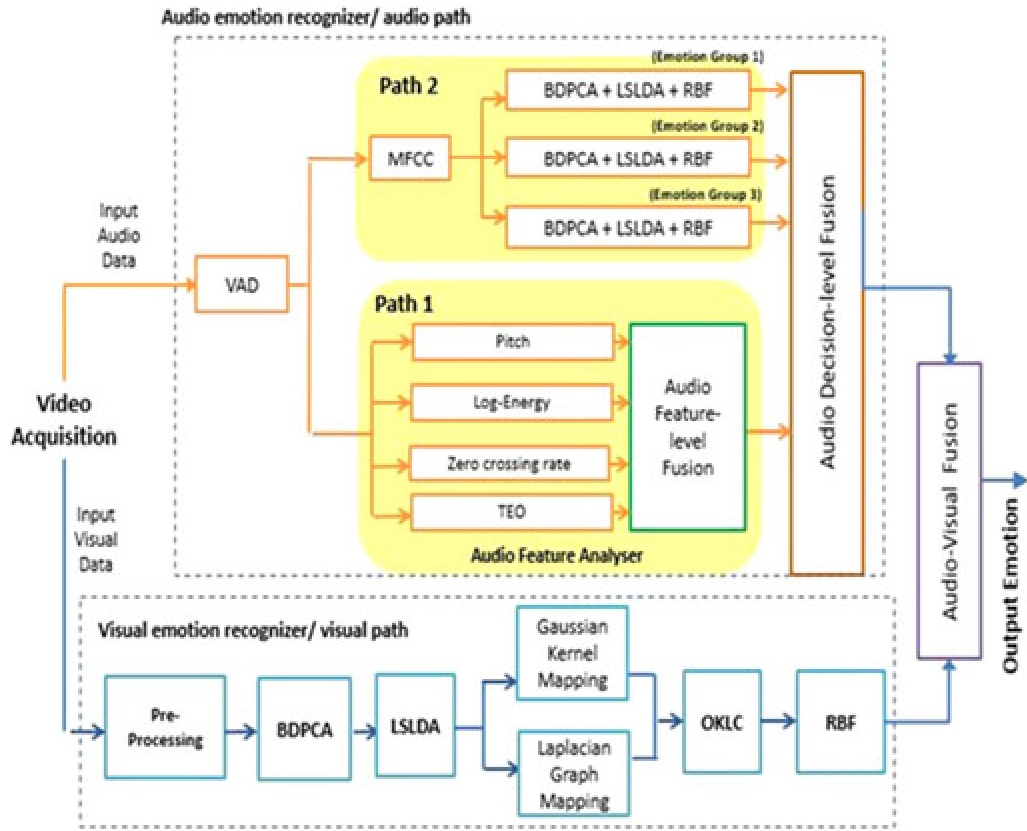
1. The Visual Path: BDPCA + LSLDA + OKL-RBF
The visual path focuses on facial expressions. Instead of standard PCA, the authors use Bi-directional PCA (BDPCA), which manages image matrices directly without flattening them into vectors—this preserves spatial structure and reduces the "curse of dimensionality."
The crown jewel is the Optimized Kernel-Laplacian Radial Basis Function (OKL-RBF). It combines:
- Kernel Mappings: To capture attribute-based data similarities.
- Laplacian Graphs: To capture structural relationships between samples.
2. The Audio Path: Expert-Guided Fusion
The audio path is split into two sub-paths:
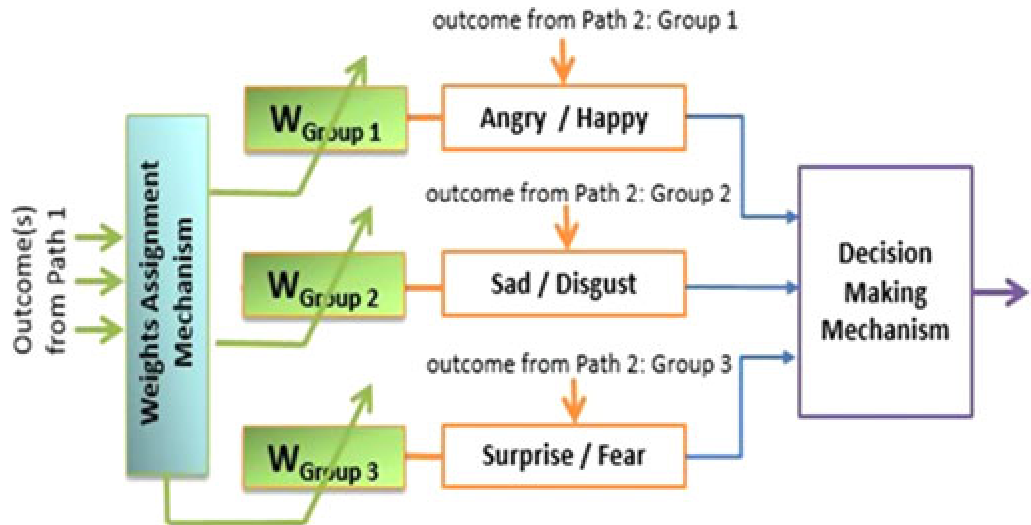
- Path A1 (Prosodic): Extracts Pitch, Energy, ZCR, and TEO. It uses a decision tree of rules to assign weights to "Emotion Groups."
- Path A2 (Spectral): Uses MFCCs and processes them through two-class classifiers.
By using Path A1 to narrow the scope, the machine learning model in Path A2 only needs to solve "Easy" binary problems (e.g., distinguishing only between Angry vs. Happy) rather than a 1-of-6 problem.
Experiments & Results: Performance at the Edge
The system was tested on the eNTERFACE’05 and RML databases—two of the most rigorous multimodal datasets available.
- Ablation Success: When the rule-base was removed and replaced with a pure ML approach, audio recognition accuracy plummeted by 11.6% (from 65.8% to 54.2% on RML). This proves that the "expert knowledge" injected into the rules is doing heavy lifting that data alone struggles to replicate.
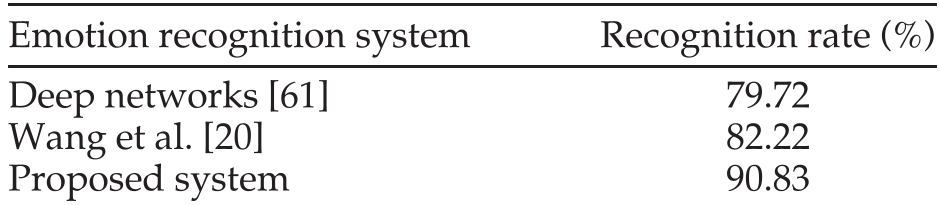
- SOTA Comparison: On the RML database, the proposed system reached 90.83%, significantly outperforming recent Deep Network approaches (79.72%).
Critical Analysis & Conclusion
Takeaway
This research underscores a vital trend in AI: Domain-Informed Machine Learning. By layering thin, computationally efficient rules on top of robust neural classifiers, we can achieve higher accuracy with less training data.
Limitations
- Subjectivity of Rules: The rules are based on specific databases. Their robustness in "in-the-wild" scenarios (e.g., heavy accents or varying lighting) needs further validation.
- Manual Thresholding: The system relies on several thresholds (for TEO, ZCR, etc.) which might require manual recalibration for different microphones or environments.
Future Outlook
The authors suggest this is perfect for Customer Relationship Management (CRM). Imagine a video chat system that can objectively score customer satisfaction by analyzing the subtle shifts in TEO energy and facial Laplacian graphs—moving beyond "what" the customer says to "how" they feel.