
Navigating the Hybrid Web: Optimizing Search in Combined Social and Wireless Networks
Search in Combined Social and Wireless Communication Networks: Delay and Success Analysis
This paper presents a comprehensive analytical framework for message search and navigation in combined social and wireless communication networks, utilizing an extended Octopus model. The researchers derive end-to-end delay distributions and success probabilities by distinguishing between heterogeneous link types (Short-Range, Long-Range, and Communication), achieving validated alignment with real-world datasets like Gowalla and ArXiv.
TL;DR
How do we find information in a world where social connections overlap with wireless signals? This paper provides a mathematical deep-dive into the "Octopus model," extending it to account for real-world messiness: links that fail, messages that expire, and the varying "speed" of different social tiers. By moving beyond simple greedy routing to cost-aware strategies, the authors prove we can find destinations faster and more reliably in hybrid networks.
The Motivation: Moving Beyond "Small Worlds"
Since Milgram’s famous "six degrees of separation" experiment, we’ve known that social networks are "searchable" using only local information. However, previous mathematical models suffered from two fatal simplifications:
- Unit Delay: They assumed a message takes the same time to move between best friends as it does between casual acquaintances.
- Perfect Success: They assumed no one ever ignores an email or drops a packet.
In a hybrid network—where you might send a file via a local Bluetooth connection (Wireless) or through a shared social contact (Social)—these assumptions break down. The authors recognize that links are heterogeneous and unreliable.
Methodology: The Extended Octopus Model
The researchers leverage the Octopus Model, which categorizes links into:
- SRCs (Short-Range Connections): Physical or close social neighbors.
- LRCs (Long-Range Connections): Social "shortcuts" that bridge distant clusters, often following a power-law distribution.
The Innovation: Cost-Aware Routing
In standard greedy routing, a node always sends a message to the neighbor closest to the destination. This paper introduces two smarter versions:
- Delay-Based Routing: Instead of just distance, it considers the ratio of distance progress to link delay.
- Success-Based Routing: It picks paths that maximize the probability of the chain actually reaching the finish line, accounting for the fact that some links are "flaky."
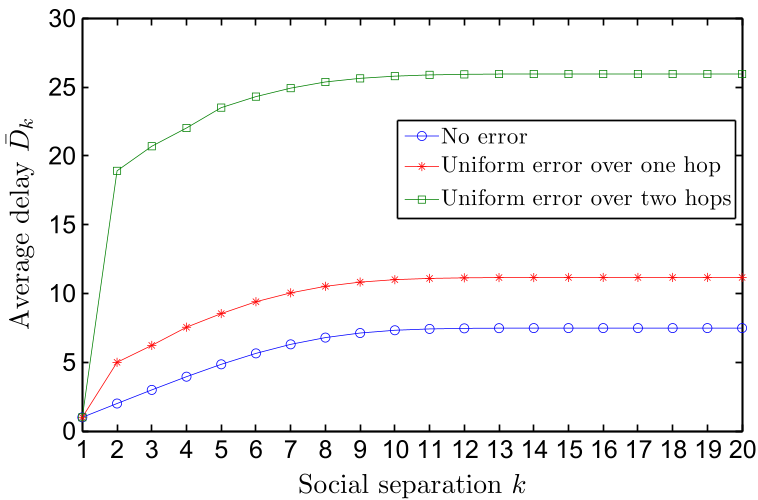 Figure 1: Comparison of analytical results vs. simulations for average search delay across varying network sizes.
Experiments & Real-World Validation
The authors didn't just stay in the realm of theory. They validated their math using two major datasets:
- ArXiv Citations: To model how information flows through academic networks.
- Gowalla: A location-based social network (LBSN) to model the literal intersection of geography and friendship.
Key Findings:
- The Saturation Effect: Search delay doesn't grow infinitely with distance. In small-world networks, even with errors and link failures, the delay "saturates" (flattens out), proving that social shortcuts are incredibly powerful.
- Routing Gains: By using the proposed success-based routing, the probability of successfully completing a message chain increased by 32% in high-failure scenarios.
- Social-Wireless Synergy: In combined networks, social links act as the "express lane." As wireless links become congested or slow, the network naturally shifts its load to social connections.
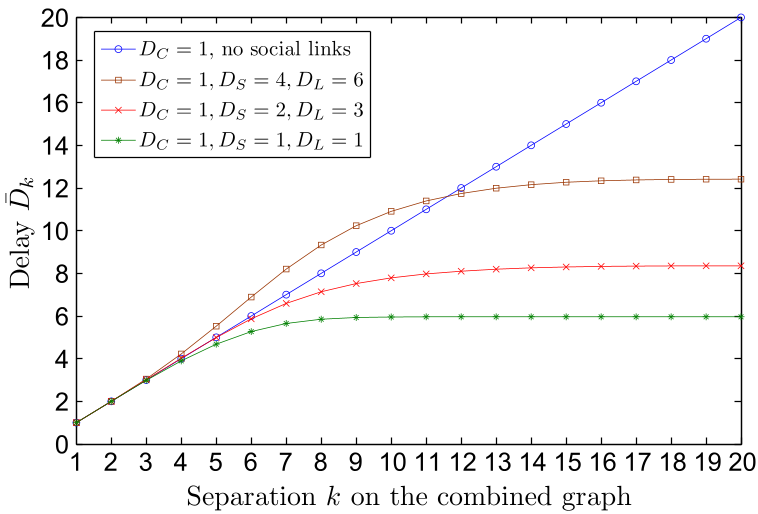 Figure 2: Real-world data validation using the Gowalla dataset, showing the search delay saturation as social separation increases.
Critical Insights & Future Outlook
The paper’s most profound takeaway is the robustness of the small-world phenomenon. Even when nodes have "blurry" views of the network (estimation errors) or links are unreliable, the "Octopus" structure ensures that paths remain efficiently findable.
Limitations: One area for further exploration is dynamic topologies. The current model assumes a relatively static snapshot of social and wireless links. In the real world, people move, and signals fade in milliseconds.
Future Work: Integrating this framework into 5G/6G D2D (Device-to-Device) protocols could revolutionize how we handle emergency broadcasts or data offloading, making our communication systems as resilient as our social circles.
Conclusion
This work transitions social search theory from an "algorithmic curiosity" to a "network engineering reality." By quantifying the cost of heterogeneous links, Sagduyu et al. have provided the blueprints for a more connected, hybrid future.