
Synergizing Crowdsourcing and Crowdsensing: A New Frontier for Spatial Context
Combining Crowdsourcing and Crowdsensing to Infer the Spatial Context
The paper introduces a hybrid framework that merges mobile crowdsensing and crowdsourcing to infer spatial context. By utilizing the i-Log application, the authors collect both hardware sensor data and user-provided semantic annotations to map WiFi infrastructures within university buildings, achieving building-level localization accuracy.
TL;DR
Researchers from the University of Trento have developed a method to map complex indoor environments by combining what smartphones "see" (crowdsensing) with what humans "know" (crowdsourcing). By linking WiFi MAC addresses to user-provided activity logs via the i-Log app, they achieved building-level localization accuracy of over 95% without relying on energy-heavy GPS.
Contextual Motivation: The Subjective Gap
In the world of pervasive computing, "location" is often treated as a simple set of coordinates. However, for a human, location is a context. The same physical office might be "my workplace" to a professor but "a meeting room" to a student. Most current SOTA systems suffer because they lack this subjective layer.
The authors argue that to truly empower users, we must account for their "theory of the world." The challenge is: how do we collect this subjective data efficiently and link it to the messy reality of radio signals (WiFi) in a crowded university campus?
Methodology: Bridging Sensors and Semantics
The core innovation lies in the formalization of context as a tuple: .
- WA (Temporal): What are you doing?
- WE (Spatial): Where are you?
- WO (Social): Who are you with?
Instead of asking users to act like sensors, the study uses an Ontological Time Diary. Students provide semantic labels (e.g., "Library," "Canteen") through a minimal-friction interface, while the background i-Log engine captures hardware metadata.
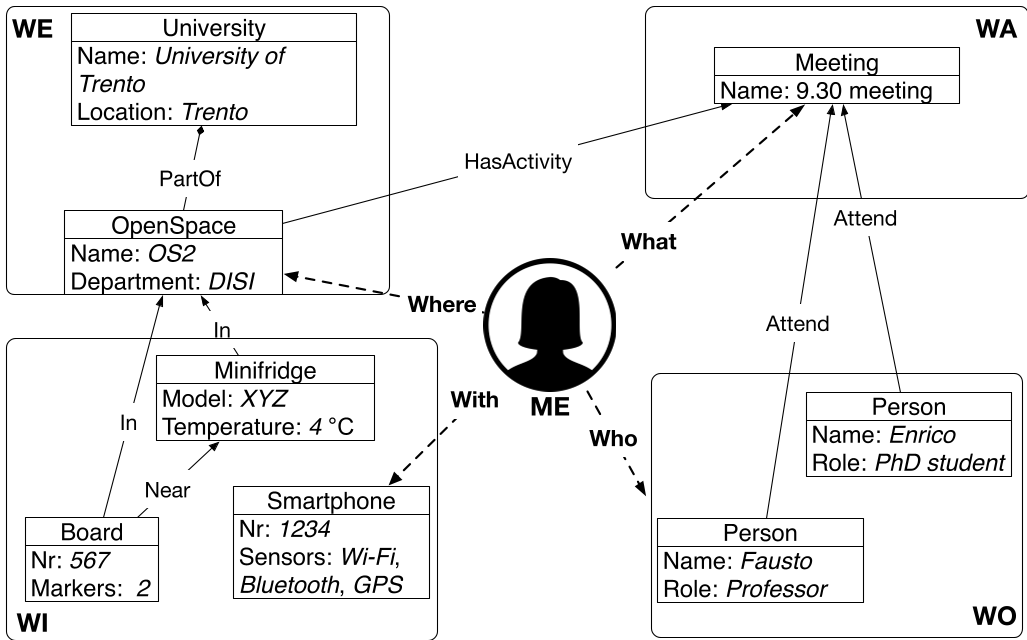 Fig 1. Knowledge graph depicting how a student's subjective context abstracts real-world entities.
The Experiment: Mapping the University of Trento
The researchers deployed i-Log to 72 students over two weeks. The genius of the approach is the temporal windowing:
- A student labels their location as "Classroom."
- i-Log records all WiFi MAC addresses seen 15 minutes before and after that label.
- The system "votes" across the crowd to determine which MAC addresses uniquely belong to which building.
Results & SOTA Comparison
Unlike traditional systems that require every user to be connected to WiFi, this method works even if the WiFi interface is "off" (using Android's background scanning) and the GPS is disabled—a common user behavior.
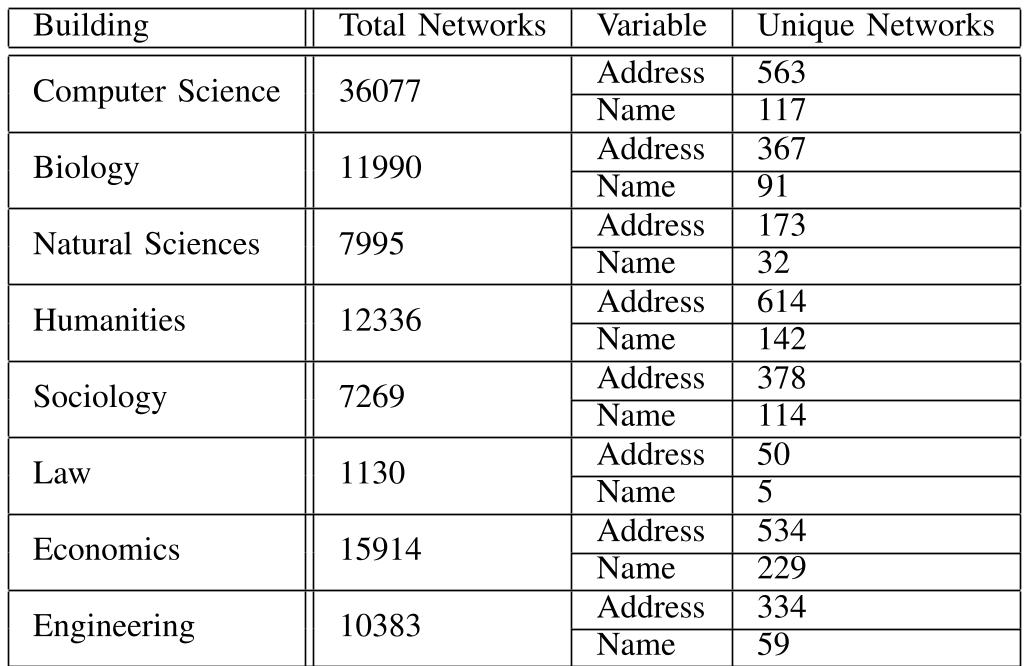 Table 1. Distribution of unique networks discovered across different university faculties.
The results were striking: using MAC addresses (which are unique to hardware) yielded a 95% accuracy rate for the majority of users. In contrast, using SSIDs (the network name like "unitn") dropped accuracy to ~30%, as names are reused across entire campuses.
Deep Insight: Heatmaps as Context Evidence
The study visualized the crowd's knowledge through heatmaps. For instance, in the Humanities building—which is isolated from other university structures—the signal distribution was "clean." However, in the Sociology and Law departments (located only 20 meters apart), the "crowd noise" reflected the physical proximity, as signals leaked across the street.
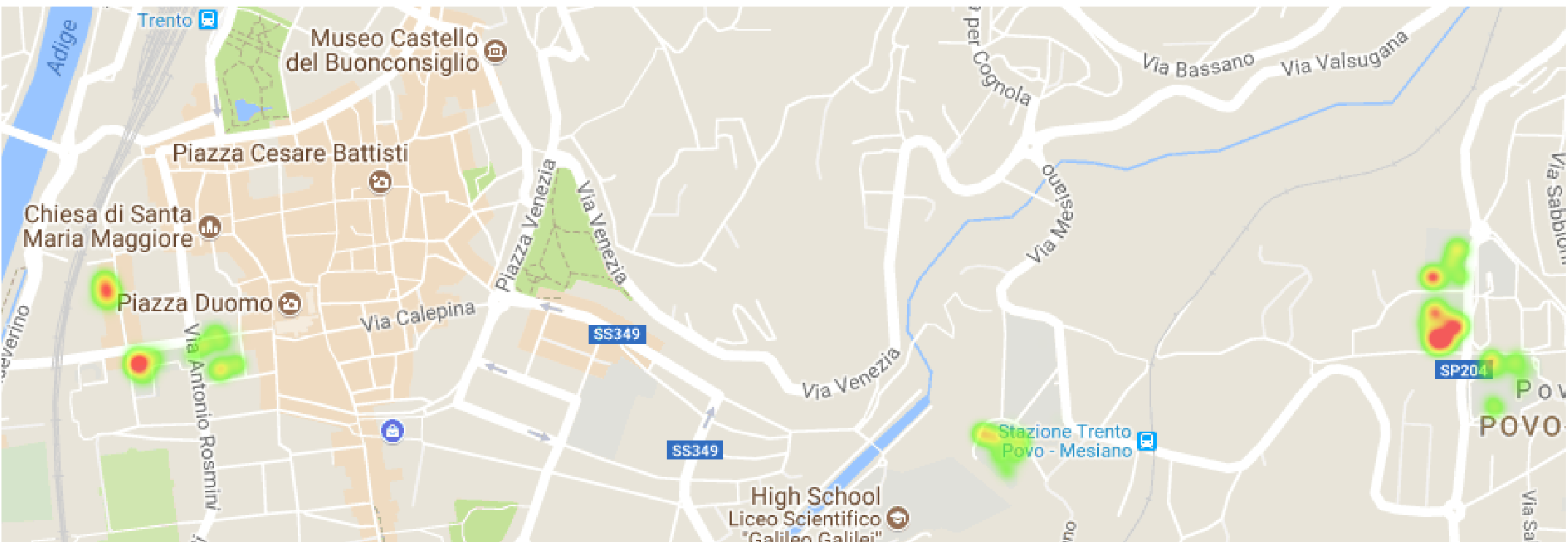 Fig 2. WiFi network density (SSID: unitnx) successfully identifying university clusters across Trento.
Critical Analysis & Future Outlook
Strengths: The study successfully proves that Mobile Crowdsourcing isn't just a manual task-filling exercise; it's a way to provide "Ground Truth" for Crowdsensing. The energy efficiency gained by avoiding GPS is a massive win for real-world deployment.
Limitations: The system still relies on users being willing to answer time diaries, which can lead to "response fatigue." The second week of the study specifically stopped questions to avoid this, highlighting the need for more passive or "gamified" annotation methods.
Conclusion: This work lays the foundation for "Personal Assistants" that don't just know where you are, but why you are there. By treating the crowd as a collective intelligence, we can map the world through a human lens.