
Beyond Sensors: Fusing Eye-Tracking and AI to Predict the Next Move in Driving
14272_ehaviors A Study of Combining Environmental and Eye-Tracking Data in a Driving Simulator.
This paper presents a comparative study of four machine learning algorithms (SVM, HMM, CNN, and RF) for predicting lane-changing behaviors (Left, Right, and Lane Keeping) in a highway driving simulator. The core contribution is the integration of environmental data (ENV) with eye-tracking (ET) data, identifying Random Forest as the superior model for real-time driver assistance.
TL;DR
Researchers at the University of Duisburg-Essen have developed a high-precision system that predicts lane-changing maneuvers before they happen. By fusing environmental data with driver eye-tracking information and applying a Random Forest (RF) algorithm, they achieved over 99% accuracy, outperforming deep learning (CNN) and traditional probabilistic (HMM) models in both speed and reliability.
Background: The Hidden Intent of the Driver
Current Advanced Driver Assistance Systems (ADAS) are great at "seeing" what is happening (e.g., a car in the blind spot), but they are less adept at knowing what the human driver intends to do. Most accidents stem from misoperation or late reactions. If an ADAS could understand that a driver is preparing to change lanes—even before the turn signal is toggled—it could provide life-saving warnings or optimize vehicle control.
The Intuition: Eyes are the Windows to the Maneuver
The central hypothesis of this paper is that driving is a cognitive-physical loop. Before a driver turns the wheel, their eyes typically scan mirrors and the target lane. However, eye-tracking (ET) data alone is noisy; it needs the context of the environment (ENV) to be meaningful.
The Methodology: A Four-Way AI Shootout
The authors tested four distinct machine learning philosophies to find the best "brain" for their ADAS:
- Support Vector Machine (SVM): Focused on finding optimal boundaries in high-dimensional space.
- Hidden Markov Model (HMM): A temporal model that views driving as a sequence of hidden "intent" states.
- Convolutional Neural Networks (CNN): Traditionally for images, here used to extract features from signal matrices.
- Random Forest (RF): An ensemble of decision trees that handles multi-class problems and irregular data distributions efficiently.
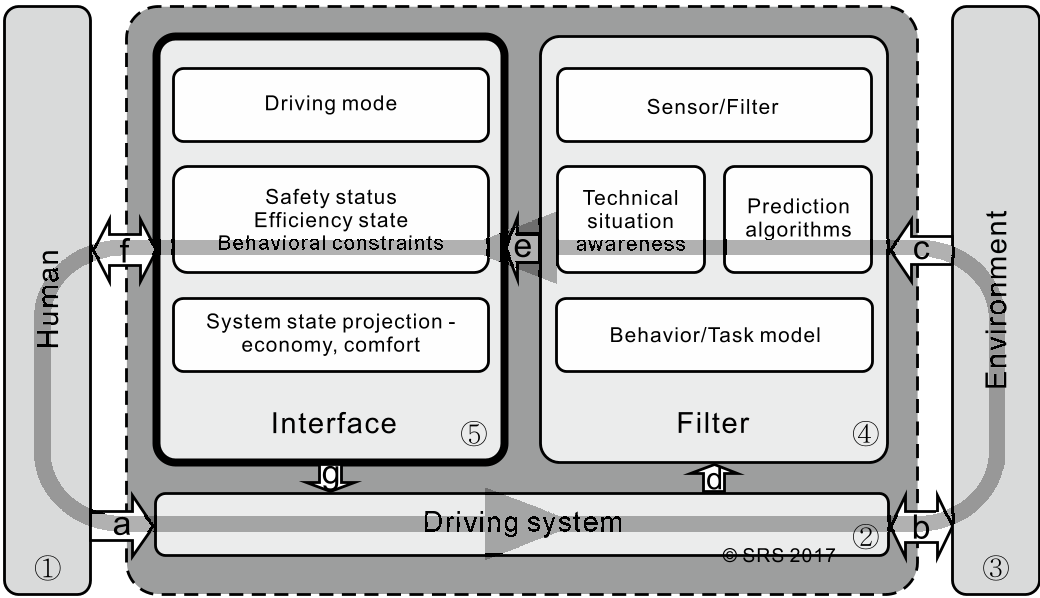 Figure 1: The proposed human-vehicle loop, where technical models (Module 4) process sensor data to provide feedback via a multi-modal interface (Module 5).
Key Insights: Why Random Forest Won
The study revealed several fascinating technical nuances:
- The ET + ENV Synergy: While adding eye-tracking improved HMM, CNN, and RF, it actually degraded SVM performance. This suggests that linear/kernel-based boundary methods struggle with the increased complexity of gaze noise, whereas tree-based methods (RF) can isolate the most relevant gaze features.
- Imbalance Issues: CNNs performed surprisingly poorly (as seen in Figure 7 of the paper). This was attributed to the "class imbalance" problem—drivers spend 90% of their time "Lane Keeping," giving the CNN too few examples of actual lane changes to learn effectively without advanced data augmentation.
- Efficiency: In an online, real-time environment, training and inference speed are paramount. RF trained in 11.9 seconds, while SVM took over 777 seconds.
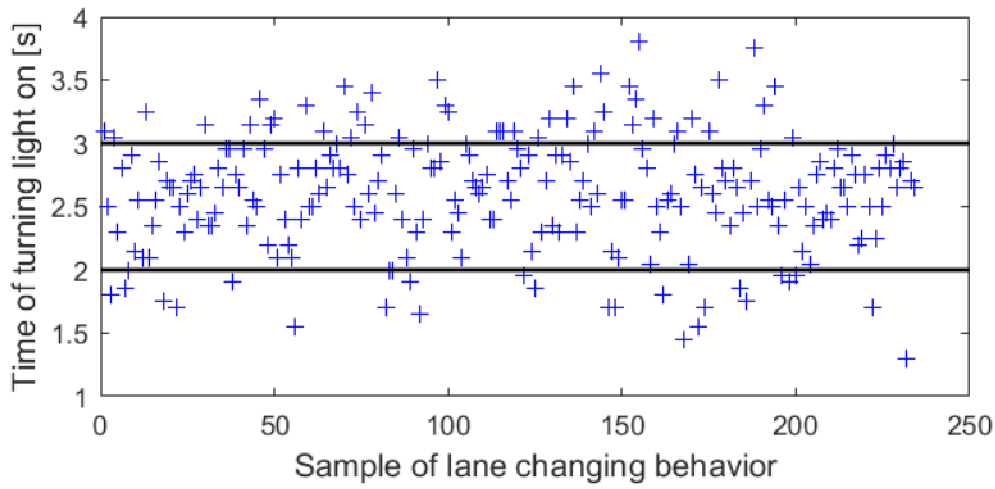 Figure 2: Analysis of the time window for lane-changing. The system aims to predict behavior within the critical 2-3 second window before the maneuver is completed.
Real-World Impact: The 1.8-Second Advantage
In online tests, the RF model (using a 3-second preset window) was able to predict lane changes approximately 1.8 seconds before the driver even engaged the turn signal. This "lead time" is the "Holy Grail" for safety systems, providing a buffer to warn of potential collisions.
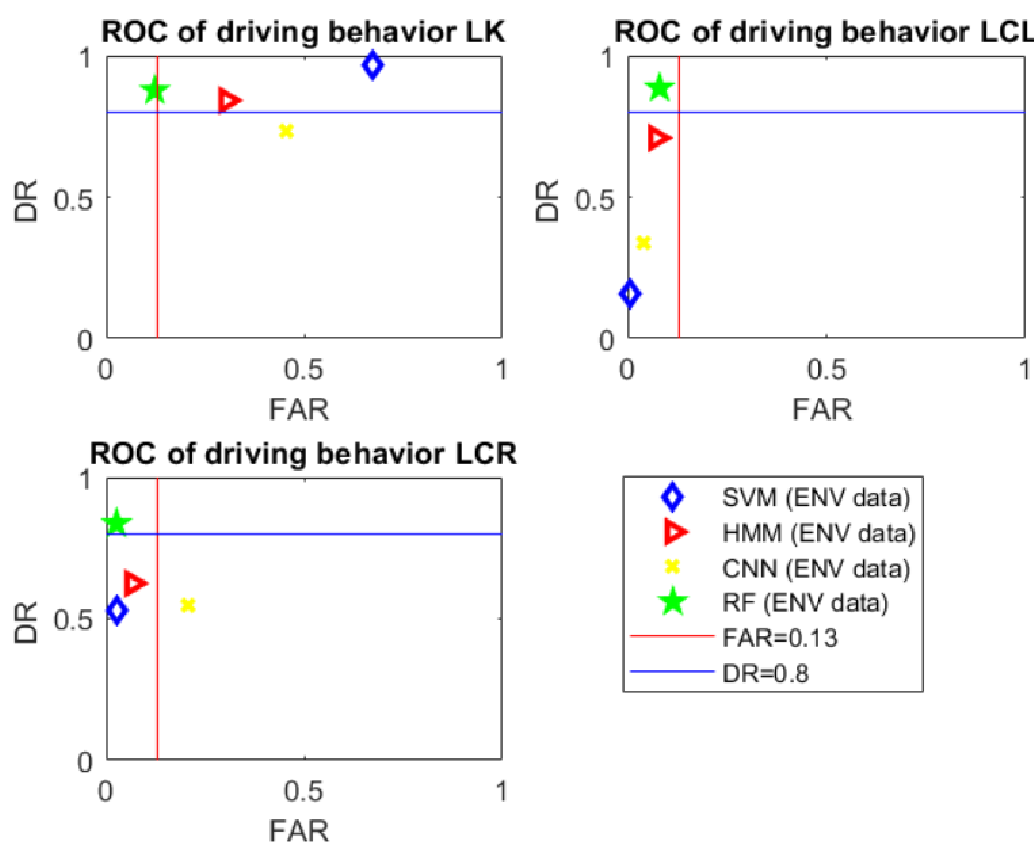 Figure 3: ROC Graph showing that RF (green markers) consistently maintains higher Detection Rates and lower False Alarm Rates compared to other models in online testing.
Critical Perspective & Future Work
While the results are stellar, the authors acknowledge a few hurdles for mass adoption:
- Sensor Integration: High-end eye-trackers are expensive. Future research should look at using standard cabin RGB cameras to extract gaze data via software.
- Data Augmentation: To make Deep Learning (CNN/RNN) viable, better methods for synthesizing rare driving events are needed.
- Individual Variability: Driving styles differ. A "one-size-fits-all" model may need to be replaced by personalized models that adapt to a specific driver’s habits over time.
Conclusion
This study proves that by looking at where a driver is looking, AI can anticipate the future of the vehicle with near-perfect accuracy. The shift from reactive systems to "intent-aware" ADAS represents a major leap toward zero-accident highways.