
Beyond Keywords: Decoding Biomedical Literature through Structure and Style
Combining linguistic and structural descriptors for mining biomedical literature
This paper introduces a multi-scale framework for classifying biomedical literature (reviews, research, and clinical papers) by combining linguistic, structural, and metric descriptors. The core methodology utilizes "Emerging Patterns" (EP) to identify features whose frequency varies significantly across document classes, moving beyond simple keyword-based analysis.
TL;DR
In the mid-2000s, as the volume of electronic biomedical literature exploded, researchers faced a needle-in-a-haystack problem: how to automatically distinguish comprehensive Reviews from specific Research or Clinical reports. This paper presents a pioneering approach that ignores what is being said (topical keywords) and focuses on how it is organized. By mining "Emerging Patterns" in structural and stylistic descriptors, the authors achieved near-perfect discrimination between document types.
The Motivation: When Vocabulary is Not Enough
Most text mining systems treat documents as a "bag of words." However, in biomedicine, a "Review" of prostate cancer and a "Clinical Case" of prostate cancer share the same core vocabulary. The true difference lies in the Logical Model:
- Reviews provide syntheses and lack specific "Materials and Methods" sections.
- Clinical Papers describe specific, rare observations with distinct linguistic markers.
- Research Papers follow a strict IMRAD (Introduction, Methods, Results, and Discussion) structure.
The authors hypothesized that by analyzing the hierarchy—from the global "Plan" down to "Comma Units"—they could identify the unique "stylistic fingerprint" of each genre.
Methodology: Multi-Scale Descriptor Mining
The researchers broke down documents into four descriptor families:
- Global/Plan: Logical structure (titles, section headers).
- Multi-scale Linguistic: Stylistic markers (e.g., use of "we/us" for personal voice, temporal adverbs like "now/present").
- Metric: Quantitative lengths of segments (paragraphs per section, sentences per comma unit).
- Lexical: Traditional keywords (used as a baseline).
The Secret Sauce: Emerging Patterns (EP)
Instead of standard frequency-based mining, the authors used Emerging Patterns. An EP is an association of descriptors whose frequency changes significantly from one class to another. This is measured by the Growth Rate (GR).

If a pattern appears frequently in "Reviews" but never in "Research," its Growth Rate is infinite, making it a perfect discriminator.
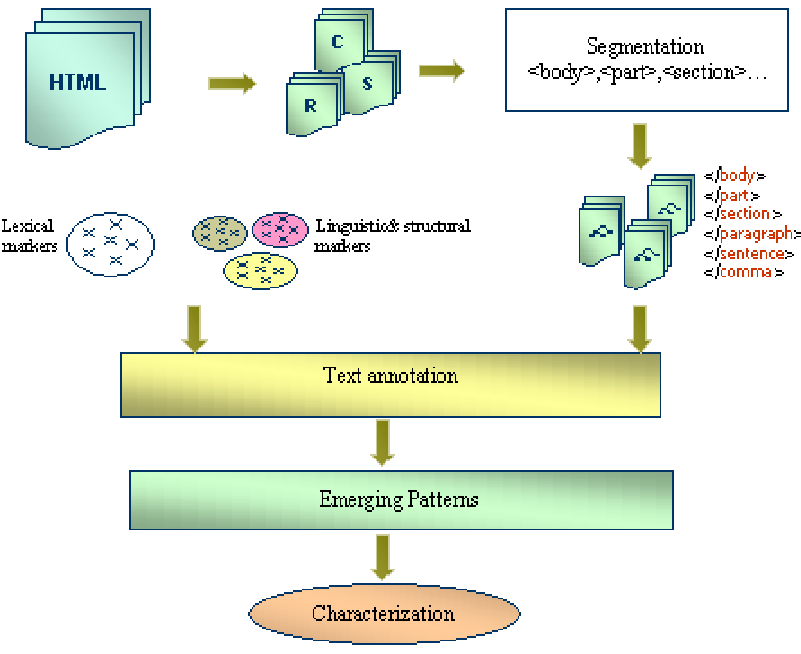 Table 1: The linguistic descriptors are analyzed across hierarchies, from the broad document body down to specific comma units.
Experiments & Critical Results
The study processed over 20,000 textual units from 47 full-text articles. The results confirmed their intuition:
- Lexical Failure: Keywords were uniformly distributed. You cannot distinguish a Review from a Research paper just by looking for "Prostate" or "Gene Expression."
- Structural Success: "Plan" descriptors showed that the presence of the pattern
{Introduction, Materials and Methods}was 100% in Research papers but 0% in Reviews. - Stylistic Fingerprints: Stylistic patterns at the "Body" level could exclude Clinical papers with infinite growth rates (GR = Inf).
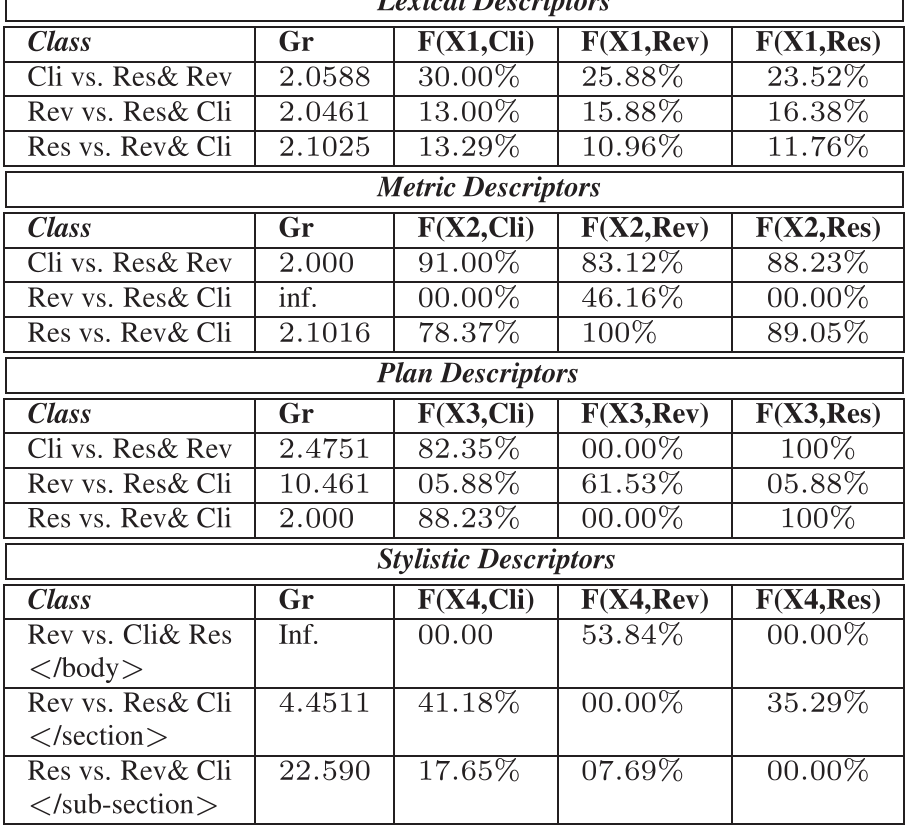 Table 2: Comparison of Growth Rates (Gr) and Frequencies (F) across different descriptor families.
Critical Analysis & Conclusion
The value of this work lies in its Negative Characterization. By identifying what a document isn't (e.g., "If it lacks a Methods section, it is NOT a research paper"), the system can effectively filter the massive influx of biomedical data.
Limitations & Legacy
While effective, the preprocessing of PDF/HTML into these fine-grained structural units is "very complex," a challenge that still exists today in the age of LLMs. However, this paper's insight remains a cornerstone for Metascientific analysis: the architecture of a paper is just as informative as its content.
Takeaway: In an era of AI-generated content, structural and stylistic consistency (or the lack thereof) remains a vital metric for categorizing scientific knowledge.