
Personalizing the Web: Bridging Social Trust and Semantic Metadata
Combining Social Networks and Semantic Web Technologies for Personalizing Web Access
The paper proposes a collaborative framework for personalizing Web access by combining Web-based Social Networks (WBSNs) with Semantic Web technologies (POWDER, RDF, OWL). It introduces a system where users can label resources, rate existing labels, and define fine-grained trust policies to assess the trustworthiness of metadata for automated access control.
TL;DR
This research presents a decentralized framework for Web access personalization that doesn't rely on black-box algorithms. By combining Social Networks (who you trust) with the Semantic Web (structured metadata), the system allows users to collaboratively label the web and set automated rules—like blocking content—based on the collective "trust score" of those labels.
Context: The Metadata Trust Gap
In the early days of the Web, metadata (PICS content labels) was supposed to help us filter the digital world. It failed. Why? Because providers didn't want to do the work, and nobody could verify if a label was honest.
The authors argue that the "Social Web" (WBSNs) provides a solution. If thousands of users tag and rate each other's tags, we can use the social graph to determine what is "trustworthy." The innovation here isn't just tagging (like Flickr or del.icio.us), but rating the tags themselves and using N3Logic rules to decide what happens when you browse.
The Five-Layer Framework
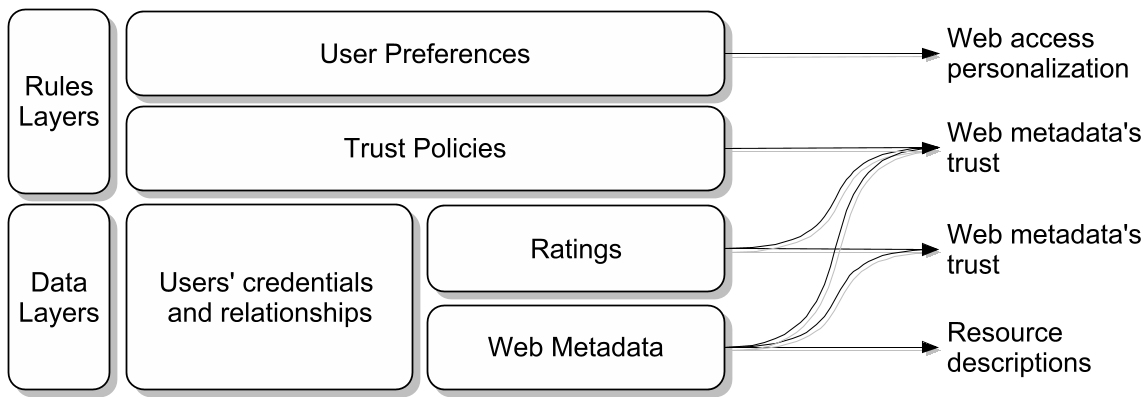
The paper breaks the solution into five logical layers, designed for interoperability:
- Users' Credentials & Relationships: Who are you and who do you know? (using FOAF).
- Web Metadata: What is the resource? (using POWDER).
- Ratings: Do you agree with a label?
- Trust Policies: Whose opinion do you value?
- User Preferences: What action should the browser take?
Methodology: How Trust is Computed
The core "magic" happens in the interaction between Trust Policies and User Preferences.
1. Dual Trust Vectors
The system supports two types of trust:
- User-defined: "I trust my friends' opinions on 'Sports' but not 'Politics'."
- Owner-defined: A website owner suggests, "Only trust medical labels from certified doctors."
2. Semantic Rule Enforcement
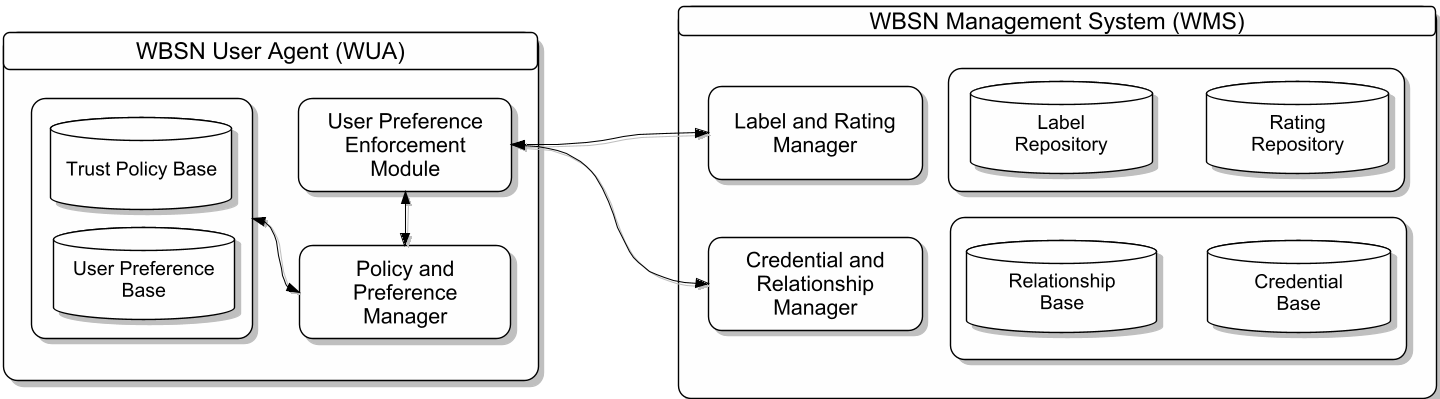
Using N3Logic, the system evaluates trust as a logic problem. For example, if David visits a site, his User Agent (WUA) checks labels from his direct social circle. If the "violence" tag has high relevance and the "trust value" (calculated from neighbors' ratings) exceeds a threshold, the preference triggers.
Experimental Scenario: Collaborative Defense
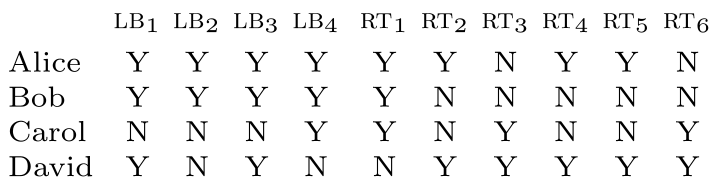
The authors illustrate the system with a scenario involving users (Alice, Bob, Carol, David) rating labels for a boxing website.
- The Conflict: Alice labels a site as "Sport," but Bob labels it "Medicine."
- The Resolution: Ratings (RT1-RT6) act as votes. If David trusts Alice more than Bob, his browser filters the site based on Alice's metadata.
The paper provides a breakdown of how different users perceive the same resources based on their social distance:
Critical Insight: Why This Matters
Unlike modern AI-driven content moderation—which often feels like a "black box"—this framework is explicit and user-centric.
- Granularity: You don't just trust a person; you trust them about a topic.
- Interoperability: By using RDF/OWL, the system can theoretically pull data from any social network (linked data).
Limitations
The primary hurdle remains user friction. Asking users to manually define N3Logic rules or rate every tag is a heavy ask. Future iterations would likely need to "automagically" learn these preferences from behavior rather than manual entry.
Conclusion
This work serves as a foundational blueprint for a "Social Semantic Web." It replaces centralized censors with a distributed, weighted voting system built on top of our existing social relationships. As we move toward decentralized web protocols, this logic-based approach to trust becomes more relevant than ever.