
COMMPAR: Bridging the Gap Between Social Topology and Parallel Simulation Efficiency
CommPar: A Community-Based Model Partitioning Approach for Large-Scale Networked Social Dynamics Simulation
This paper introduces COMMPAR, a two-phased model partitioning approach designed for large-scale networked social dynamics simulation. It combines the Infomap community detection algorithm with k-way weighted graph partitioning to optimize simulation performance on multi-processor systems, achieving superior efficiency in inter-processor communication.
TL;DR
Large-scale social simulations often struggle with the "communication wall" when distributed across multiple processors. COMMPAR solves this by first detecting the natural "communities" within a social network and then mapping these clusters to processors. By aligning the simulation's logical structure with the hardware's physical layout, it drastically reduces inter-processor overhead compared to traditional graph partitioning.
Context: Why Social Networks are Different
In the world of Parallel Discrete Event Simulation (PDES), how you "cut" your model across CPUs determines whether your simulation flies or crawls. Social networks aren't random; they possess a Community Structure—clusters where interactions are intense.
Existing methods usually treat partitioning as a generic graph problem, trying to balance the number of nodes per CPU while minimizing "cuts." However, this ignores two social realities:
- Dynamic Density: Most interactions happen inside communities.
- Power-Law Heterogeneity: Huge communities exist alongside tiny ones, making "equal-sized" cuts mathematically counterproductive for performance.
Methodology: The Two-Phased Strategy
COMMPAR introduces a workflow that respects the "Physics" of social interaction.
Phase 1: Community Discovery
Instead of arbitrary slicing, the authors use Infomap. This algorithm uses the probability flow of random walks to find where a "signal" gets trapped—these are your communities.
Phase 2: Weighted Aggregation & Mapping
Since communities have wildly different sizes (following a Power-Law distribution), you can't just assign one community to one processor. COMMPAR builds a "Metagraph" where:
- Nodes = Whole communities (weighted by the number of agents).
- Edges = Inter-community links.
This Metagraph is then partitioned using METIS to ensure each processor gets a fair share of the total workload while keeping the most "talkative" communities together.
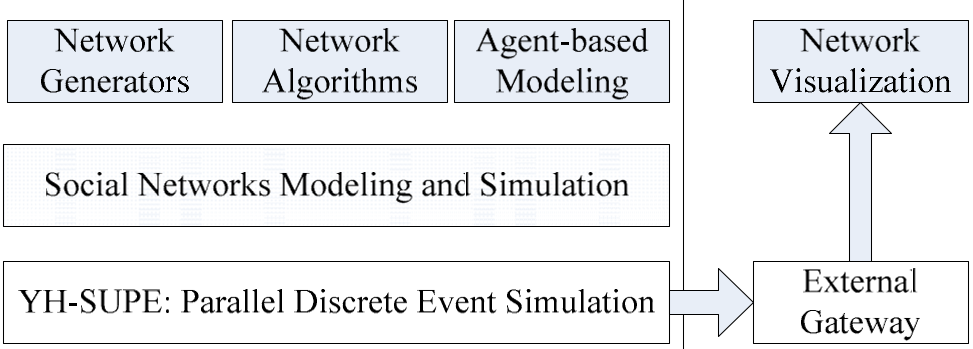 Figure 1: The SUPE-Net framework where COMMPAR is implemented, showing the separation between the engine and the model distribution logic.
Experiments: Proving the Intuition
The authors tested COMMPAR using a massive Actor-Collaboration Network (over 1.2 million edges). They compared it against:
- Scatter/Block: Simple, structure-blind distribution.
- Direct Graph Partitioning: Standard METIS without the community-first step.
Performance Breakthrough
COMMPAR consistently showed the lowest Inter-processor Message Count. In a simulation environment, every message between processors is a potential bottleneck. By "trapping" the random walkers within processors via community-aware placement, the overhead remained flat even as the system scaled.
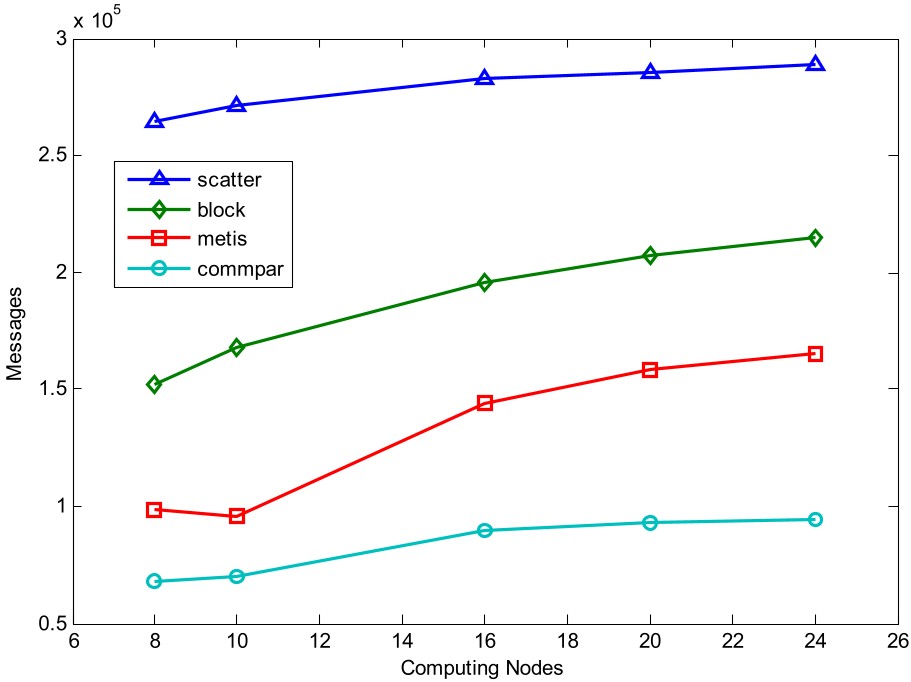 Figure 2: COMMPAR (bottom line) maintains significantly lower inter-processor communication compared to standard Scatter and Block methods.
Critical Insight & Future Outlook
The brilliance of COMMPAR lies in its Inductive Bias. It assumes that the "units of simulation" should be social groups, not individual nodes.
Limitations: The current approach is static. In real-world social dynamics (like a viral trend), community boundaries might shift. A future "Dynamic COMMPAR" that re-partitions the network as communities evolve during runtime would be the "Holy Grail" of this field.
Conclusion: For researchers dealing with billions of interactions, COMMPAR proves that understanding the topology of your data is just as important as the speed of your processors.