
MobileHealthNet: Re-Engineering Communication for Collaborative Healthcare in Mobile Social Networks
A Communication Infrastructure for Collaboration in Mobile Social Networks
This paper introduces a data-centric communication infrastructure for Mobile Social Networks (MSNs) within the MobileHealthNet project. It leverages the OMG Data Distribution Service (DDS) specification and the CoreDx middleware to enable reliable, real-time collaborative health care services in regions with poor connectivity.
TL;DR
MobileHealthNet introduces a robust communication infrastructure designed to bridge the gap between healthcare professionals and patients in remote areas. By moving away from fragile, connection-oriented protocols (TCP/HTTP), it adopts a Data-Centric Publish-Subscribe (DCPS) model based on the Object Management Group (OMG) DDS standard. This allows for reliable real-time vital monitoring and collaboration even over intermittent wireless networks.
The Problem: Why Current MSNs Fail in Health Care
Mobile Social Networks (MSNs) in the healthcare sector aren't just for socializing—they are critical pipelines for patient records and real-time biometric data like respiratory frequency and heart rate. However, existing infrastructures (like MobiSoc or Mobilis) face three major "walls":
- Connection Fragility: Standard protocols like TCP/IP require a stable, end-to-end connection. In mobile environments, signal drops cause session terminations, requiring constant re-handshaking.
- Lack of Prioritization: There is no native mechanism to distinguish between a "social greeting" and a "critical cardiac alert" in terms of network priority.
- Proximity Constraints: Many MSN middlewares rely on Bluetooth or ad-hoc Wi-Fi, which limits collaboration to users in the same physical vicinity—a major hurdle for specialists serving distant, underserved communities.
The Insight: Data-Centric Communication
The authors argue that the middleware should not care where the node is, but rather what the data is. By adopting the Data Distribution Service (DDS), they transition from "Message-Centric" to "Data-Centric" logic.
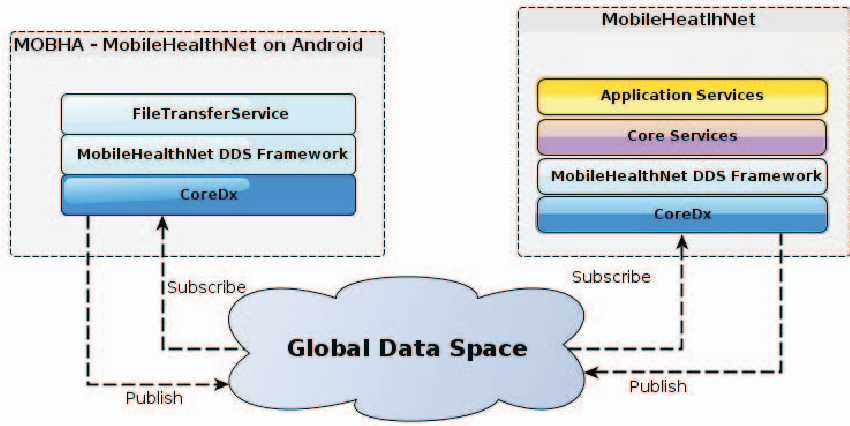
In this model, applications interact with a Global Data Space. A provider simply "publishes" a topic (e.g., Patient_HeartRate), and any authorized consumer "subscribes" to it. The middleware handles the complexity of delivery, buffering data during disconnections, and ensuring delivery once connectivity is restored.
Methodology: The Architecture
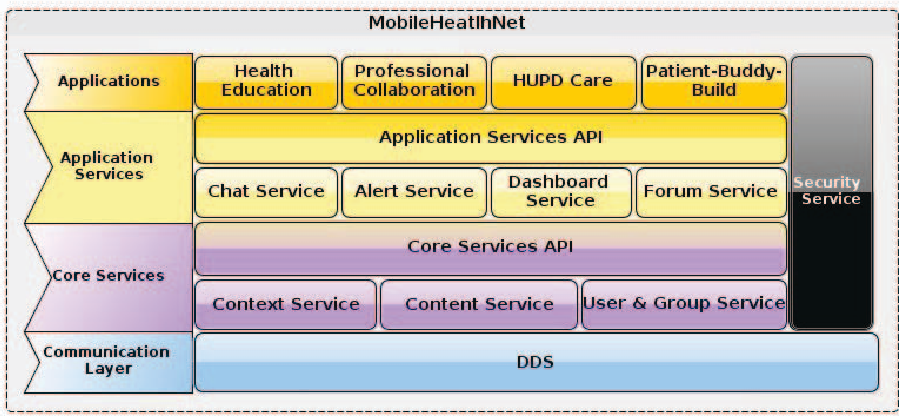
The MobileHealthNet infrastructure is built on the CoreDx implementation of DDS, specifically chosen for its small footprint on Android devices.
1. The DCPS Model
The system uses a Topic-based architecture where topics act as connectors between writers and readers. For example, a mobile client requesting user data publishes to a UserRequest topic and subscribes to a User topic for the response.
2. Quality of Service (QoS)
This is the "secret sauce" of the paper. Unlike standard web protocols, DDS allows for specific QoS policies:
- Reliability: Ensures critical medical data arrives even if the network is flaky.
- Urgency/Priority: Alert services are assigned a maximum priority identifier, ensuring notification packets jump to the front of the queue in congested 3G/satellite links.
- Durability: Allows a node that was offline to "catch up" on published data it missed.
Comparison with State-of-the-Art
The authors differentiate their work from several key baselines:
- Mobiclique/SAMOA: Limited by ad-hoc/Bluetooth range. MobileHealthNet uses infrastructure-based networks (3G/Wi-Fi) to support distant collaboration.
- MobiSoc/Mobilis: Heavily reliant on HTTP/XMPP over TCP. MobileHealthNet uses DDS over UDP (typically), which handles roaming and intermittent disconnection with significantly lower overhead.
Critical Analysis & Conclusion
MobileHealthNet successfully identifies that the bottleneck in mobile health collaboration isn't the interface, but the communication protocol's underlying assumptions. By leveraging DDS, they provide a blueprint for systems that are:
- Asynchronous-First: Designed for a world where "Always-On" is a myth.
- Context-Aware: Able to prioritize data based on medical urgency.
Limitations: While the architecture is theoretically sound, real-world deployment in "offside regions" (low-income, remote areas) will face challenges regarding the cost of data and the actual processing power of low-end legacy Android devices. Future work involves extensive field testing at the University Hospital of UFMA (HU-UFMA) specifically within asthma and chronic pain patient programs to validate these quantitative performance gains.
Main Takeaway: The shift to Data-Centric Publish-Subscribe (DDS) is no longer just for industrial IoT; it is a prerequisite for reliable, life-critical Mobile Social Networks.