
Graph-Aware Caching: Leveraging Social Network Metrics for Superior Video Distribution
Communication Timescales, Structure and Popularity: Using Social Network Metrics for Youtube-Like Multimedia Content Distribution
This paper proposes a social network-based caching strategy for YouTube-like multimedia content, moving beyond individual video popularity to exploit inter-video relationships. By ranking videos using "Closeness Centrality," the authors develop a distributed L2 cache system that significantly reduces backbone traffic.
TL;DR
This research moves the needle in Content Distribution Networks (CDNs) by treating YouTube videos not as isolated files, but as nodes in a social network. By using Closeness Centrality to rank videos based on their relationships (related video links), the authors demonstrate a significantly more efficient distributed L2 cache that reduces backbone load even with limited storage.
Background Positioning
In the landscape of web optimization, most strategies focus on Temporal Locality (recent is better) or Popularity (most-viewed is better). This paper is a strategic pivot toward Structural Locality, arguing that a video's value is defined by its position within the recommendation graph. It acts as a bridge between Social Network Analysis (SNA) and Network Engineering.
Problem & Motivation: The Loneliness of Popularity
Existing caching systems for "YouTube-like" services often struggle because global popularity doesn't always translate to local demand. Furthermore, the "Related Videos" section creates a hidden navigation path that traditional caches ignore.
The authors realized that users don't just find videos in a vacuum; they follow links. Therefore, if Video A is frequently linked to other high-traffic videos, it has a high "structural value" even if its individual view count isn't at the very top. The challenge was: How do we mathematically quantify this structural value for millions of videos?
Methodology: Ranking via Centrality
The authors collected longitudinal data via the YouTube API to build a graph where nodes are videos and edges are "related video" links. They then tested three heavyweights of Social Network Theory:
- Degree Centrality: Simple count of outgoing links.
- Betweenness Centrality: Measuring how often a node acts as a "bridge" on shortest paths.
- Closeness Centrality: Measuring how "near" a video is to all others, weighted by the inverse of view counts ().
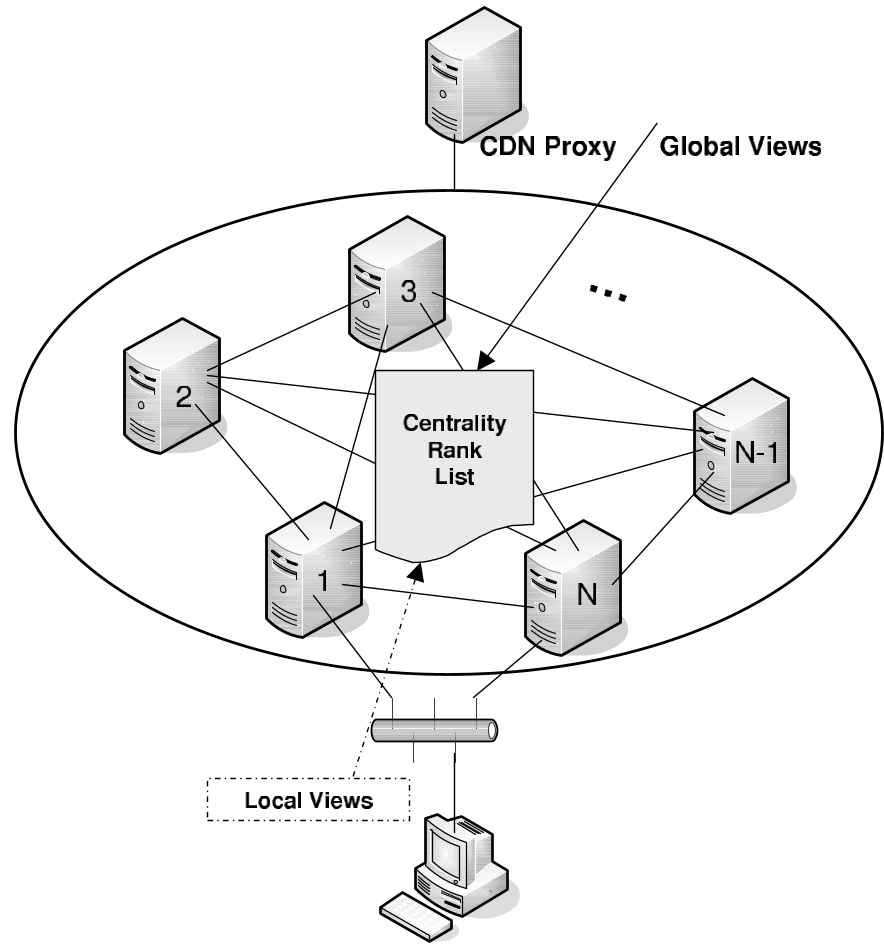 Figure: The proposed L2 Distributed Cache architecture modeled on a P2P Distributed Hash Table (DHT).
The key insight was using Closeness Centrality with a view-weighted edge. This ensures that videos leading to "heavy hitters" are prioritized in the cache.
Experiments: Closeness is King
The researchers compared these metrics across standard feeds (Top Rated, Most Viewed) and a massive "Science and Technology" dataset (250k+ videos).
Key Findings:
- Superiority of Closeness: In almost every scenario, Closeness Centrality yielded higher hit rates than Degree or Betweenness, especially when cache space was at a premium.
- Temporal Stability: By analyzing the "Exclusive-OR" of graph structures over time, they found that "Top Rated" categories are stable for about 5 hours, while "Most Recent" feeds are too volatile for structural caching.
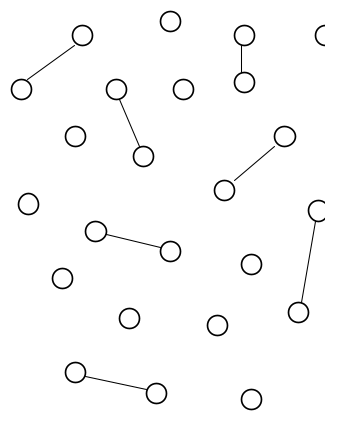 Figure: Quantifying how video relationship structures change over 5-hour intervals.
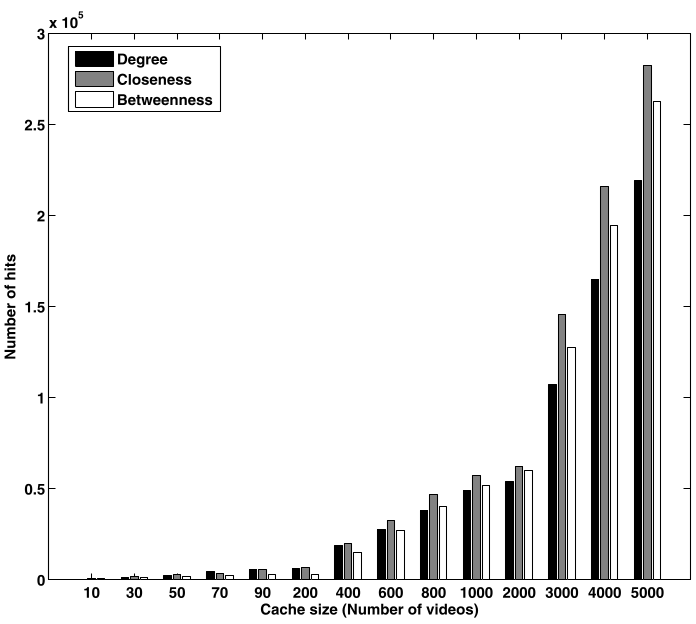 Figure: Hit rates for different centrality measures. Closeness (top line) consistently outperforms others.
Critical Analysis & Conclusion
Takeaway: The power of this approach lies in its Inductive Bias. It assumes users follow recommendations, and by caching the "central" hubs of these recommendations, the network stays one step ahead of the user.
Limitations:
- Computational Complexity: Calculating Betweenness and Closeness on a graph of millions of videos is computationally expensive ( or ). Real-time implementation would require highly optimized approximation algorithms.
- Data Access: The strategy depends on having access to the "Related Videos" metadata, which platform owners may not always expose via API in the same way.
Future Outlook: This work paves the way for "Self-Organizing CDNs" that don't just look at what was watched, but understand the topology of interest. As we move towards more algorithmic-driven content (TikTok, Reels), graph-based caching will likely become the standard rather than the exception.