
The Digital Pulse of Neighborhood Governance: How Email Reshapes Urban Power
Communications technology and urban governance reform: project highlights
This paper presents the findings of an NSF-funded study evaluating the impact of the Early Notification System (ENS) and electronic communications on the neighborhood council system in Los Angeles. Using Social Network Analysis (SNA), the authors investigate how simple technologies like email reshape political networks and citizen participation in urban governance.
TL;DR
Can a technology as simple as email revolutionize how a city is governed? This research examines the Los Angeles neighborhood council reform, revealing that while digital tools like the Early Notification System (ENS) increase information flow, their true power lies in how they reconfigure the "Social Capital" and "Network Centralization" of community groups. The study proves that technology doesn't just deliver data—it dictates the architecture of political influence.
Contextual Positioning
Published in 2005 during the height of the early "e-Government" movement, this paper sits at the intersection of public policy and Social Network Analysis (SNA). Unlike contemporary papers that chase complex LLMs, this work provides a foundational look at how simple communication protocols influence complex human institutions. It is a seminal evaluation of the Los Angeles neighborhood council system—a landmark experiment in decentralizing urban power.
Problem & Motivation: The "Techno-Driven" Trap
The late 1990s and early 2000s were characterized by a "techno-driven" craze. The assumption was simple: provide an electronic notification system (ENS), and citizen participation would naturally flourish.
The authors identify a critical nuance: Technological optimism often masks bureaucratic resistance.
- The Gap: While the City of Los Angeles mandated communication systems, the actual implementation was a rudimentary listserv that failed to meet ambitious Charter goals.
- The Insight: The authors realized that to understand if the reform worked, they couldn't just look at "usage counts." They needed to see how the structure of interactions changed—viewing citizen participation as "the penetration of citizens into policy-making networks."
Methodology: Social Network Analysis (SNA)
The core innovation here is the application of SNA to voluntary democratic associations. The researchers treated the Los Angeles charter reform as a natural experiment.
Architecture of Participation
The study focused on two dimensions of networks:
- Internal Networks: How members within a neighborhood council talk to each other.
- External Networks: How the council acts as a bridge between community stakeholders and city departments.
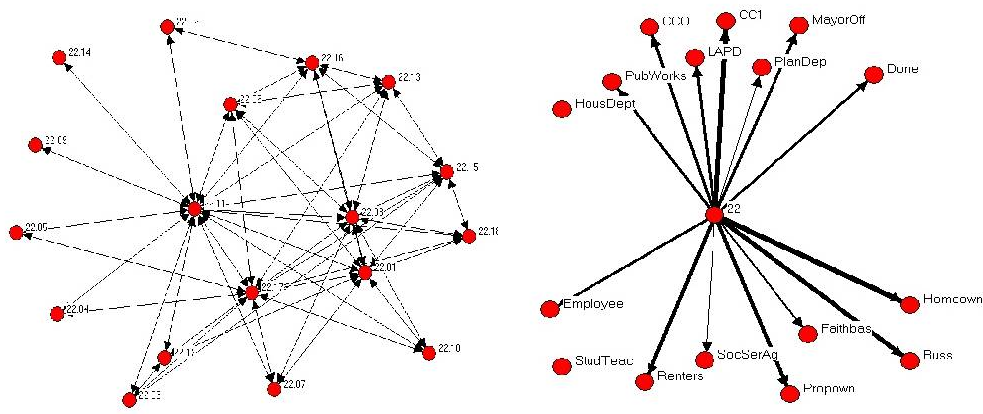
Figure 1: The sociogram on the right illustrates the Neighborhood Council acting as a 'central hub,' connecting diverse community groups (bottom) to city offices (top).
Experiments & Critical Findings
The team analyzed how email reliance affected the "health" of these political networks.
1. The Cohesion Paradox
The data showed a strong correlation between email density and group cohesion. Councils that utilized email heavily developed denser internal ties, which supported collective action. However, email is a double-edged sword for equality.
2. Centralization vs. Parity
One of the most profound findings relates to the Centralization of power:
- Low Variance in Use: When all council members used email at similar rates, the network became decentralized. Power was distributed.
- High Variance in Use: When only a few members were "power users" of email, the network became highly centralized. Email actually exacerbated power imbalances, creating digital gatekeepers.
Critical Analysis & Future Outlook
The study concludes that technological reform is inseparable from institutional reform. The "Early Notification System" was limited not by its code, but by the "political and bureaucratic changes" it failed to trigger.
Limitations
- Simplicity of Tools: The study focuses largely on email and listservs, which may seem dated but remain the backbone of professional governance.
- Confounding Variables: The authors admit that high turnover in city offices (due to term limits) made it difficult to isolate the impact of technology from shifting political winds.
Takeaway for Today
As we move into an era of AI-driven "Digital Twins" of cities, this paper serves as a sobering reminder: The medium is the message. Adding a technology layer to a broken bureaucracy won't fix it; it will only automate the existing power structures. To truly empower citizens, we must design for network density and usage parity, not just information delivery.