
Enhancing LBSNs: A Machine Learning Framework for Community-Aware Location Discovery
Introducing Community Awareness to Location-Based Social Networks
The paper introduces a community-aware architecture for Location-Based Social Networks (LBSN) that integrates Mobile Virtual Communities (MVC) and Machine Learning. It proposes a system that automates community discovery and adapts location popularity statistics based on a user's specific social group affiliations.
Executive Summary
TL;DR: This paper tackles the "discovery fatigue" in Location-Based Social Networks (LBSNs) by proposing a system architecture that automatically identifies and suggests Mobile Virtual Communities (MVCs). By leveraging a centralized Machine Learning Engine triggered by mobile device events, the system personalizes location popularity reports based on the user’s specific social circles.
Context: This work positions itself as an architectural evolution of standard social networks (like Facebook/Twitter), transitioning them into pervasive, context-aware systems where location and community identity are inextricably linked.
The Problem: One Size Does Not Fit All
In current LBSNs, when you look for a "popular" restaurant, the ranking is typically a global average. However, a popular spot for a "hiking community" is vastly different from what a "fine-dining group" might prefer. Current systems fail to:
- Automate Community Discovery: Users must manually search for groups.
- Contextualize Popularity: Geographic popularity doesn't account for the unique tastes of different sub-cultures or communities.
Methodology: The MLE Architecture
The core of the proposal is a sophisticated backend architecture designed to handle the lifecycle of community data.
1. Popularity Options & Filtering
The system allows users to set granular filters. Instead of a generic "Top 10" list, users can filter by:
- Average Age: Tailoring results to specific demographics.
- Time Windows: Distinguishing between morning, afternoon, and night-time hotspots.
- MVC Membership: Filtering popularity based strictly on the ratings of people within the same community.
2. The Machine Learning Engine (MLE) Training
The "intelligence" of the system resides in the MLE Training Execution component. It pulls data from the MVCDB (community data) and MLTDB (training datasets) to create predictive models.

3. Event-Driven Triggering
Unlike static recommendation systems, this architecture is event-driven. When a user performs a "Check-In" or leaves a "Rating" on their mobile device, it can trigger a re-training or update of the MLE. This ensures that the community suggestions remain dynamic and reflect the latest trends within the social group.
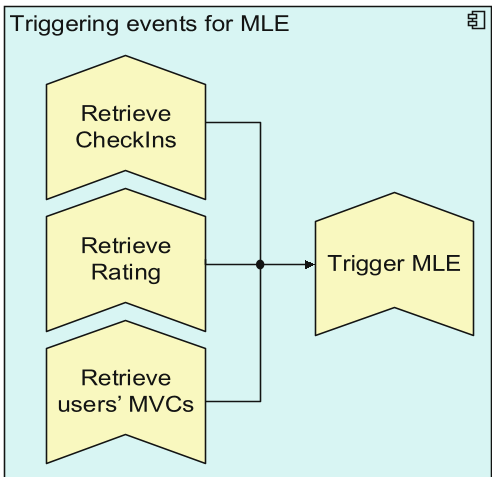
Insights & System Workflow
The recommendation process follows a logical flow:
- Retrieve Options: The system fetches the user’s preferred filters (age, time, current communities).
- Estimate Suggestions: Using the trained MLE, the system predicts which other communities the user might enjoy based on their location history.
- Fallback Mechanism: Importantly, the authors include a "failure-safe" function. If an MLE isn't ready for a specific niche, the system uses alternative heuristic means to provide suggestions, ensuring no dead-ends in the user experience.
Critical Analysis & Conclusion
Takeaway
The shift from "Global Popularity" to "Community-Aware Popularity" is essential for the maturity of LBSNs. This paper provides the blueprint for how to bridge the gap between raw GPS data and social identity using a structured ML pipeline.
Limitations & Future Work
While the architecture is logically sound, the paper focuses on the Application Layer of the ArchiMate® framework. Future research needs to address:
- Privacy: How to handle location/community data without compromising user anonymity.
- Scalability: Training individual MLEs for thousands of micro-communities could become computationally expensive.
- Cold Start: Improving recommendations for new users who have not yet performed enough check-ins to be classified into a community.
In conclusion, by making social networks "community-aware," we can transform them from simple directories into proactive assistants that understand the social fabric of the physical world.