
CommunityBCC: Leveraging Collective Intelligence through Latent Worker Communities
Community-based bayesian aggregation models for crowdsourcing
The paper introduces CommunityBCC, a novel community-based Bayesian label aggregation model for crowdsourcing. It models crowd workers as belonging to a few latent communities with shared behavioral traits (confusion matrices) to improve label accuracy, especially in sparse data scenarios.
TL;DR
The accuracy of crowdsourced data is often hampered by "sparse" contributions from workers. CommunityBCC addresses this by assuming workers aren't just independent agents but belong to latent communities with shared biases. By learning these group profiles, the model can "fill in the gaps" for workers with few labels, boosting accuracy by 8% on average over traditional SOTA methods.
The Sparsity Trap in Crowdsourcing
Modern AI relies on massive labeled datasets, often gathered via platforms like Amazon Mechanical Turk. However, the data distribution usually follows a power law: a few "super-workers" provide many labels, while the vast majority provide only a handful.
Existing probabilistic models like the Dawid&Skene algorithm or Bayesian Classifier Combination (BCC) try to estimate a "confusion matrix" (a profile of reliability and bias) for every single worker. But if a worker has only labeled three items, estimating their 5x5 confusion matrix is mathematically unstable. The result? Noise and inaccurate ground-truth estimation.
Methodology: The Power of Groups
The core insight of the University of Southampton and Microsoft Research team is that workers are not unique snowflakes; they tend to fall into specific types:
- The Accurate: Usually correct across all classes.
- The Biased: Consistently over-rates or under-rates products.
- The Spammers: Random or near-random voters.
Architecture: Joint Inference
CommunityBCC introduces a hierarchical Bayesian layer. Instead of generating labels directly from individual traits, it adds a Community Plate:
- A worker is assigned to a latent community membership ().
- The community has a consensus confusion matrix.
- The individual worker's matrix is a Gaussian perturbation of that community's matrix.
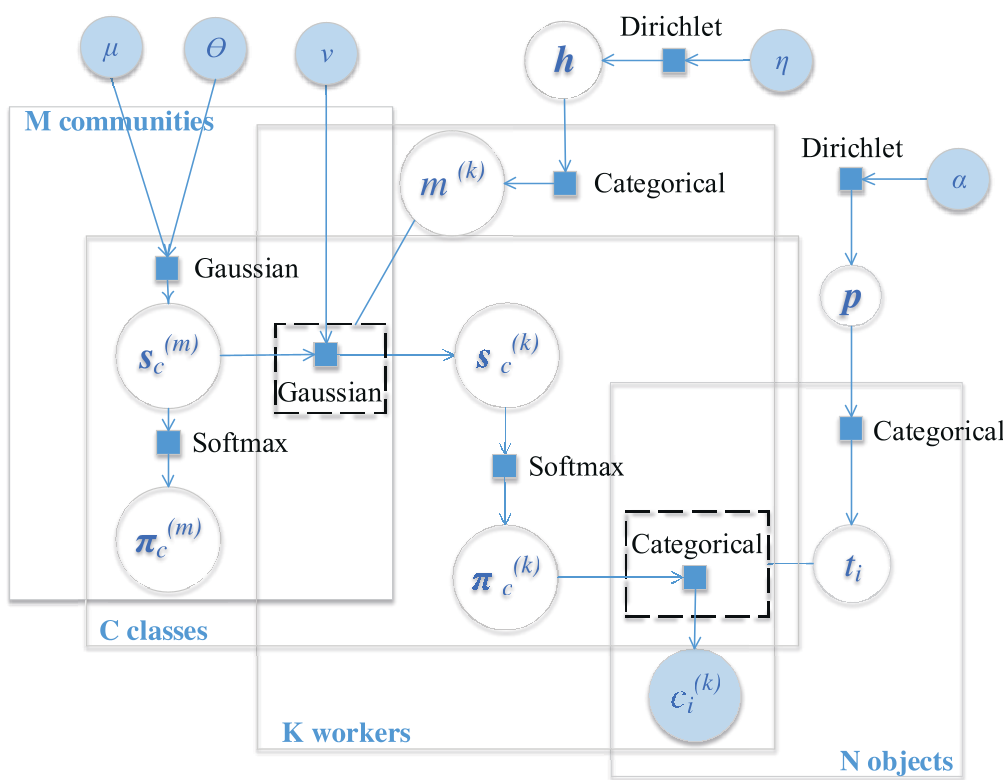 Figure 1: The Factor Graph of CommunityBCC showing the integration of the community plate into the standard BCC framework.
This structure allows the model to perform knowledge transfer. Even if a worker has only provided two labels, if those labels align with the "Biased" community, the model can infer the rest of their likely behavior based on the community profile.
Scalability through Decomposition
Computing this for millions of labels is non-trivial. The authors implemented a scalable inference engine by decomposing the model into three sub-models: the Object Model, the Community Model, and Worker Models. By using Message Passing (EP and VMP), they achieved a linear scaling that handles hundreds of thousands of labels in minutes.
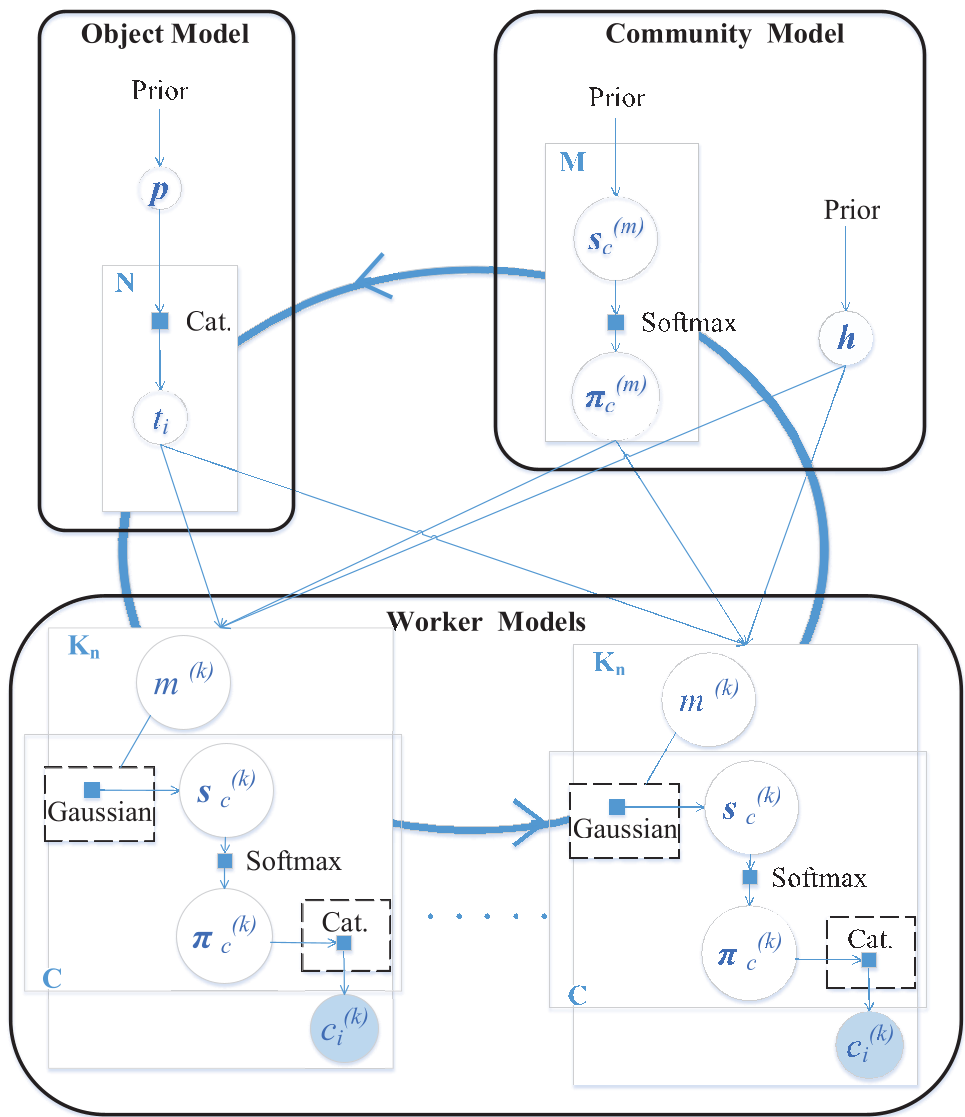 Figure 2: The iterative inference schedule allows for local computations to be merged into a global consensus.
Experimental Showdown
The model was tested against Majority Voting (MV), Dawid&Skene, and BCC on four massive datasets (Search Relevance, Sentiment Analysis, etc.).
Key Result: Dominance in Sparsity
The most striking finding is in the "efficiency" of learning. As shown in the accuracy-to-data-volume curves, CommunityBCC reaches high accuracy much faster than its peers. This is critical for industrial applications where every label costs money.
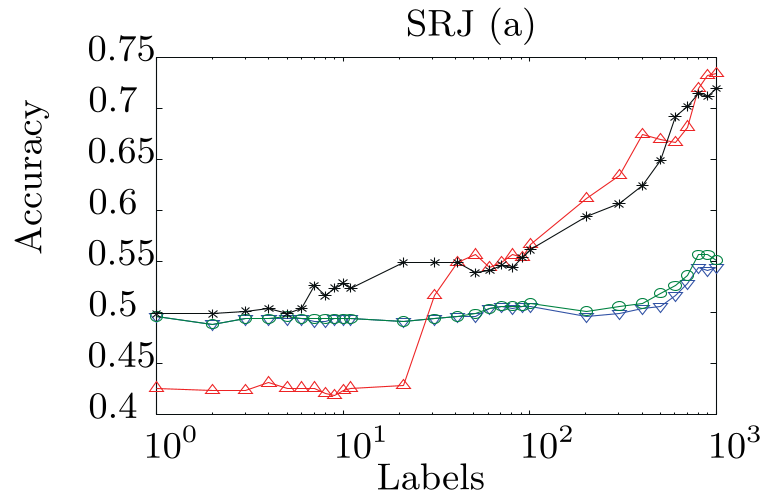 Figure 3: Accuracy vs. Data volume. CommunityBCC (red line) shows a significantly steeper learning curve in sparse data regions.
Critical Insight & Conclusion
CommunityBCC moves crowdsourcing theory from "individual reliability" to "social behavior modeling." By recognizing that human error is often systematic and shared within groups, we can build robust AI pipelines that are resilient to the noise of the crowd.
Limitations: One caveat is the reliance on a fixed number of communities (), though the authors mitigate this using marginal likelihood based model selection. Future work might benefit from non-parametric approaches (like Dirichlet Processes) to allow the number of communities to grow automatically.