
Unmasking the "Teleporters": Detecting Cheaters in Location-Based Social Networks via Community Structure
14796_Community-based cheater detection in location-based social networks.
This paper introduces a graph-based cheater detection method for Location-Based Social Networks (LBSNs) like Foursquare. It leverages community structure discovery (using the Louvain method) and user connectivity features to identify "cheaters" who fake location check-ins to illicitly gain rewards and badges.
TL;DR
In the gamified world of Location-Based Social Networks (LBSNs) like Foursquare, digital badges and "Mayorships" are social currency. However, "cheaters" often spoof their GPS to claim rewards without ever visiting the venues. This paper proposes a novel detection framework that doesn't rely on hardware sensors but instead looks at the social graph. By analyzing community clusters and badge distributions, the authors achieve high-accuracy detection (F1 > 0.88), proving that cheaters leave distinct signatures in how they connect with others.
The Motivation: Why GPS Spoofing is a Hard Nut to Crack
Most LBSNs encourage engagement through psychological rewards (badges) and tangible discounts (coupons). This creates an incentive for "Location Cheating."
Current defense mechanisms face a dilemma:
- Hardware Dependency: Using NFC or Bluetooth requires specific infrastructure at every venue.
- IP/GPS Limits: IP addresses can be masked via VPNs, and GPS coordinates can be easily faked by developer-mode apps.
- The "Super User" Noise: Distinguishing a legitimate traveler from a botting cheater is non-trivial when only looking at individual data points.
The authors' key insight is social: Cheaters are not isolated nodes. They often interact with other cheaters or follow specific patterns to unlock "group-based" badges (like the "Swarm" badge on Foursquare, which requires many users to check in at once).
Methodology: The "Cheater Picking" Framework
1. Graph Construction
The researchers built two distinct views of the network:
- Friendship Graph: An undirected graph where edges represent mutual "Following/Friend" status.
- Common Check-in Graph: A weighted graph where an edge represents two users checking in at the same venue. The weight increases with the number of shared venues.
2. Community Discovery
Instead of treating the network as a giant hairball, the authors used the Louvain Method to partition users into communities. Within these communities, connections are dense, while between communities, they are sparse.
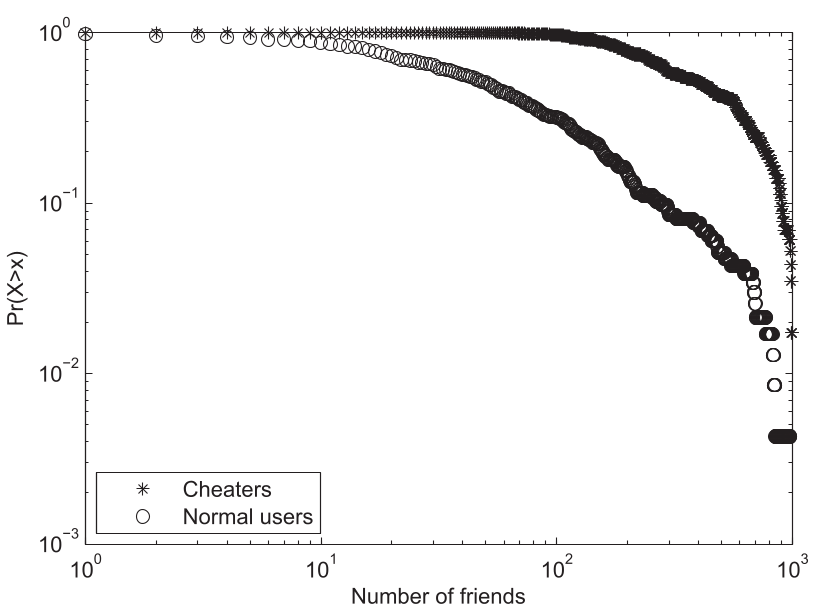 Figure 1: Comparison of CDFs between cheaters and normal users regarding friends, check-ins, and badges.
3. The Detection Heuristic
The algorithm identifies a community as "suspect" if: Where is a threshold for badge count and is a probability threshold. The logic is that cheaters accumulate badges at a rate far exceeding normal social circles.
Experiments & Results: Badges as the Smoking Gun
The researchers manually labeled a dataset of 349 users from Foursquare. Their analysis (Figure 1) revealed that while friends and check-in counts overlap significantly between groups, badge counts are a near-perfect separator. All cheaters in their dataset held more than 100 badges, a feat rare for casual users.
Performance Benchmarks
- Accuracy: In the Friendship Graph, the F1-score stabilized above 0.88 once the sample size reached 300 nodes.
- Common Check-in Graph: While still effective (F1 ~ 0.84), it was slightly less accurate than the friendship graph. This is likely because normal users often check in at famous "landmark" venues (e.g., airports, stadiums), creating accidental edges with cheaters.
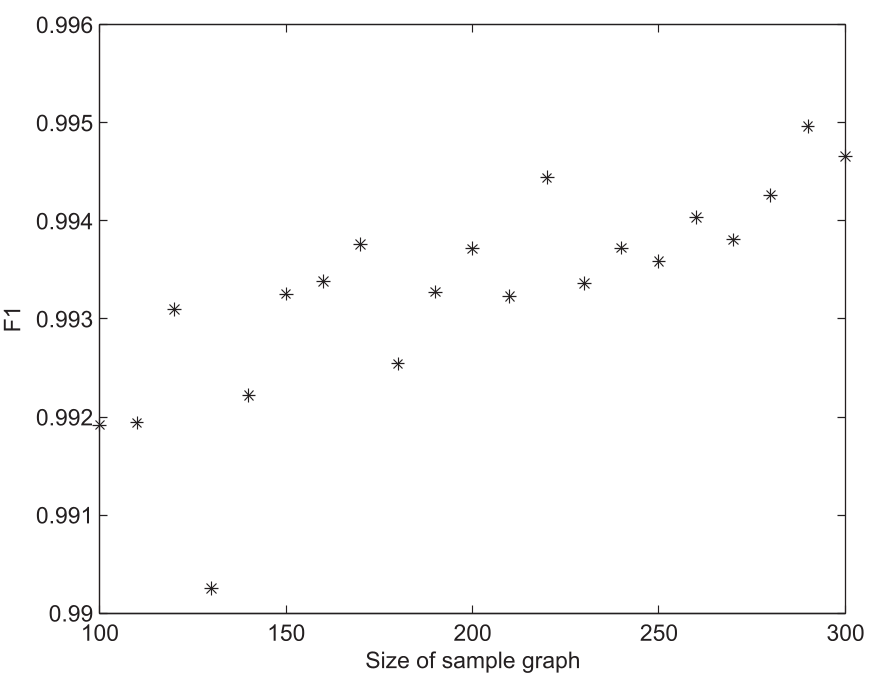 Figure 2: F1-Score vs. Sample Size. Connectivity-based detection holds strong as the graph grows.
Critical Analysis & Conclusion
The Good
This method is non-intrusive and content-agnostic. It doesn't need to track a user's real-time movement or private sensor data; it only needs the publicly available social ties and public badge achievements.
The Limitations
- Manual Labeling: The ground truth relies on manual labeling, which is difficult to scale to millions of users.
- Evolving Cheaters: Professional cheaters might learn to "stay under the radar" by intentionally keeping their badge counts low or diversifying their friendship groups to avoid being clustered into a "cheater community."
Final Takeaway
Fraud detection in 2026 is moving away from examining actions to examining relationships. By leveraging the Inductive Bias that malicious actors coordinate and share sub-structures, LBSN providers can maintain the integrity of their gamified ecosystems without requiring heavy-handed hardware verification.