
CBEAR: Balancing Social Connectivity and Battery Life in Mobile Social Networks
Community-Based Energy-Aware Routing Protocol in Mobile Social Networks
This paper introduces CBEAR (Community-Based Energy-Aware Routing), a novel protocol for Mobile Social Networks (MSNs) that integrates social community dynamics with energy constraints. It optimizes data sharing by partitioning networks into functional communities and balancing the energy load across nodes to extend network longevity.
TL;DR
Mobile Social Networks (MSNs) rely on "storage-carry-forward" mechanisms, but popular nodes often die early from battery exhaustion. CBEAR (Community-Based Energy-Aware Routing) solves this by partitioning users into communities and selecting relays based on a dual-metric: their social encounter probability and their current energy consumption rate. The result? A significant boost in network lifespan and transmission success.
Problem & Motivation: The "Centrality" Trap
In the world of Delay Tolerant Networks (DTNs), we often treat highly active nodes as "VIPs" for routing. While the Epidemic protocol floods the network and PROPHET predicts encounters, they both ignore a harsh reality: mobile terminals have limited batteries.
When a node becomes a central hub for data, it consumes energy at an accelerated rate. Once these "social butterflies" run out of power, the network loses its best bridges, leading to a catastrophic drop in performance. The authors of CBEAR realized that true SOTA performance requires Load Balancing—not just finding the best path, but finding the most sustainable one.
Methodology: The Core of CBEAR
CBEAR operates on a two-tier strategy: Intra-community and Inter-community routing.
1. The Energy-Aware Flag
The system defines a threshold for energy. If a node's energy falls below a specific level, it sets an energy flag , meaning it will only accept messages intended for itself, effectively "resting" to preserve its remaining life.
2. Multi-Factor Utility Function
The relay selection is governed by an efficacy function : This formula weights the total energy consumed () against the rate of consumption relative to remaining energy (). It ensures that nodes with high energy depletion rates are bypassed to maintain network equilibrium.
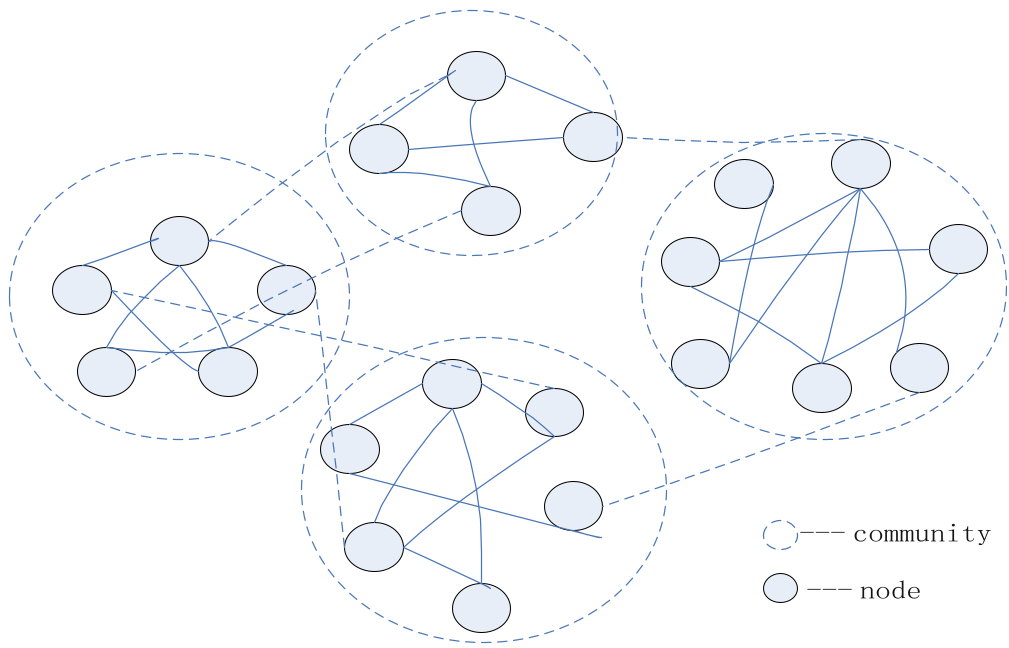 Figure 1: The MSN Network Model showing community clusters and inter-community bridges.
Experiments & Performance
The researchers compared CBEAR against Epidemic and PROPHET in a simulated 6000m x 4000m environment.
Success Rate & Longevity
The results were striking. As contact times increased:
- Epidemic and PROPHET saw success rates plummet after 900 contacts as key nodes died.
- CBEAR remained stable well past 1,500 contacts, proving that its energy regulation successfully achieved load balance.
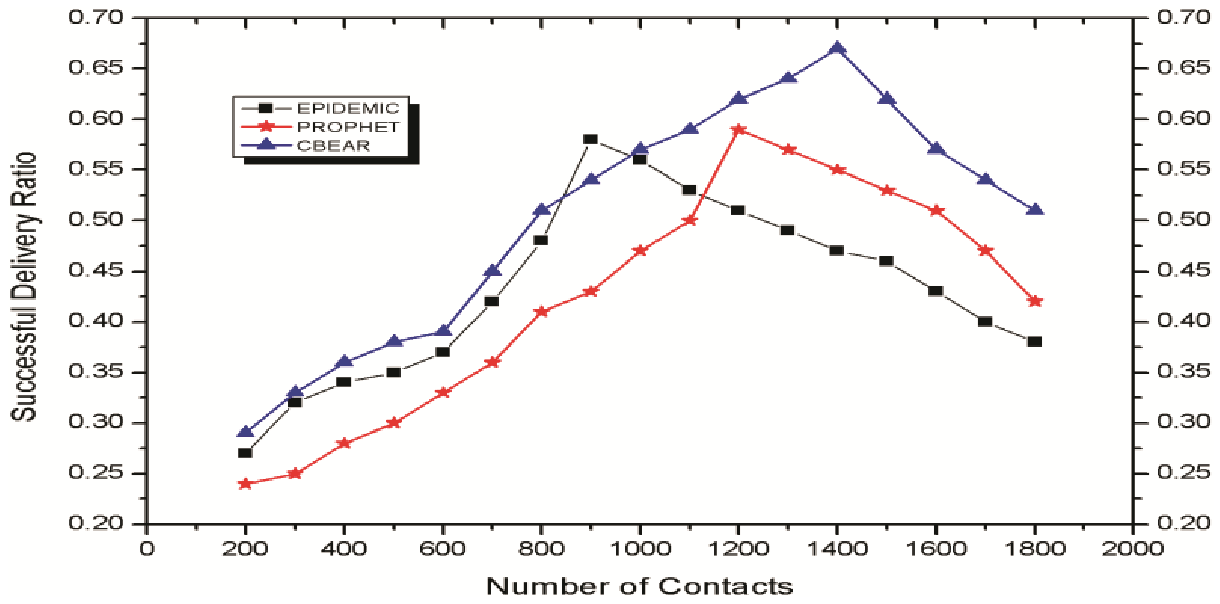 Figure 2: Data transmission success rate. CBEAR (top line) shows superior stability in long-term scenarios.
Routing Overhead
By restricting the number of message copies (L-copies) and prioritizing high-energy intermediate nodes, CBEAR achieved the lowest Routing Overhead Ratio. Unlike Epidemic routing, which causes network congestion through "contagious" diffusion, CBEAR filters for quality over quantity.
Critical Analysis & Conclusion
Takeaway
CBEAR successfully shifts the focus from purely "social" metrics to "socio-physical" metrics. By treating energy as a finite resource, the protocol ensures that the network doesn't just work fast, but works longer.
Limitations & Future Work
While CBEAR solves the energy balance problem, it does introduce slightly higher average latency (delay) because it occasionally avoids the "fastest" (but low-battery) nodes in favor of more sustainable ones. The authors also note that current community partitioning relies on centralized data collection. Future iterations could move toward decentralized community detection and address node selfishness, where users might lie about their energy levels to avoid forwarding tasks.
In conclusion, CBEAR is a significant step toward making Mobile Social Networks viable for real-world deployment where battery life is the ultimate constraint.