
Social Capital: Using Community Detection to Predict Professional Success
Community-Based Measures for Social Capital
The paper introduces a novel structural model for measuring Bonding and Bridging Social Capital using community detection. Unlike previous methods, it calculates these measures independently of node attributes by leveraging community membership as a proxy for individual characteristics, validated on a large-scale DBLP collaboration network.
TL;DR
Is your professional success determined by who you know, or how you are connected to different worlds? This paper presents a new algorithmic framework to measure Bonding (deep connections within your circle) and Bridging (diverse connections across circles) social capital without needing personal data. By testing on 2.2 million academic papers, the authors prove that "bridging" across different research communities is a much stronger indicator of a high H-index than staying within one's own niche.
Problem & Motivation: The Attribute Bottleneck
In social network analysis, "Social Capital" is the value derived from relationships. Sociologists like Robert Putnam categorized this into two types:
- Bonding: Strengthening ties within homogeneous groups (e.g., your immediate research lab).
- Bridging: Building ties across diverse groups (e.g., collaborating between Computer Science and Biology).
The Problem: Previous computer science models either required rich personal attributes (which are often private or hard to scrape) or used overly simplistic distance-based metrics (where is bonding and is bridging). These methods miss the "latent" characteristics shared by people in the same communities.
The Insight: The authors argue that Community Membership is a perfect proxy for attributes. If two people are in the same community, they are inherently "similar" in some latent way (interest, skill, or geography), regardless of whether they have directly collaborated yet.
Methodology: The Math of Similarity and Diversity
The core of the paper lies in redefining similarity based on community overlaps rather than direct edges.
1. Community-Based Similarity
The methodology uses the Jaccard Coefficient of community sets. If node belongs to communities and node to :
- Similarity
- Diversity
2. Distance Decay
To account for the "strength" of a tie, they introduce a connectivity function . This means a friend-of-a-friend contributes less to your capital than a direct co-author.
3. The Core Formulas
The Bonding and Bridging capital for any individual is the summation of these similarity/diversity scores across the entire network, weighted by connectivity.
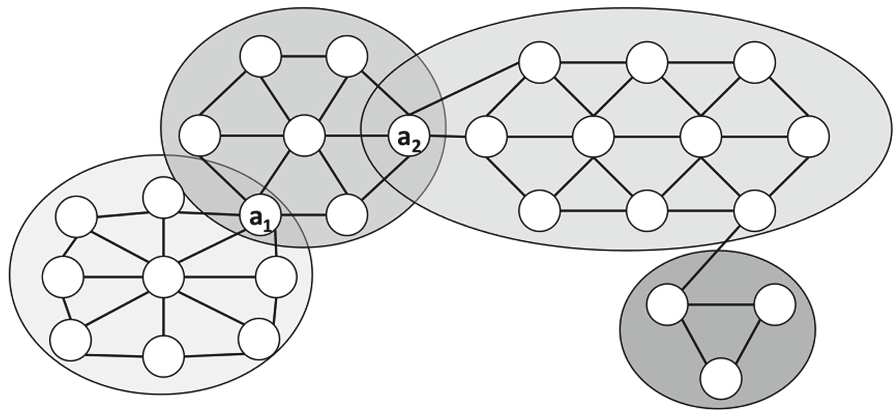 Figure: Visualizing shared vs. disparate community memberships.
Experiments: Validating on DBLP
The authors performed a massive validation using the DBLP dataset (academic collaborations).
- Dataset: 1.4M edges, 400K nodes (authors).
- Success Metrics: Total Citations and H-index.
- Community Detection: They compared BIGCLAM (which allows overlapping communities) and Louvain (which is highly scalable).
Key Findings
- Bridging > Bonding: At the individual level, Bridging capital consistently showed a much higher correlation with the H-index () than Bonding capital (). This confirms the long-standing theory that "weak ties" and diverse networks lead to better career advancement.
- Venue Success: The model was surprisingly good at predicting the success of entire publication venues. Aggregated social capital correlated heavily (up to ) with venue H-index.
- Louvain's Granularity: Even though Louvain doesn't allow overlaps, its ability to detect a higher number of communities provided more fine-grained structural information than BIGCLAM, leading to better results.
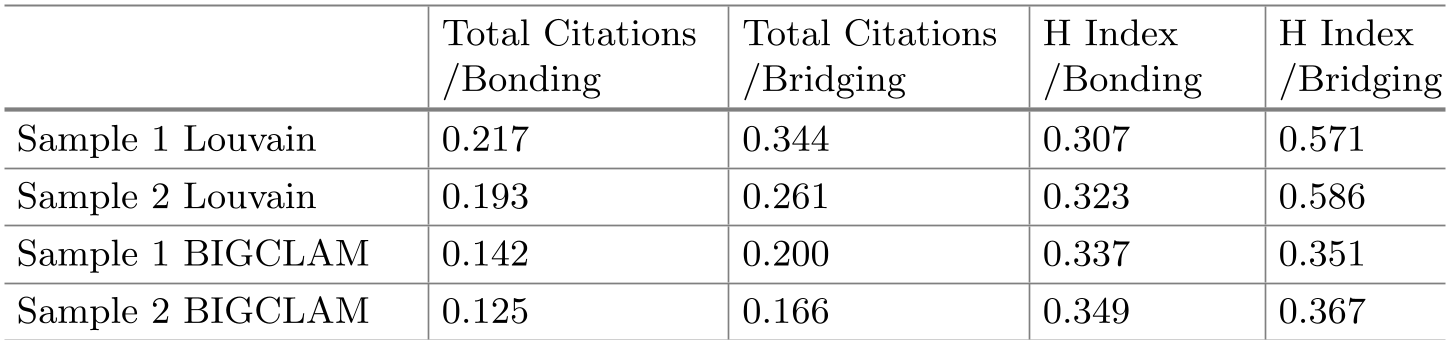 Table: Correlation between Social Capital types and Individual Academic Success.
Critical Analysis & Conclusion
Takeaway: This work turns "Community Detection" into a powerful tool for socioeconomic prediction. It proves that you don't need to know what a person likes or what they do to estimate their professional potential—you just need to know which "circles" they move in.
Limitations:
- The model relies heavily on the quality of the community detection algorithm.
- It treats all communities as equal, whereas being the "bridge" between two high-impact communities is likely more valuable than bridging two low-impact ones.
Future Outlook: Integrating these structural measures with Graph Neural Networks (GNNs) could allow for even more predictive power, potentially forecasting which researchers are likely to become future "stars" based on their current network trajectory.