
Social Networking for Machines: Optimizing P2P Query Routing via Interest-Based Communities
How Community-Based Peer-to-Peer Social Networks Can Affect Query Routing?
The paper proposes a community-based Peer-to-Peer (P2P) model inspired by social network characteristics, using a shared ontology to cluster peers by interest. It demonstrates that by leveraging "hubs" and controlled flooding mechanisms, search performance can be significantly optimized compared to random unstructured networks.
TL;DR
This research tackles the inefficiency of search in Peer-to-Peer (P2P) systems by morphing the network topology into a "social" structure. By grouping peers into interest-based communities defined by a shared ontology and utilizing high-connectivity "hubs," the authors significantly reduce network congestion while maintaining high search success rates.
Context & Motivation: The Blind Search Problem
In the world of decentralized systems, finding a file is surprisingly difficult.
- Unstructured Networks (e.g., Gnutella) use "flooding"—sending a query to everyone. It’s simple but creates a "broadcast storm" that eats bandwidth.
- Structured Networks (e.g., Chord/CAN) use Distributed Hash Tables (DHTs). They are efficient but "brittle"; they don't handle related data or dynamic peer departures well.
The authors' insight is simple: Humans don't search blindly. We use social networks where people with similar interests cluster together. If a P2P network mimics this—where a researcher looking for "Machine Learning" papers is logically "closer" to other ML researchers—the search becomes surgical rather than broadcast-heavy.
Methodology: Engineering a "Social" P2P Model
The proposed model rests on three pillars:
1. The Shared Ontology (The Common Language)
Every peer stores a shared ontology (like the ACM Classification System). This acts as a map, allowing peers to identify which "Community" they belong to based on the files they store.
2. Hubs and Representatives
- Representatives: The "gatekeepers" of a community who help new peers find their place.
- Hubs: Peers with high capacity and many connections. They act as local knowledge centers.
3. Controlled Flooding
Instead of blind flooding, the authors propose a mechanism where:
- Queries are routed directly to the relevant community representative.
- Hubs receive the query and distribute it to their neighbors, but critically, they avoid re-sending to other hubs to prevent infinite loops and message explosions.
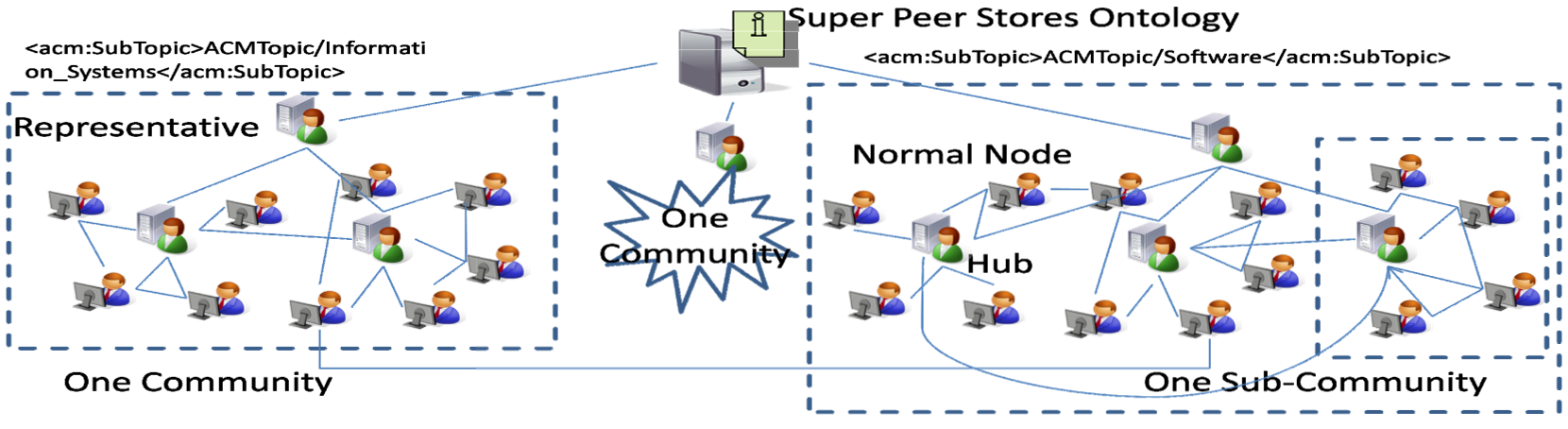 Figure 1: An instance of the proposed model using the ACM ontology to define logical communities (e.g., C1, C2) and hubs.
Experiments: Social vs. Random
The authors simulated a network of 1,000 nodes, comparing a standard random P2P network (Experiment 1) against three variations of their social model:
- Exp 2: Social model + Pure Flooding.
- Exp 3: Social model + Controlled Flooding (Hubs don't talk to Hubs).
- Exp 4: Social model + Restricted Flooding (Normal nodes don't forward).
Key Findings
- Traffic Reduction: The total "Sent Messages" in the social model were significantly lower than the random network because the search was confined to a specific community interest.
- Success Rate: The high Clustering Coefficient of the social model ensured that even with fewer messages, the "Success Rate" (finding at least one answer) remained high.
- Recall Trade-off: Interestingly, the random network had higher Recall (finding all copies), because the social model stops searching once a hub provides an answer—a feature, not a bug, for efficiency.
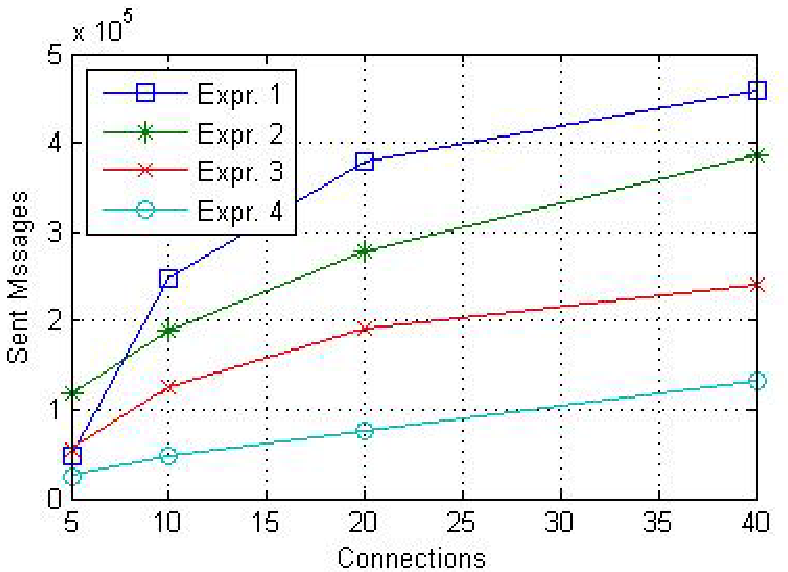 Figure 2: Sent messages per connection. Controlled flooding (Exp 3 & 4) maintains much lower traffic compared to the baseline.
Critical Insight & Summary
The core takeaway is that Network Topology is Methodology. By simply rearranging how peers connect (based on semantic similarity) and how they forward messages (respecting hub roles), we can solve the scalability issues of unstructured P2P systems without the complexity of DHTs.
Limitations:
- The model relies on a "Shared Ontology." If peers have diverse or cross-disciplinary data, the ontology might become a bottleneck.
- Highly connected "Hubs" might become points of failure or performance bottlenecks if not balanced properly.
Future Outlook: This work paves the way for "Content-Aware Overlays," which could be vital for modern edge computing and decentralized AI, where finding localized data quickly is more important than exhaustive global searches.