
CBPL: Scaling Relationship Labeling via Community Structures and Pseudolikelihood
A Community-Based Pseudolikelihood Approach for Relationship Labeling in Social Networks
This paper introduces Community-Based Pseudolikelihood (CBPL), a novel approach for relationship labeling in social networks. By integrating community structure into Conditional Random Fields (CRFs) and employing pseudolikelihood estimation, it achieves State-of-the-Art (SOTA) performance in accuracy and computational efficiency compared to traditional Relational Markov Networks (RMNs).
Executive Summary
TL;DR: The paper addresses the "Relationship Labeling" problem—inferring the type of connection between nodes (e.g., Family vs. Colleague) in a social network. They propose CBPL (Community-Based Pseudolikelihood), which uses community detection to guide the construction of a Conditional Random Field (CRF). By replacing the global likelihood with a local Pseudolikelihood, they eliminate the bottleneck of expensive approximate inference, achieving higher accuracy and dramatically faster training times than traditional Relational Markov Networks (RMNs).
Background: This work sits at the intersection of Statistical Relational Learning (SRL) and Community Detection. It moves away from the "Flat" model assumption (where edges are independent) and improves upon the "Global" relational models that struggle with scalability.
The "Independence" Trap and RMN Bottlenecks
Traditional machine learning assumes that data points are Independent and Identically Distributed (IID). In a social network, this is fundamentally false. If person A and B are in a "Family" community, their mutual connections are highly likely to also be "Family."
While Relational Markov Networks (RMNs) were designed to capture these dependencies, they face two major hurdles:
- Computational Explosion: They require global normalization (the partition function ), which involves "Loopy Belief Propagation" over the entire graph—a process that is slow and often fails to converge safely.
- Template Rigidity: Typical templates (like triad cliques) are too generic and don't account for the intrinsic "group" clusters human societies form.
Methodology: Bringing "Communities" into the CRF
The authors' core Insight is that "birds of a feather flock together." Relationships should not just be linked because they share a node, but because they share a context.
1. The Three-Step Pipeline
- Step 1: Community Detection: Running algorithms like Infomap (for hard partitions) or GCE (for overlapping groups) to identify the social latent structure.
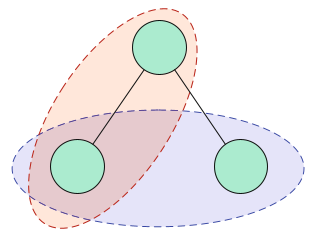
- Step 2: CRF Construction: Instead of creating edges between all adjacent relationships, a link is only established in the CRF if two relationships start from the same person and end in the same community. This makes the graph sparser and more theoretically sound.
- Step 3: Pseudolikelihood Estimation: Instead of maximizing , they maximize the product of local conditionals: .
2. The Math of Efficiency
By using Pseudolikelihood, the gradient computation becomes , where is the number of labels and the links in the model. Contrast this with RMNs, which are . This reduction in complexity is what allows the model to scale to large networks like mobile Call Detail Records (CDRs).
Experiments: Terrorists and Phone Calls
The authors tested the model on two distinct datasets:
- TerroristRel: A sparse network of terrorist affiliations.
- PhoneCallNet: A dense network derived from encrypted mobile metadata.
Performance Gains
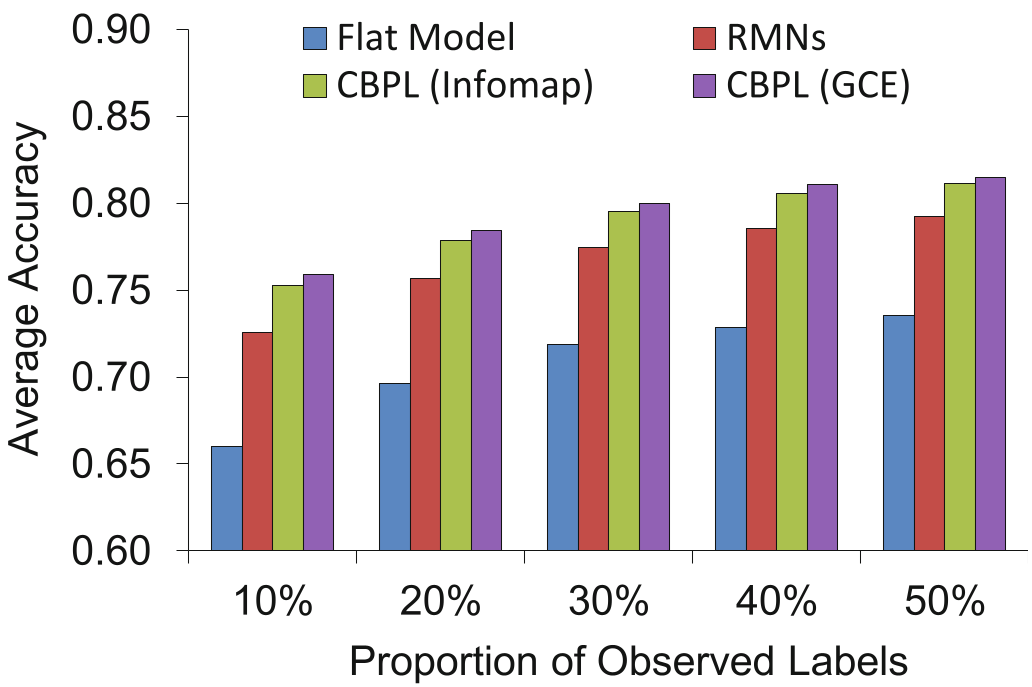
The results confirm that adding relational information (Link structure) significantly boosts accuracy over "Flat" models. Moreover, CBPL consistently beats RMN:
Key Findings:
- Accuracy: CBPL provides a ~3-5% absolute accuracy boost over RMN.
- Training Speed: As the proportion of observed labels increases, RMN's training time grows exponentially, while CBPL remains nearly linear. In the PhoneCallNet experiment, CBPL was over 25x faster than RMN.
Critical Analysis & Conclusion
The genius of CBPL lies in its use of Community Detection as a Pre-processor. By pruning the dependency graph using social context, the authors not only improved the "Signal-to-Noise" ratio of the features but also made the optimization problem much easier to solve via Pseudolikelihood.
Limitations & Future Work
- Static vs. Dynamic: The current model looks at a snapshot. Social networks are dynamic; a version that incorporates temporal community shifts would be a natural next step.
- Supervision: The model is supervised. In real-world "dark" networks (like crime), labels are scarce. Moving toward a semi-supervised PL-EM algorithm for community-based CRFs would highly enhance its practical value.
Final Takeaway: CBPL proves that we don't need complex global inference if we have a smart local structure. By understanding the "Community," we understand the "Relationship."