
HSIN: Bridging Lexical Gaps in CQA via Heterogeneous Social Influential Networks
Question retrieval for community-based question answering via heterogeneous social influential network
The paper introduces HSIN (Heterogeneous Social Influential Network), a question retrieval framework for Community-based Question Answering (CQA). It leverages a combination of LSTM-based text embedding and random-walk-based graph learning to integrate question content, categories, and asker social interactions.
TL;DR
Question retrieval in platforms like Quora is plagued by "lexical gaps"—different words describing the same concept. While deep learning has improved text embeddings, it often ignores the social context of the asker. This paper proposes HSIN, a framework that fuses LSTM-based textual analysis with social network interactions through a heterogeneous graph. It achieves a substantial performance boost (up to 30% improvement in MAP) by leveraging the intuition that social circles and categories provide strong clues for semantic intent.
Problem & Motivation: Beyond the Literal Word
In Community Question Answering (CQA), users often ask the same thing in different ways. A human knows that "How to start with machine learning?" and "Introductory materials for ML" are semantically equivalent, but a machine primarily looking at keywords (Bag-of-Words) might fail.
The authors identify two specific bottlenecks:
- Lexical Gaps: Word ambiguity (e.g., "Apple" the company vs. the fruit) and mismatches.
- Feature Sparsity: Short query titles contain very few clues for traditional NLP models to latch onto.
The Insight? Users aren't isolated. They have friends, specific interests, and they post within categories. By building a network that connects Users Questions Categories, we can use the "Social Influence" to fill the gaps left by sparse text.
Methodology: The HSIN Framework
HSIN treats the CQA environment as a Heterogeneous Social Network.
1. Dual Feature Extraction
- Textual Stream: Uses a Long Short-Term Memory (LSTM) network to process the sequential nature of questions, capturing long-term dependencies that simple word-embeddings miss.
- Social Stream: Constructing a graph where nodes are Users (), Questions (), and Categories ().
2. Random Walk Learning
Inspired by DeepWalk, the model performs random walks across this heterogeneous graph to generate "paths" (sequences of nodes). These paths act like "sentences" in a social language, capturing the structural proximity between a user and their likely interests.
3. Joint Ranking Optimization
The model translates these insights into a unified embedding space. It uses a Hinge Loss function for ranking: This ensures that questions within the same category or asked by socially connected users are pulled closer in the vector space than irrelevant ones.
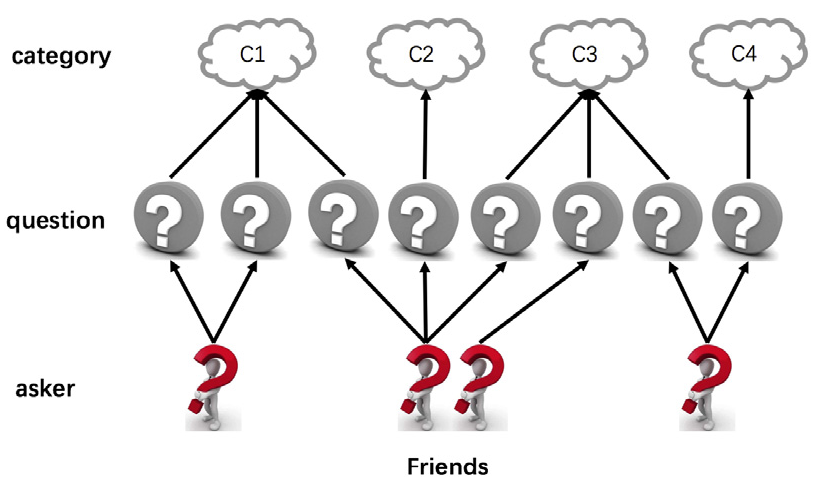 Fig 1: The heterogeneous CQA network illustrating connections between users, categories, and questions.
Experiments & Results: Crushing the Baselines
The authors tested HSIN against traditional models (VSM, BM25) and deep learning baselines (Doc2Vec, DRLM, RCNN).
- Performance Metrics: Across MAP, P@1, P@5, and MRR, HSIN consistently outperformed the competition.
- The Social Advantage: While textual-only deep models like RCNN achieved a MAP of 0.2689, HSIN reached 0.4067. This gap proves that social metadata isn't just "extra" info—it's a critical signal.
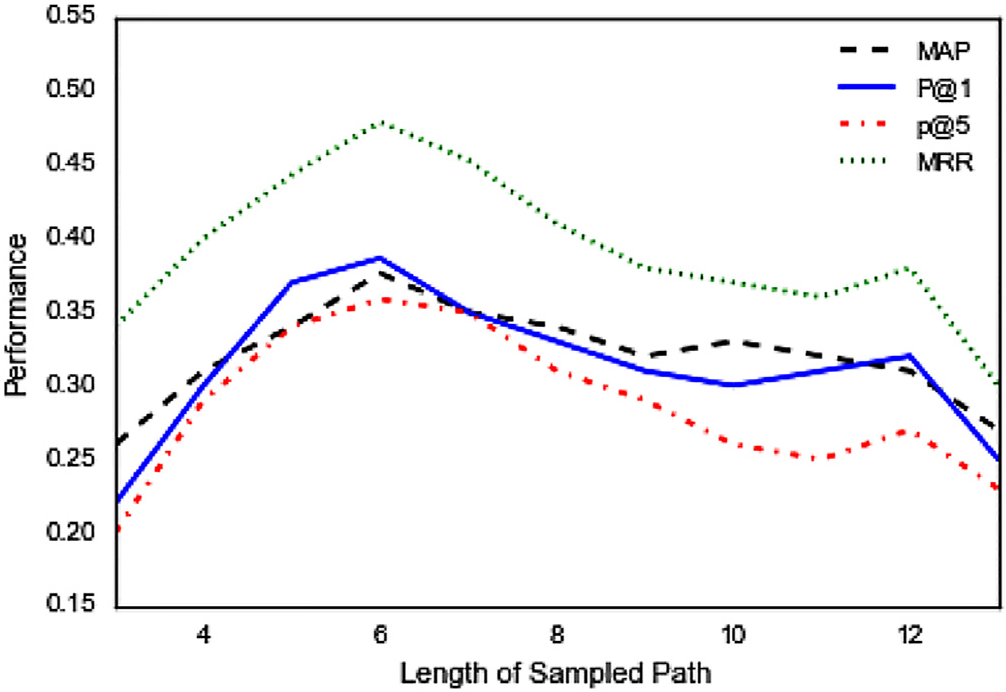 Fig 2: Precision@1 results across different training data proportions, highlighting HSIN's consistent superiority.
Critical Insight: Why Does It Work?
HSIN works because it successfully leverages Inductive Bias from social hierarchies. If User A and User B are friends (social edge) and User A asks about "Neural Networks" (category edge), even if User B's question is "How to train models?", the model can infer the "Neural Network" context through the graph structure, effectively resolving the lexical ambiguity of the word "models."
Limitations & Future Work
- Cold Start: The paper doesn't deeply address how the model handles brand-new users with zero social ties.
- Graph Scale: As the network grows to millions of users, the computational cost of random walks and joint training may require more distributed optimization strategies.
Conclusion
HSIN represents a pivot from "Textual Retrieval" to "Contextual Discovery." By viewing a question not as a string of words, but as a node in a living social ecosystem, we can achieve far higher accuracy in connecting users with the knowledge they seek.