
CRBMP: Strategic Rumor Blocking via Community Intelligence and DR-Submodular Optimization
Community-Based Rumor Blocking Maximization in Social Networks
This paper introduces the Community-Based Rumor Blocking Maximization Problem (CRBMP) to mitigate misinformation in social networks. The authors propose a two-stage framework involving budget allocation via DR-submodular maximization on an integer lattice and a greedy seed selection process, achieving a approximation for allocation and a approximation for selection.
TL;DR
In the era of viral misinformation, blocking rumors requires more than just "picking popular users." This paper introduces CRBMP, a framework that partitions social networks into communities and uses a two-stage greedy approach to allocate "protector" seeds. By treating budget allocation as an optimization problem on an integer lattice, the authors achieve a approximation for resource distribution, significantly outperforming traditional proximity-based methods on large datasets.
Context: The Social Network Architecture
The spread of rumors (e.g., grain crises or 5G conspiracies) causes real-world panic. While Influence Maximization (IM) is a well-studied field, Rumor Blocking is harder because it involves a Competitive Independent Cascade (CIC) model: rumors and protectors race to influence inactive nodes.
The authors identify a critical gap: social networks are not homogeneous. They consist of communities where internal bonds are much stronger than external ones. Ignoring this structure leads to inefficient resource waste.
Methodology: A Two-Stage Precision Strike
The authors break the problem into two distinct mathematical challenges:
1. Budget Allocation (Global Strategy)
Instead of selecting seeds one by one across the whole network, the algorithm first decides how many protectors each community should get. This is modeled as a function over an integer lattice .
- DR-Submodularity: The authors prove that the objective function follows the "Diminishing Returns" property. Adding a protector to a community with few resources helps more than adding one to a community already saturated with protectors.
- Greedy Allocation: Algorithm 1 iteratively assigns a unit of budget to the community that yields the highest marginal gain until the total budget is reached.
2. Protector Seed Selection (Local Tactics)
Once community is assigned protectors, Algorithm 2 performs a local search within that community to pick the specific nodes that maximize the expected number of protected users.
 Note: The network is first partitioned based on influence density before allocation begins.
Experiments: Performance vs. Scale
The researchers tested their approach on three datasets ranging from 379 to 3,783 nodes.
Key Findings:
- Superiority with Scale: While the gap between the proposed Greedy algorithm and the "Proximity" baseline (picking nodes near rumors) is small in small networks, it becomes massive in larger networks like the Bitcoin Alpha dataset.
- The Submodularity Curve: As the budget increases, the marginal benefit of each new protector decreases, confirming the theoretical DR-submodular proof.
- Computational Trade-off: The greedy approach is significantly more effective than "Random" or "Proximity" methods, but it comes at a higher computational cost due to the Monte Carlo simulations required to estimate influence.
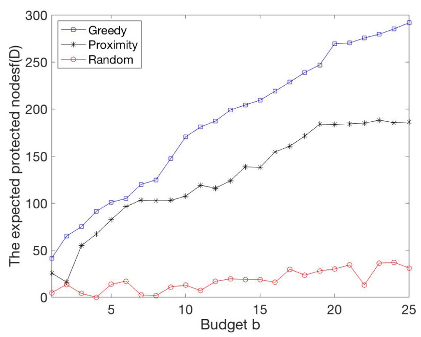 (a) Small Dataset: Narrow lead. (b) Large Dataset: Significant performance gap.
Critical Analysis & Takeaways
Why it works: By partitioning the network first, the algorithm reduces the search space for seed selection. The use of the integer lattice allows for a more granular distribution of influence "power" across the infrastructure.
Limitations:
- Time Complexity: The current greedy approach relies on Monte Carlo simulations, which might be too slow for ultra-large-scale graphs (millions of nodes) without further optimization (like Reverse Influence Sampling).
- Detection Lag: The model assumes rumors are detected with a delay ; however, in real-world scenarios, the "rumor source" is often hidden or evolving.
Future Outlook: This work paves the way for integrating Community Intelligence into automated content moderation systems. Future iterations could leverage graph neural networks (GNNs) to replace the expensive Monte Carlo step, enabling real-time rumor suppression.