
Personalized PageRank: Navigating Communities in Decentralized Social Networks
Community classification on Decentralized Social Networks based on 2-hop neighbourhood information
This paper addresses the challenge of community detection in Decentralized Social Networks (DSN) using only local 2-hop neighborhood information. By framing community detection as a binary classification problem, the authors evaluate several proximity-based classifiers, demonstrating that Personalized PageRank (PPR) significantly outperforms traditional metrics like Common Neighbors and Adamic/Adar.
TL;DR
In the world of Decentralized Social Networks (DSN), no one has the "big picture." This paper explores how individual users can identify their own communities using only 2-hop local information. By shifting the perspective from global clustering to local classification, the authors prove that Personalized PageRank (PPR) can identify community members with high accuracy, achieving up to a 64% improvement over standard ranking methods.
Background: The Visibility Crisis in DSNs
Centralized giants like Facebook or X (Twitter) have a bird's-eye view of every connection. However, decentralized platforms like Diaspora or Musubi prioritize privacy; users or "super-nodes" only see their immediate friends and, at most, their friends' friends (a 2-hop neighborhood).
The problem? Most community detection algorithms (like Modularity-based clustering) require the full graph. When you only see 2 hops, traditional "clustering" breaks down. The authors rethink this: instead of partitioning the whole world, can we just classify who belongs to our world?
The Intuition: Proximity as a Proxy for Community
The study tests four primary proximity measures to see which best identifies "positive" nodes (those in the same community as the observer):
- Common Neighbors (CN): Simple overlap; more mutual friends mean higher likeness.
- Adamic/Adar (AA): Weights mutual friends higher if they have fewer total connections (rarer matches are more significant).
- PageRank (PR): The classic stationary distribution of a random walker.
- Personalized PageRank (PPR): A "biased" random walk that frequently jumps back to the observer or a set of known community members.
Why PPR Wins
Wait, why does PPR work so much better? The secret lies in the Escaping Vector (EV). Unlike standard PR, which can teleport to any random node in the graph, PPR teleports back to the "source." In this context, if we know even a few people in our community (pre-known labels), we can bias the walk toward them. This creates an "ink-spilling" effect where the score stays concentrated within the local community structure rather than leaking into the rest of the network.
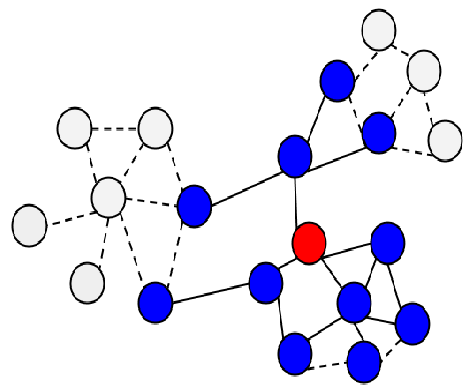 Figure 1: Comparison between (a) global community detection and (b, c) local classification from an observer's 2-hop view.
Experimental Results: Linear Gains from Small Effort
Testing on the Chinese SNS Renren, the results were striking. While CN and AA provide a decent baseline (AUC around 0.74), PPR pushed the AUC to 0.8339.
Key findings include:
- Relative Improvement: PPR improved upon standard PageRank by 64.97%.
- The Labeling Trade-off: The authors found a linear relationship between the number of known community members provided in the Escaping Vector and the classification accuracy.
- Heuristic Strength: Using "high-degree" known community members as seeds for the PPR walk yields better results than picking random members, as these "hubs" help anchor the community more effectively.
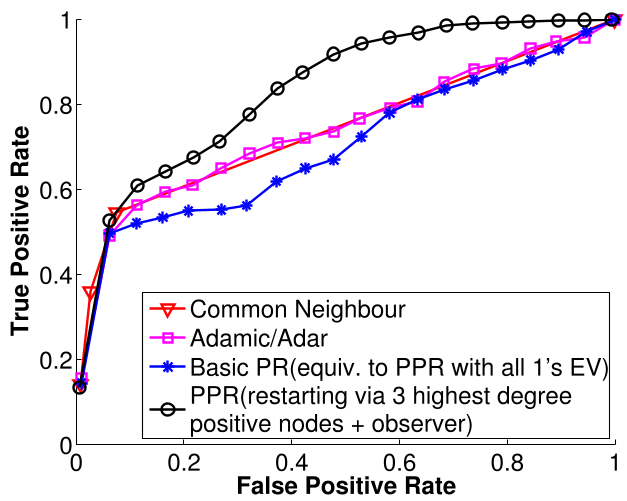 Figure 2: The ROC curves clearly show PPR (the top-most line) outperforming CN, AA, and PR.
Critical Insight & Future Outlook
The beauty of this research is its minimalism. It doesn't require complex neural networks; it uses the intrinsic "flow" of the graph topology to solve a privacy-enforced data limitation.
Limitations: The study assumes we have some "pre-known" labels. In a completely cold-start scenario, the performance gain might be lower. Furthermore, the 2-hop limit is a strict constraint that might miss broader community structures that emerge at 3 or 4 hops.
What's next? The authors are currently exploring privacy-preserving protocols that allow different observers to share their local views to improve detection without revealing their entire contact lists. As decentralized social media gains traction, these "local-first" algorithms will be crucial for features like friend recommendations and content filtering.
Conclusion
This work shifts community detection from a "global mapping" problem to a "local navigation" problem. By leveraging Personalized PageRank, users in decentralized networks can effectively identify their "tribe" using only the information available in their immediate social vicinity.