
Enhancing Personalization: Solving the Cold Start Problem via Attribute-Aware Community Detection
Community Detection for Cold Start Problem in Personalization: Community Detection is Large Social Network Graphs Based on Users’ Structural Similarities and Their Attribute Similarities
This paper introduces an enhanced community detection algorithm designed to mitigate the "Cold Start" problem in personalization systems. It combines the Girvan-Newman structural approach with a modified SAC2 (Structure-Attribute-Cluster) framework and Louvain Modularity, leveraging both graph topology and user attribute similarities.
TL;DR
This research addresses the "Cold Start" dilemma—where recommender systems fail due to a lack of user history—by pivoting from purely structural graph analysis to an attribute-integrated community detection model. By combining Louvain Modularity with k-Nearest Neighbor (k-NN) graphs weighted by user "personas," the method achieves a 14% improvement in clustering purity over existing attribute-aware baselines.
Problem & Motivation: The Structural Blind Spot
In the realm of social computing, a persona represents a user's activities and attributes. Most classic algorithms, such as the Girvan-Newman method, identify communities based on "who you know" (edges). However, for a new user entering a system, the "who you know" data is often non-existent or sparse.
The authors argue that "who you are" (attributes like age, gender, and specific interests) is just as important as structural connectivity. Current SOTA methods often fail because they don't adequately balance these two dimensions, leading to poor recommendations during the initial "Cold Start" phase of a product's lifecycle.
Methodology: Fusing Identity with Connectivity
The proposed solution builds upon the SAC2 (Structure-Attribute-Cluster) algorithm but introduces a specialized weighting and optimization phase.
1. The Similarity Metric
Instead of relying on binary edge existence, the model calculates a distance metric using Euclidean Distance across normalized user attributes (e.g., age normalized to a 0-1 scale).
2. The Hybrid k-NN Graph
The core innovation lies in the construction of a directed k-NN graph where the choice of neighbors is governed by a weighting factor : By setting , the authors prioritize Attribute Similarity over Structural Links, ensuring that even if two users aren't "friends" yet, they are clustered together if their personas match.
3. Louvain Optimization
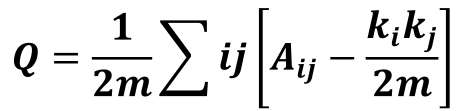
The final phase applies the Louvain Method, a greedy optimization technique that maximizes Modularity (Q). This measures the density of links inside communities versus links between them.
Experimental Results
The authors tested the algorithm using 2,000 mock user profiles based on real-world Facebook "Brand Page" data extracted via the Facebook Graph API.
- Purity Benchmark: The proposed modification reached a 0.72 purity score, significantly higher than the original SAC2's 0.63.
- Persona Mapping: The resulting communities showed high internal consistency with the predefined "test personas" (e.g., young males interested in sports and fashion).
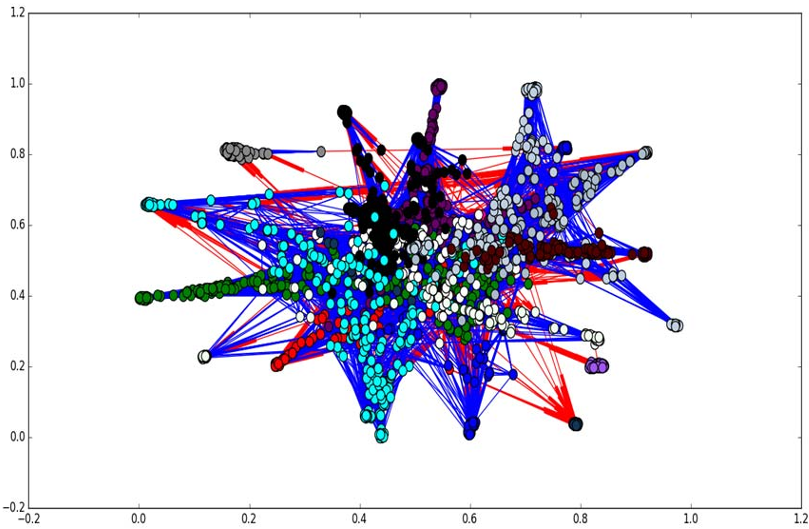 Fig. 1: Visualization of detected communities showing distinct clustering of user personas.
Critical Analysis & Conclusion
The strength of this work lies in its pragmatic approach to the Cold Start problem. By modifying the edge-weighting logic within a k-NN framework before applying Louvain, the authors create a pipeline that is both computationally efficient ( for k-NN and near-linear for Louvain) and context-aware.
Limitations: While effective, the reliance on Euclidean distance assumes that all attributes are continuous or can be meaningfully normalized. In real-word scenarios, categorical attributes (like "Location" or "Relationship Status") might require more complex similarity measures like Gower's distance or Jaccard similarity for better accuracy.
Future Outlook: This methodology paves the way for "Hybrid Recommendation Engines" that can seamlessly transition from attribute-based grouping (for new users) to behavior-based grouping (for veteran users) by dynamically adjusting the weight.