
DualNMF: Purifying Political Communities through Structural Balance and Matrix Factorization
Community detection in political Twitter networks using Nonnegative Matrix Factorization methods
The paper introduces a novel framework for political community detection on Twitter using Nonnegative Matrix Factorization (NMF). By combining endorsement-filtered connectivity graphs with user content (words, hashtags, URLs), the proposed DualNMF method achieves state-of-the-art results, including 88% purity and 75% ARI in clustering partisan users.
TL;DR
Detecting political camps on Twitter is notoriously difficult because "interactions" don't always mean "agreement." This paper solves the problem by using Heider’s Structural Balance Theory to filter out ambiguous interactions and applying a Dual-Regularized Nonnegative Matrix Factorization (DualNMF) approach. The result? A significant jump in clustering purity (up to 88%) and a dramatic reduction in the "over-clustering" effect typically seen in sparse social networks.
The "Noise" in the Network: Why Simple Clustering Fails
Most community detection algorithms (like the Louvain method) rely on a simple assumption: if two people interact, they belong together. On Twitter, this is a dangerous assumption.
- Structural Bonds vs. Sentiment: A "follow" is a long-term bond, while a "mention" might just be a political argument.
- Sparse Data: Twitter connectivity is "Swiss cheese"—it has more holes than substance. Connectivity-only methods often fragment the network into dozens of tiny, meaningless clusters.
- Ambiguity: While a "clean" retweet usually implies endorsement, a retweet with edits or a mention can be a "dunk" or a critique.
Methodology: The "Purification" Process
The authors propose a two-step pipeline to clean the data and then cluster it.
1. Endorsement Filtering (The P-O-X Theory)
Using Heider's triad balance theory, the authors assume that "the friend of my friend is my friend." If User A retweets User B (positive) and User B retweets User C (positive), a mention between A and C is likely also positive.

2. DualNMF Framework
Instead of just looking at who mentions whom, the authors factorize a User-Word matrix. The "Dual" part comes from two regularizers:
- User Connectivity Regularizer: Keeps people who endorse each other in the same cluster.
- Word Similarity Regularizer: Keeps people who use similar vocabulary in the same cluster.
The objective function focuses on minimizing reconstruction error while maintaining these graph-based constraints:
J = ||X - UW^T||^2 + α Tr(U^T Lc U) + β Tr(W^T Lw W)
Experiments: Word Usage is King
The authors tested three content types: Words, Hashtags, and URL Domains. Surprisingly, using all of them (MultiNMF) was less effective than just using keywords (DualNMF). Words provide the most granular signal for political orientation, whereas hashtags are often too "fuzzy" or short-lived.
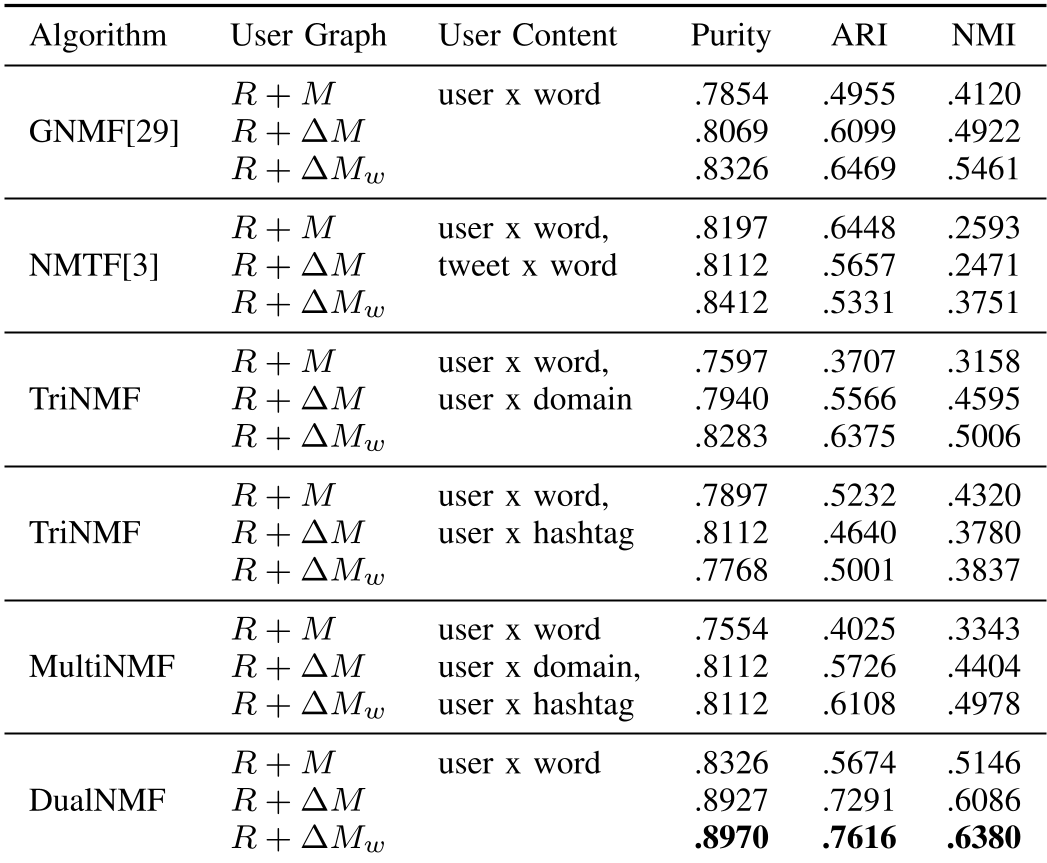
Performance Highlights:
- Purity: Reached ~89.7% in UK datasets.
- Filtering Impact: The filtered graph () improved the Normalized Mutual Information (NMI) by over 100% in many cases compared to the raw graph.
- Comparison: Outperformed the recent NMTF baseline by 8% in purity and nearly 60% in NMI.
Critical Insight & Conclusion
This paper highlights an essential truth in Social Network Analysis (SNA): Information density matters more than information volume. By filtering the graph down to high-confidence endorsements and focusing on linguistic patterns (DualNMF), the model avoids the trap of "over-clustering" sparse networks.
Takeaway for Practitioners: When dealing with adversarial environments (politics, brand wars, etc.), don't treat all edges as equal. Use structural theories to weight your graph before applying NMF or other latent factor models.
Limitations: The model currently relies on pre-defined ground truth (political party lists). Future work could explore how this scales to "organic" movements where ground truth isn't clearly labeled.