
PCSNMF: Enhancing Community Detection with Pairwise Constraints and Symmetry
Community Detection in Social Network with Pairwisely Constrained Symmetric Non-Negative Matrix Factorization
This paper introduces Pairwisely Constrained Symmetric Non-Negative Matrix Factorization (PCSNMF), a semi-supervised community detection method. It combines symmetric NMF for undirected networks with pairwise "must-link" and "cannot-link" constraints from ground-truth data, achieving state-of-the-art Accuracy and Normalized Mutual Information (NMI) on social networks like DBLP and LiveJournal.
TL;DR
Community detection is the cornerstone of social network analysis. This paper presents PCSNMF, a novel framework that bridges the gap between unsupervised network partitioning and full supervision. By utilizing a symmetric matrix factorization approach bolstered by "must-link" and "cannot-link" constraints, the authors achieve higher accuracy and more meaningful sub-community identification than traditional NMF or basic semi-supervised methods.
Background: Why Symmetry and Supervision Matter
In an undirected social network, the relationship between Node A and Node B is identical to that between Node B and Node A. This inherent Symmetry is often lost in standard NMF (), where and are treated as distinct entities. Furthermore, real-world data often comes with "ground-truth" hints—like shared interests or common affiliations—that unsupervised algorithms ignore.
The challenge lies in how to use this knowledge. Prior works like CNMF forced nodes with the same labels to have identical representations, which is often too rigid for the messy reality of social connections.
Methodology: The PCSNMF Approach
The core innovation of PCSNMF is its objective function, which balances reconstruction accuracy with a penalty for violating prior knowledge.
1. The Symmetric Foundation
Instead of two different matrices, PCSNMF seeks a single matrix such that . This ensures the basis space and the coefficient space are the same, inherently respecting the network's undirected nature.
2. Gradual Pairwise Constraints
Instead of forcing labels, the authors introduce a penalty term:
- Must-link (): If two nodes belong to the same community, the penalty increases if their low-dimensional representations are dissimilar.
- Cannot-link (): If nodes are known to be in different communities, the penalty increases if their representations are too close.
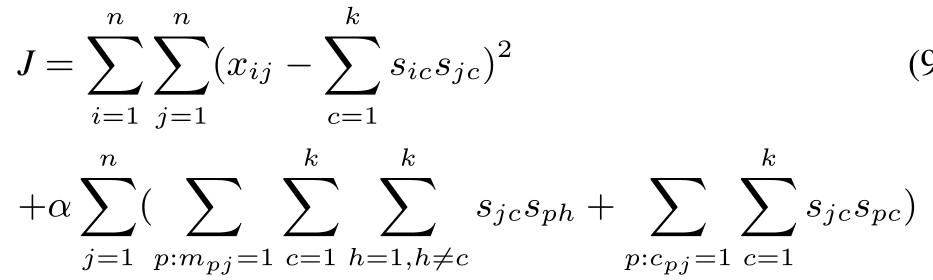
The beauty of this approach is that it is gradual. The algorithm "encourages" the representations to follow the constraints during the iterative update process rather than forcing them at the start.
Experimental Evidence
The authors tested the model on several datasets, ranging from the classic "Karate Club" to massive networks like DBLP (7,783 nodes) and LiveJournal (21,529 nodes).
SOTA Comparison
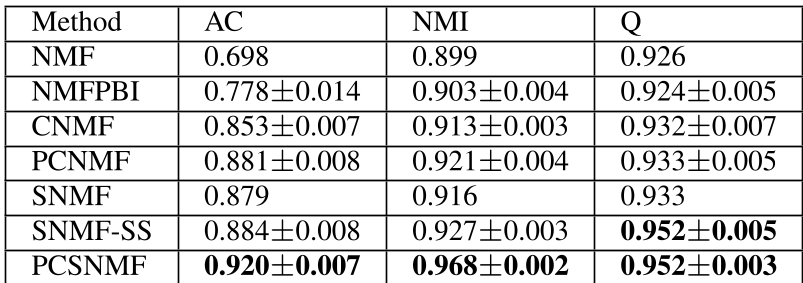
As shown in the results for the LiveJournal network, PCSNMF consistently outperformed both unsupervised methods (NMF, SNMF) and other semi-supervised variants (CNMF, SNMF-SS).
Key Findings:
- Accuracy (AC): PCSNMF reached 0.920, roughly 4% higher than simpler semi-supervised SNMF models.
- Normalized Mutual Information (NMI): At 0.968, the clusters found by PCSNMF are almost perfectly aligned with the ground-truth communities.
Why It Works: Academic Insight
The success of PCSNMF stems from its Inductive Bias. By assuming symmetry, the model reduces the search space by half, which naturally stabilizes the factorization for undirected graphs. By using pairwise constraints as a regularizer (the term) rather than a hard constraint, the model retains enough flexibility to discover communities for the thousands of unlabeled nodes based on the "hints" provided by a small subset of labeled nodes.
Conclusion and Future Outlook
PCSNMF represents a robust step forward in semi-supervised social network mining. By respecting the physical nature of the network (non-negativity and symmetry) and integrating human-level ground truth, it provides a more nuanced view of social structures.
Limitations: The current model assumes non-overlapping communities. However, in real social networks, people often belong to multiple groups (e.g., family, work, and hobbies). Extending PCSNMF to Overlapping Community Detection remains an exciting frontier for future research.