
GA-Net: Revolutionizing Community Detection via Genetic Evolution
Community detection in social networks with genetic algorithms
This paper presents a novel Genetic Algorithm (GA) for community detection in social networks. By optimizing a density-based fitness function and utilizing a graph-based representation, the method automatically determines the number of clusters and identifies groups with high intra-connectivity and low inter-connectivity.
TL;DR
Community detection is a cornerstone of social network analysis, yet defining "community" and finding it algorithmically remains a challenge. This paper introduces GA-Net, a Genetic Algorithm that treats community detection as an optimization problem. By using a clever graph-based encoding and a topology-aware fitness function, it skips the need to pre-define the number of clusters and outperforms classical modularity-based methods like Girvan-Newman on complex benchmarks.
The Challenge: Navigating the Graph Maze
In social networks, communities are informally defined as groups where "everyone knows everyone," but outside connections are rare. Translating this intuition into a computer algorithm usually leads to two headaches:
- The Problem: How do you know how many communities exist without looking?
- The Search Space: For a network with nodes, the number of possible partitions is astronomical (governed by Bell numbers).
Prior works often relied on greedy heuristics or required a fixed . This paper argues that Evolutionary Heuristics can explore this space more intelligently by "evolving" towards the best structural partition.
Methodology: Evolution Meets Topology
The core innovation of GA-Net lies in its data representation and fitness evaluation.
1. Locus-based Adjacency Representation
Instead of a simple list of cluster IDs, the chromosome is an array of genes. If the -th gene has value , it means a link exists between node and node .
- The Benefit: This representation naturally forms connected components. When you decode the chromosome, each component automatically defines a community. The number of communities () is an emergent property, not a fixed input.
2. Specialized Variation Operators
Standard crossover and mutation might break the graph structure. GA-Net uses "Variation Operators" that ensure a node is only linked to its actual neighbors in the physical network, drastically pruning the search space to only include physically possible solutions.

Experiments: The Football Network Test
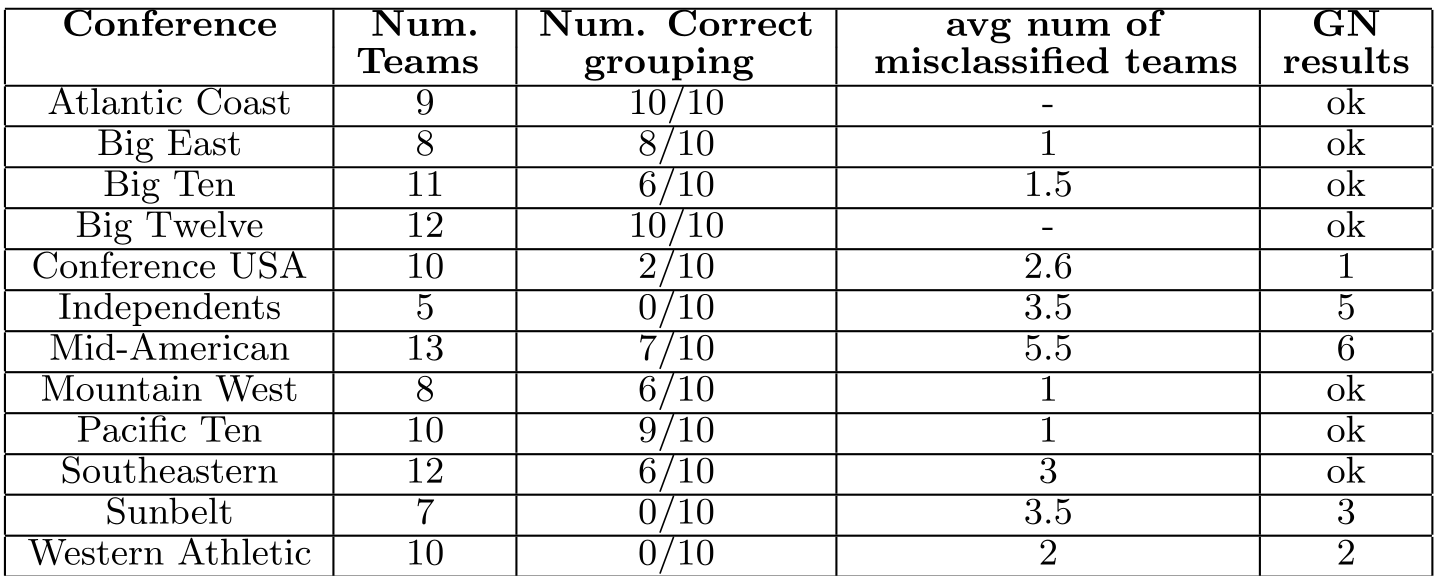
The author tested GA-Net on the American College Football network, a gold-standard benchmark where nodes are teams and edges are games. The ground truth consists of 12 "Conferences."
Key Findings:
- Comparison with Girvan-Newman (GN): For tough conferences like the Mid-American, GA-Net outperformed the industry-standard GN algorithm. GN split this conference in two, while GA-Net correctly identified it in 70% of runs.
- Robustness: Even in failure cases (like the Independents or Sunbelt), the GA-Net results mirrored the limitations of the GN algorithm, suggesting those local structures were topologically ambiguous rather than the algorithm being flawed.
Critical Analysis & Future Outlook
The beauty of the GA-Net approach is its inductive bias. By limiting the genetic operators to search only within the space of existing edges, it turns a generic clustering problem into a topology-aware search.
Limitations:
- Scalability: While GA-Net is efficient for the 115-node football network, Genetic Algorithms traditionally face high computational costs on million-node graphs.
- Sensitivity: The success relies heavily on the fitness function's ability to represent the "quality" of a community.
Future Path: Combining this genetic search with Graph Neural Networks (GNNs) could be the next frontier—using GNNs to learn node embeddings and GAs to find the optimal global partition.
Takeaway
GA-Net proves that you don't need to tell an algorithm how many groups to find if you give it the right "survival of the fittest" criteria based on network density. Its ability to solve the -unknown problem makes it a highly flexible tool for real-world social mining.