
Beyond the Graph: Detecting Topical and Interactive Groups in Social Networks
12609_From community detection to topical, interactive group detection in Online Social Networks.
This paper introduces a socio-semantic framework for detecting coordinated and topically cohesive groups in Online Social Networks (OSNs) across different platforms like Reddit, Twitter, and Discord. The author proposes the Internal Semantic Similarity (Iss) metric, utilizing Doc2Vec embeddings to quantify group thematic focus alongside traditional topological community detection algorithms.
Executive Summary
TL;DR: This research addresses the challenge of identifying coordinated groups in social networks—such as propaganda botnets or activist circles—by combining structural graph analysis with semantic content modeling. By introducing the Internal Semantic Similarity (Iss) metric and testing across Twitter, Reddit, and Discord, the author provides a framework that distinguishes "accidental" clusters from "intentional" interactive groups.
Academic Positioning: This work bridges the gap between pure graph theory (Community Detection) and Natural Language Processing (Topic Modeling). It is a practical methodological contribution that enhances the toolkit for social network analysts monitoring influence operations.
Problem & Motivation: The "Blind Spot" in Community Detection
Most community detection algorithms (like Louvain or Label Propagation) treat social networks as simple mathematical graphs. They look for "clumps" of nodes with many internal connections. However, in the real world, nodes (users) don't just connect; they talk.
Previous works either focused on individuals (influencers) or looked at global topics. The author argues that the group dimension is the real driver of attitudes and propaganda. The pain point is that current tools cannot tell the difference between a group of people who happens to live in the same city (topical but perhaps not interactive) and a coordinated botnet pushing a specific narrative (both topical and highly interactive).
Methodology: The Socio-Semantic Bridge
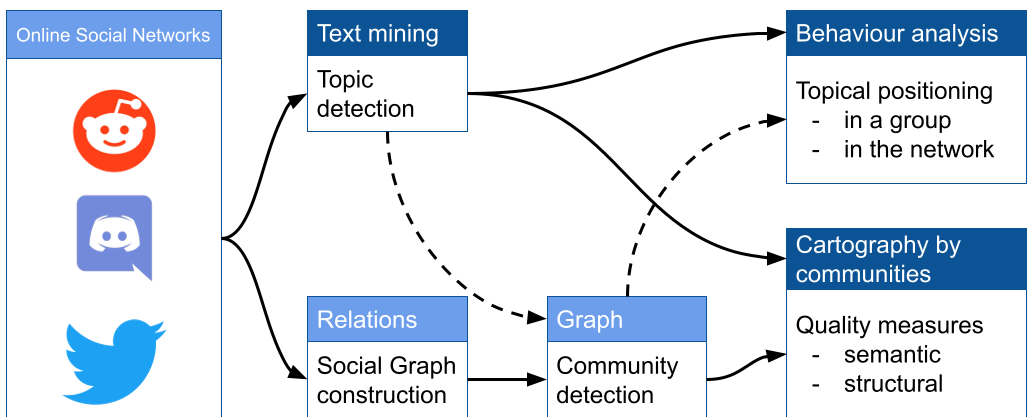
The author proposes a dual-path framework:
- Structural Path: Gathering relations (mentions, comments, replies) into a social graph.
- Semantic Path: Processing text using Doc2Vec embeddings. Unlike traditional LDA which uses discrete labels, Doc2Vec maps messages into a continuous high-dimensional space, allowing for more nuanced similarity calculations.
The Innovation: Internal Semantic Similarity (Iss)
The core contribution is a new metric to measure how "together" a group is in terms of what they say. Using a simplified approach (), the system represents each user by the mean vector of their documents and then calculates the average similarity between all users in a suspected community.
Experiments: Cross-Platform Validation
The framework was tested on three distinct environments:
- Discord: Structured, high-interaction (Chat-based).
- Reddit: Semi-structured (Comment trees).
- Twitter: Open, noisy (Micro-blogging).
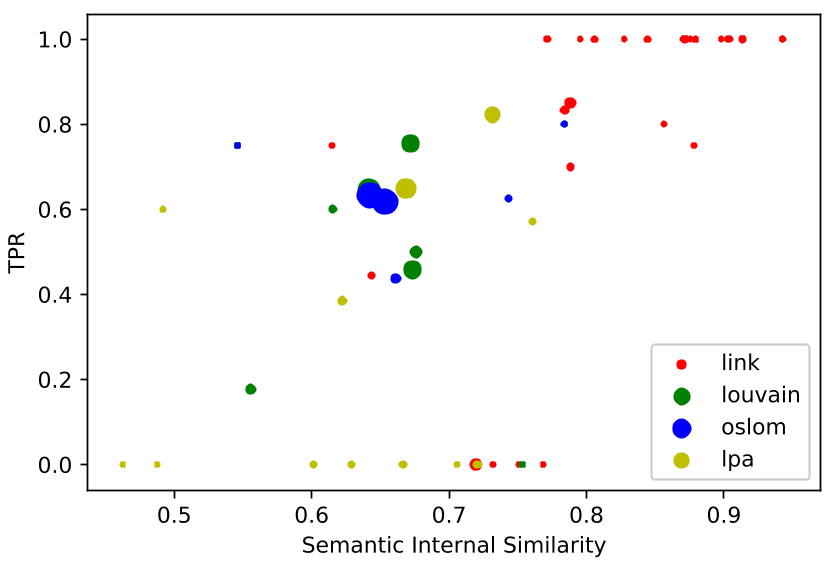
By plotting Semantic Similarity against Triad Participation Ratio (TPR), the author reveals the "DNA" of different groups. For example, "Link" algorithms tend to find small, extremely tight-knit clusters (high TPR, high Iss), while Louvain finds broader, more diverse populations.
Deep Insight: Identifying the "Botnet"
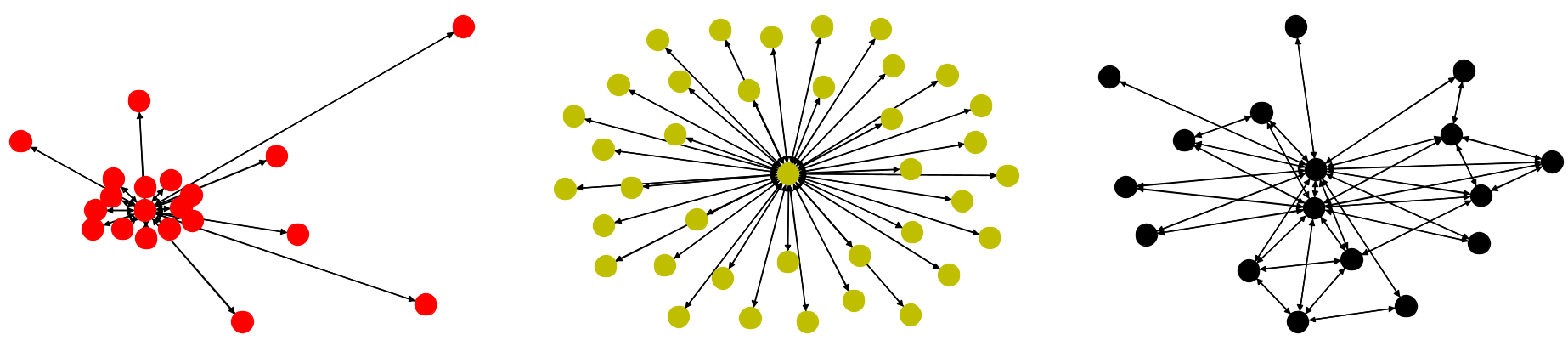
Quality measures come to life in the Twitter case study. The author identified three distinct groups (A, B, and C):
- Group B (The Automated Emitter): High semantic similarity (0.89) but zero TPR. This is a classic "star" pattern where a central node broadcasts and others merely retweet—a hallmark of a simple botnet.
- Group C (The Interactive Group): High similarity and high TPR (0.82). This represents genuine human interaction, such as friends discussing a TV show.
Critical Analysis & Conclusion
Takeaway: The study proves that identifying malicious coordination requires looking at "who talks to whom" AND "what they are saying" simultaneously. The metric is a lightweight yet powerful way to flag groups that are too "perfectly aligned" in their messaging.
Limitations: The data represents a static snapshot. In reality, malicious actors are adaptive. Furthermore, the reliance on reciprocity (mutual links) on Twitter might filter out sophisticated "stealth" accounts that avoid direct interaction yet synchronize their messaging.
Future Outlook: The author suggests that moving toward Graph Embeddings—where text and topology are fused into a single vector space—is the next frontier for automated social network forensics.