
Community Gravity: The Hidden Force Driving Viral Marketing and Social Trust
Community gravity: measuring bidirectional effects by trust and rating on online social networks
The paper introduces "Community Gravity" (CG), a novel metric to quantify the bidirectional interaction between trust and ratings in online social networks. By analyzing massive datasets from @cosme and Epinions, the authors demonstrate how trust facilitates product diffusion while rating similarity simultaneously drives the formation of trust links.
TL;DR
Why do some brands go viral while others, despite having similar visibility, fail to foster a loyal following? This paper introduces Community Gravity (CG), a bidirectional model that proves trust breeds similar ratings, and similar ratings breed trust. By calculating this "attraction force," the authors can predict which online communities will become dense, self-propagating clusters of high-value consumers.
The "Chicken and Egg" Problem of Social Trust
In the world of online shopping, we face a classic bidirectional dilemma:
- Influence (Trust Rating): You trust a friend, so you buy the cosmetic product they recommended and rate it similarly.
- Homophily (Rating Trust): You notice a stranger has the exact same taste in skincare as you, so you begin to trust their future reviews.
Most prior work focuses on one side of this coin. This paper argues that the interaction between the two is what creates a "Gravity" effect, pulling users into tightly-knit community cores.
Methodology: Modeling the Feedback Loop
The authors propose two foundational equations to describe the evolution of a community:
- The Rating Equation: A user's rating is a weighted sum of their original preference and the average ratings of their "Okiniiri" (bookmarked trusted users).
- The Trust Equation: Trust is updated based on the similarity (often Cosine or Jaccard) between two users' historical ratings.
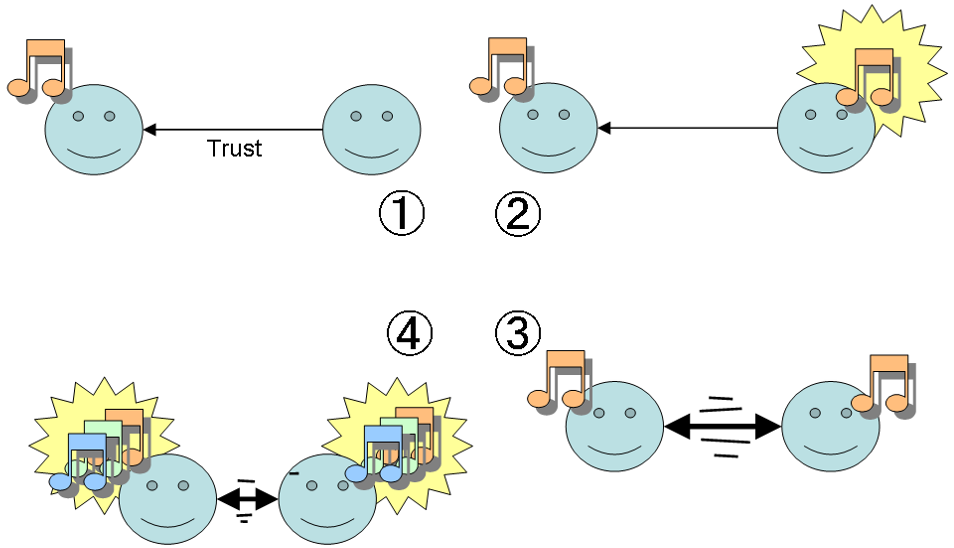
Figure 1: The sequential model showing how trust leads to product adoption, which then reinforces homophily.
By transforming these into a classification task, the authors used SVMs to weigh features such as skin type, brand averages, and network distance. They found that Cosine Similarity of ratings and Transitivity (friends of friends) were the strongest predictors of trust.
Measuring "Gravity"
The core contribution is the Community Gravity (CG) index: Where is the "Trust-to-Rating" sensitivity and is the "Rating-to-Trust" sensitivity.
When this product is high, it indicates a "Strong Gravity Community." In such communities, a single product review can trigger a chain reaction of adoptions.
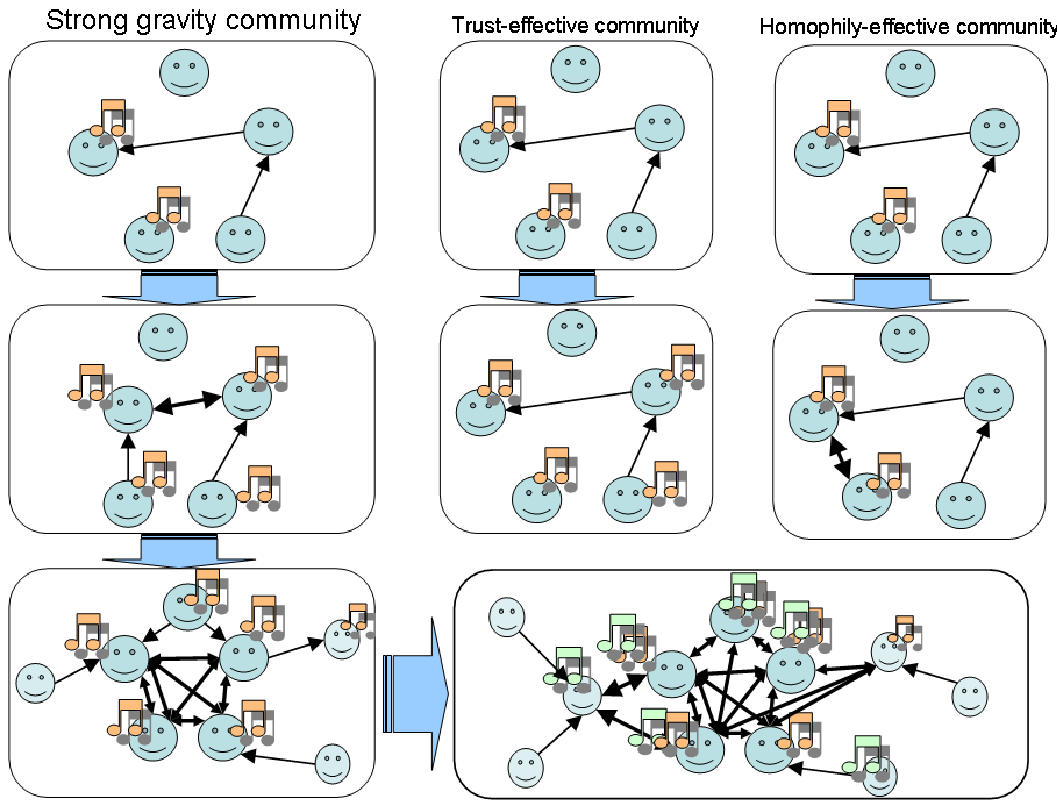
Figure 2: Visualizing a Strong Gravity Community (densely clustered) versus a standard community (sparse/flat).
Experimental Results: The Proof in the Pudding
Using data from @cosme (Japan's largest cosmetics site) and Epinions, the researchers identified that brands like Majolica Majorca and Anna Sui possess the highest CG.
The difference is stark when looking at Propagation Networks:
- High CG Brand: A "core-periphery" structure appears. A central group of enthusiasts tests the product, and it radiates outward through the trust network.
- Low CG Brand: Even if the brand is "popular" (like DHC), the propagation is flat. People buy it, but not because of social trust; thus, no self-sustaining community forms.
| Feature Category | Trust Prediction (F1) | Rating Prediction (F1) |
|---|---|---|
| Profile only | 54.02% | 58.21% |
| Rating + Trust | 81.60% | 86.77% |
Critical Insights & Takeaways
- Transitivity Matters: Trust isn't just about sharing a skin type; it's about the network. If A trusts B and B trusts C, A is highly likely to trust C in these feedback-rich environments.
- Brand as a Medium: High-gravity brands act as "anchors" for social clusters. Marketing shouldn't just target individuals; it should target the "gravity" of the brand community.
- Limitations: The study relies on explicit trust actions (bookmarks). In modern "algorithmic" feeds, trust is often implicit, which might require new ways to calculate the and parameters.
Future Outlook
As E-commerce shifts further toward social commerce (e.g., TikTok Shop, Xiaohongshu), the ability to measure Community Gravity will be the difference between a one-hit-wonder product and a legacy brand. Platforms that encourage "fan" systems rather than just "follower" systems will likely see higher CG and better long-term user retention.