
From Signals to Socializing: Using Control Theory to Map Digital Communities
Community identification in dynamic social networks based on H2 norm analysis: A new approach from control theory
This paper introduces a control-theory-based framework for identifying communities in dynamic social networks, specifically social news sites like Digg. By modeling interpersonal influence as a Linear Time-Invariant (LTI) system, the authors utilize the H2 norm of transfer functions to quantify influence and propose an algorithm to cluster members into "meta-groups" or communities.
Executive Summary
TL;DR: This paper bridges the gap between Control Theory and Social Science by treating social news site interactions (like Digg) as Linear Time-Invariant (LTI) systems. By calculating the H2 norm of transfer functions—a classic control metric—the authors successfully identify "meta-groups" or communities based on how members influence each other's opinions over time.
Background: Within the academic landscape, this work is a fascinating cross-disciplinary "theory application." It moves community detection away from static graph partitioning (like Girvan-Newman) toward a dynamic, system-theoretic analysis of influence.
Problem & Motivation: The Silence of Indirect Influence
Most community detection algorithms ask: "How often do Alice and Bob talk?" But on sites like Digg, Reddit, or Pinterest, Alice might never talk to Bob. Instead, Alice submits a story, and Bob votes on it because he saw it on the front page.
The authors argue that we cannot rely on interaction frequency because we cannot "see" the influence directly. The challenge is to estimate how strongly members are influenced by an issue and each other using only the timestamps of their actions (e.g., the "velocity" of votes).
Methodology: The Social Influence State-Space
The core innovation lies in the modification of the Social Influence Network Theory. The authors model a person's opinion as a value between 0 (uninterested) and 1 (interested). Unlike traditional models where individuals influence each other peer-to-peer (), they propose a Social News Site Model where users are influenced by the aggregate state of the platform.
1. The LTI Model
The development of the number of interested people is modeled as: Where is susceptibility. This looks remarkably like a discrete-time state equation.
2. Measuring Influence with the H2 Norm
To define how "Group M" (people interested in issue M) influences "Group L" (people interested in issue L), the authors derive a Transfer Function . The influence measurement is defined as: In control theory, the H2 norm measures the "energy" of a system's response. Here, it signifies how a "pulse" of interest in one topic propagates to another.
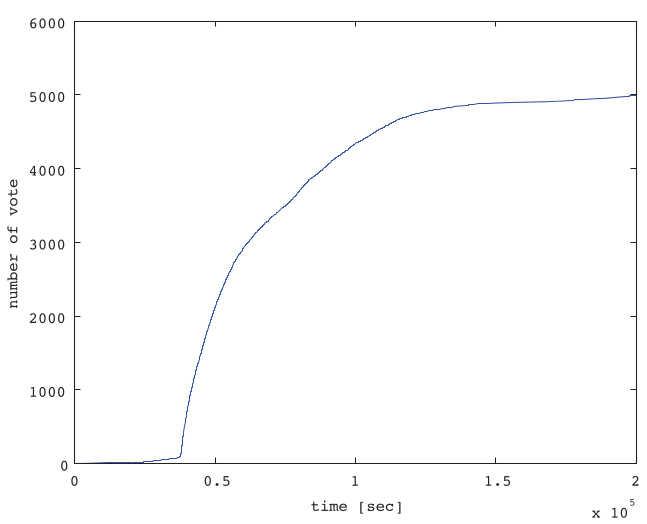 Fig 1: Real-world voting dynamics on Digg, confirming that interest develops in a predictable, linear-like trajectory suitable for LTI modeling.
Experiments & Results: Mapping Digg
The researchers tested their algorithm on 4 weeks of logs from Digg. They specifically looked at stories ranked 41-50 to avoid the "mainstream" bias of top-tier celebrity news.
By building the state-space matrix (which captures susceptibility and cross-influence) and running their Community Identification Algorithm, the results were strikingly accurate:
- Community 1: Politics
- Community 2: Nature / Photo
- Community 3: IT / Technology
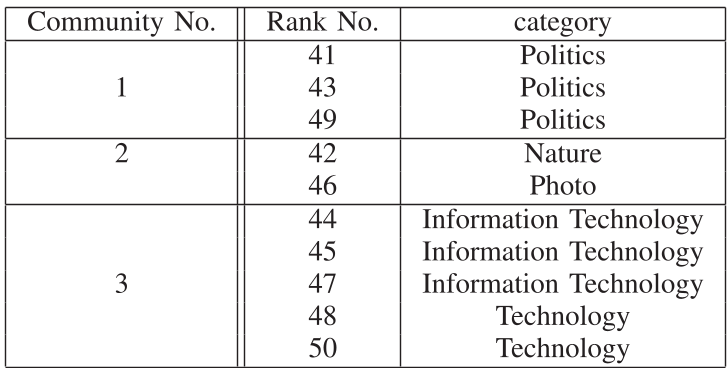 Fig 2: The algorithm correctly clustered disparate stories into logical thematic communities solely based on user voting behavior dynamics.
Critical Analysis & Conclusion
Takeaway
The beauty of this approach is that it does not use keywords or tags. It identifies communities purely based on the dynamic behavior of users. This is incredibly valuable for multimedia platforms (photos, art) where text descriptions are sparse or misleading.
Limitations
- Complexity: Finding the optimal set of "Influence Groups" is a combinatorial max-min problem. As the number of stories increases, the computational cost will skyrocket.
- Linear Assumption: The model assumes LTI (Linear Time-Invariant) behavior. Human interest is often non-linear and bursty, which might require more complex "Switched Systems" or "Non-linear Control" models in the future.
Future Outlook
This paper paves the way for "Control-as-a-Service" in social recommendation. Imagine a feed that doesn't just show you what you like, but understands the transfer function of your interests to broaden your horizons scientifically.