
CommRank: Revolutionizing Social Influence Analysis through Community Structures
Community Influence Analysis Based on Social Network Structures
The paper proposes CommRank, a community-oriented social influence analysis model and algorithm that treats communities as primary units in social networks. By integrating intra-community structural information and inter-community interactions, it achieves state-of-the-art precision in influence ranking and significantly accelerates Influence Maximization (IM) tasks.
TL;DR
While traditional metrics focus on individual "influencers," most social activity is actually clustered within communities. This paper introduces CommRank, an algorithm that models communities as "super nodes." By balancing internal cohesion with external interaction, it identifies influential communities more accurately than PageRank and speeds up Influence Maximization (IM) problems by over 50x-100x.
Problem & Motivation: The Individual Bias
Most Social Network Analysis (SNA) tools treat the network as a flat collection of individuals. Familiar metrics like PageRank, Betweenness, and Closeness are designed to find the "superstar" nodes. However, real-world social networks are inherently modular.
The authors argue that existing methods suffer from two main flaws:
- Neglect of Internal Logic: They ignore how dense internal interactions within a community contribute to its global standing.
- Scalability Bottlenecks: Solving the Influence Maximization problem (finding the top seeds to spread a message) is NP-hard. Doing this globally on millions of nodes is computationally prohibitive.
Methodology: The "Super Node" Approach
The core innovation is the Community Model (CM). Instead of looking at individual edges, the model aggregates them into:
- Inter-community weights (): The strength of connections between Community and .
- Intra-community weights (): The internal activity level, adjusted by a Tuning Factor ().
The Alpha () Factor
The intuition here is brilliant: social activities within a community are frequent but "cheaper." To prevent huge, insular communities from unfairly dominating the influence rankings, the tuning factor acts as a "damping" mechanism. It balances the importance of internal stability against external reach.
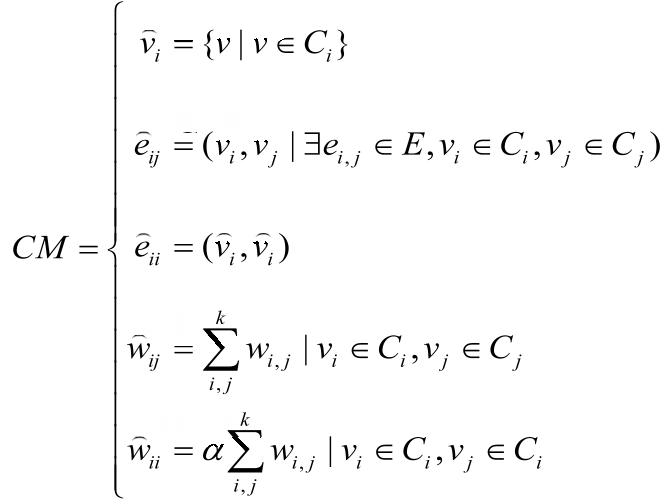
The algorithm then iterates similarly to PageRank but operates on this condensed community graph, making it mathematically elegant and computationally light.
Experiments: Superior Precision and Blazing Speed
The researchers tested CommRank against seven baselines on four datasets (Rugby, Football, Olympics, and an Artificial Benchmark).
1. Ranking Precision
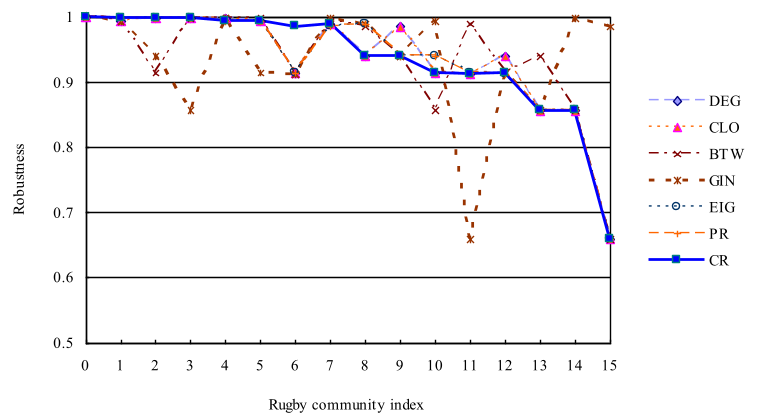
Using Kendall’s Tau coefficient (a measure of ranking correlation) and Network Robustness, CommRank consistently proved more accurate. As shown in the charts, removing high-influence communities identified by CommRank caused the most significant drop in network connectivity, proving these communities are the true "backbones" of the network.
2. Influence Maximization (The "100x" Speedup)
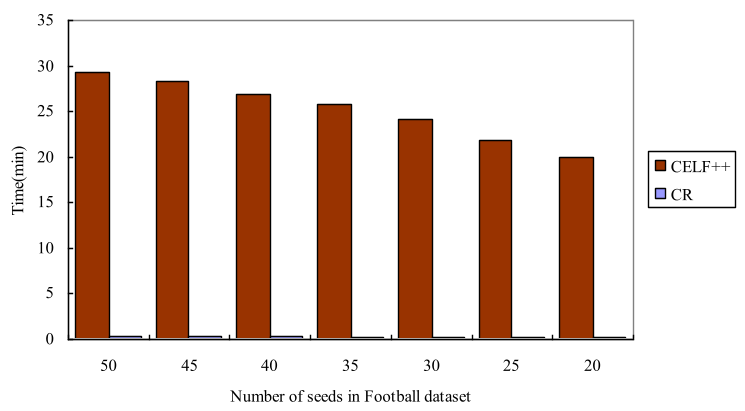
Perhaps the most practical result is the approximation algorithm for IM. By selecting seeds from influential communities identified by CommRank, the authors avoided the global greedy search.
- Efficiency: On the Benchmark dataset, the traditional CELF++ algorithm took 631.18 minutes. CommRank-based selection took only 12.58 minutes.
- Effectiveness: Despite the speedup, the "influence gain" (how many people the message reached) remained nearly identical (608.9 vs 629.3).
Critical Insight & Conclusion
The genius of CommRank lies in its structural abstraction. By moving from a "node-centric" to a "community-centric" view, we don't just get a faster algorithm; we get a more realistic representation of human society.
Takeaway for Practitioners: If you are running a viral marketing campaign, don't just look for the user with the most followers. Look for the community with the highest CommRank—the internal density and external bridges of that group will propagate your message far more efficiently.
Current Limitations: The model currently assumes community partitions are static and pre-known. Future work integrating dynamic community detection with influence ranking would be the "holy grail" for real-time social media monitoring.