
Beyond the 'Like': Decoding the Socio-Cognitive Drivers of Brand Page Engagement
Community Management on Social Networking Sites: Why and How Stakeholders Use Corporate Facebook Pages
This study investigates stakeholder engagement on corporate Facebook brand pages by integrating Uses-and-Gratifications (U&G) with Social Cognitive Theory (SCT). Using an online survey (N=215), it identifies distinct incentive dimensions—Activity, Novel, Monetary, Status, and Self-reactive—that drive different levels of user interaction: consumption, participation, and production.
TL;DR
Why do we follow brands on Facebook? Is it for the coupons, the news, or simply to show off our lifestyle? This study bridges communication theory and social psychology to reveal that our behavior on corporate pages is a complex ladder of incentives. While most users remain passive "consumers" seeking entertainment, "active" engagement is a calculated move driven by status-seeking and the practical need for instant information.
Background: The Gap in Community Management
In the Web 2.0 era, corporate Facebook pages have become the digital "front porch" for organizations. However, simply building a page doesn't guarantee a community. The authors argue that previous PR and marketing research treated users as a monolithic block. By applying Uses-and-Gratifications (U&G) alongside Social Cognitive Theory (SCT), the researchers uncover the "Why" behind the "Like," shifting the focus from media attendance to goal-oriented behavior.
The Interaction Continuum: Consume, Participate, Produce
The study adopts Shao's (2009) typology to categorize human-brand interaction:
- Consumption: Reading posts, watching videos (Low interaction).
- Participation: "Liking" or sharing (Medium interaction).
- Production: Commenting, providing feedback, or direct messaging (High interaction).
Methodology: Mapping Incentives to Behavior
The researchers conducted an online survey of 215 Facebook users in Switzerland. They used Exploratory Factor Analysis (EFA) to group 36 different motives into the incentive dimensions defined by Bandura’s SCT.
1. Consumption: The Seekers of Fun and Facts
For users who just browse, three factors emerged:
- Activity Incentives: Entertainment and passing time.
- Self-reactive Novel Incentives: Seeking "unique" information to form an opinion.
- Monetary Incentives: The hunt for vouchers and discounts.
2. Participation: Managing the Digital Self
When a user hits the "Like" button, the motivation shifts significantly toward Status Incentives.
- Identity Signaling: Users "Like" brands to convey a specific image of themselves to their peers (e.g., "I use this high-end lifestyle brand").
- Practical Novelty: Using the Facebook News Feed as a lazy but efficient way to stay updated without searching.
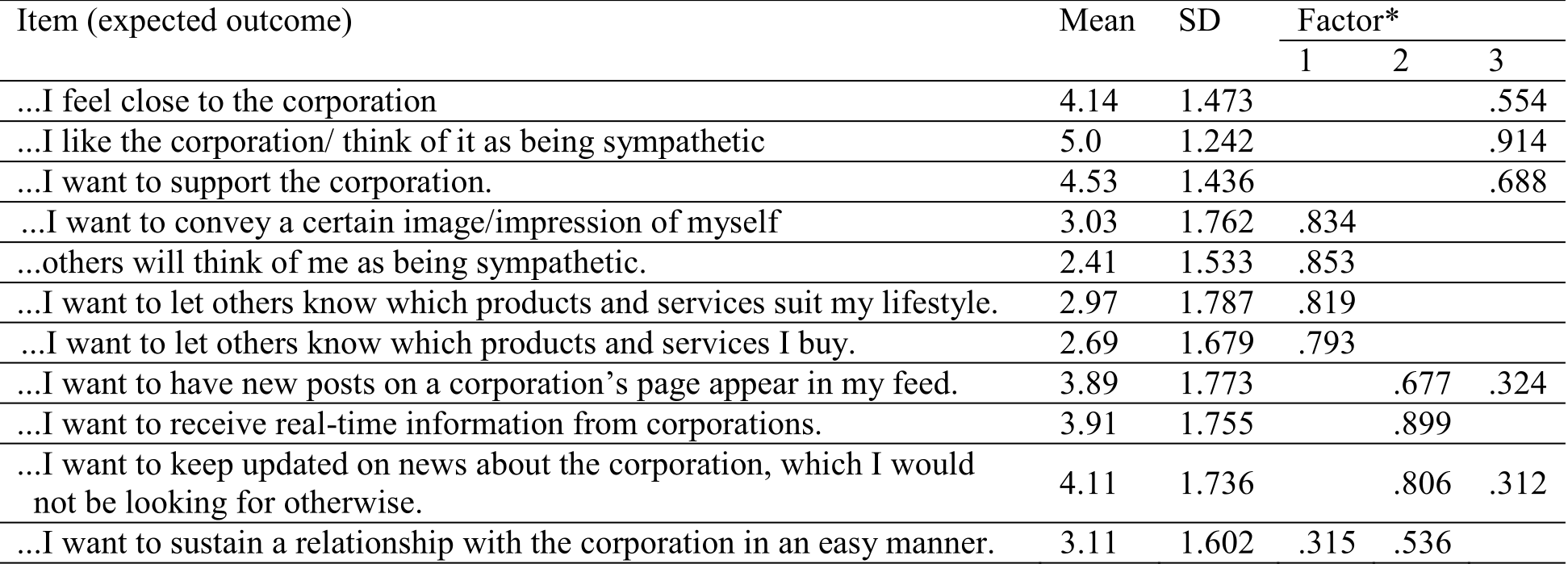 Note: Table 2 shows high factor loadings for image management (Status) and real-time information (Practical Novelty).
3. Production: The Rare Voice
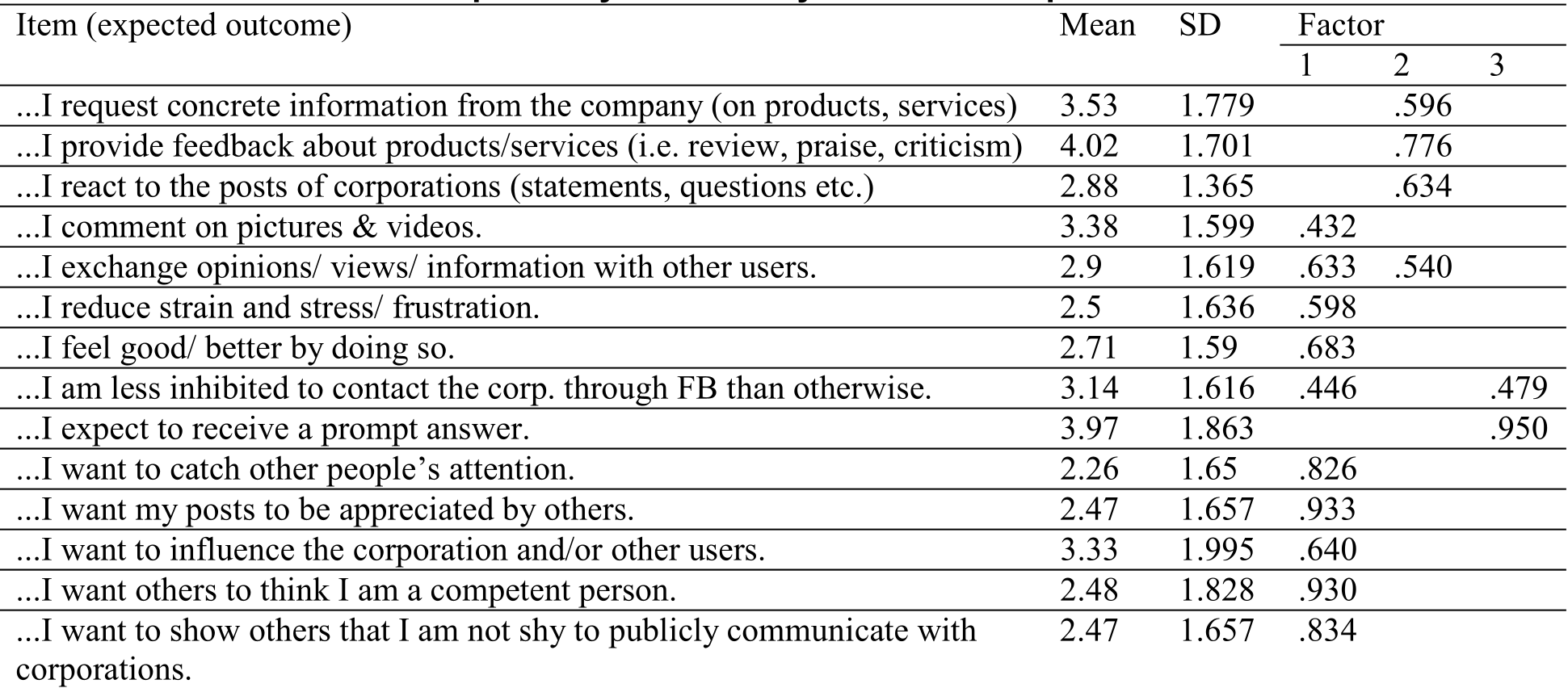
Only ~27% of the sample produced content. This group is driven by:
- Social Incentives: Exchanging views with others.
- Responsiveness: A critical finding was the high loading (0.95) for "expecting a prompt answer." Users treat comments as a faster alternative to email or phone calls.
Critical Insight: The "Interwoven" Dimensions
One of the most profound academic contributions of this paper is the discovery that brand page incentives are intertwined. For example, "Self-reactive" motives (emotional regulation) often merge with "Novelty" (information seeking). This suggests that users don't just want facts; they want the reassurance or emotional satisfaction that comes from being informed about a brand they support.
Managerial Implications
- For Content Creators: Since consumption is driven by "Activity," stop posting dry corporate PR. Use fun, interactive media (videos, quizzes) to sustain the "lurkers."
- For Brand Managers: Recognize that "Likes" are a form of social currency. If your brand doesn't have a positive reputation, users won't "Like" it because it doesn’t help their "Status Incentives."
- For Customer Service: If you provide a space for "Production," you must be fast. The primary incentive for posting is the expectation of a near-instant response.
Conclusion and Limitations
The study successfully validates SCT as a superior framework for understanding SNS behavior. However, the sample was relatively small and geographically limited to Switzerland. Future shifts toward AI-driven feeds (like TikTok) may change these dynamics, as "Consumption" becomes even more passive while "Participation" becomes more algorithmic.
Takeaway: Community management isn't just about "posting content"; it's about managing a delicate ecosystem of social status, entertainment, and practical utility.