
Micrograph: Architecting the Future of Spontaneous Social Communities
Community Membership Management for Transient Social Networks
The paper introduces Micrograph, a middleware designed for managing Transient Social Networks (TSNs). It enables the autonomic formation and membership management of encounter-based mobile communities using a hierarchical social graph model, achieving scalable peer-to-peer coordination on Android devices.
TL;DR
Researchers at Georgia Tech have developed Micrograph, a middleware that solves the "membership problem" for Transient Social Networks (TSNs). Unlike Facebook, which relies on long-term relationships and central servers, Micrograph allows mobile devices to form spontaneous, decentralized communities based on local interest and physical proximity (e.g., flea markets or emergency responses), scaling efficiently to thousands of nodes with minimal overhead.
The "Transient" Gap in Social Networking
Current social platforms are fundamentally "sticky" and centralized. They assume you want to maintain a permanent digital identity and that you have reliable internet access. However, real-world social interactions are often ephemeral:
- Spatial & Temporal Locality: You only care about the people in the same auction or stadium right now.
- Encounter-based: You may not know the participants beforehand.
- Resource Constraints: Mobile devices have limited battery and fluctuating connectivity.
Existing opportunistic networks (like Haggle or MobiClique) are great at passing messages but terrible at answering a simple question: "Who exactly is in my group right now?" This lack of consistent membership state prevents complex collaborative applications.
Methodology: The Three-Tiered Social Model
To handle the chaos of moving nodes and heterogeneous hardware, Micrograph abstracts the network into three distinct layers:
- Data Connectivity Network (DCN): The physical layer of all reachable devices (Wi-Fi, Bluetooth, Cellular).
- Feasible Overlay Graph (FOG): A filtered set of nodes that meet "health" criteria, such as battery life, safe distance (upper bound on physical distance), and stability.
- Transient Social Network (TSN): The application-specific view where users are grouped by specific interests (e.g., "Car Bidders" vs. "Sellers").
The Hierarchical Role System
Micrograph avoids the bottleneck of a single central node by using a dynamic role-based architecture:
- Coordinator: The "brain" of an FOG, managing overall evolution and merging of graphs.
- Managers: Sub-leads that maintain state for a subset of nodes (FOGsub), ensuring the workload doesn't overwhelm a single device.
- Members: Ordinary nodes that report status and receive membership updates.
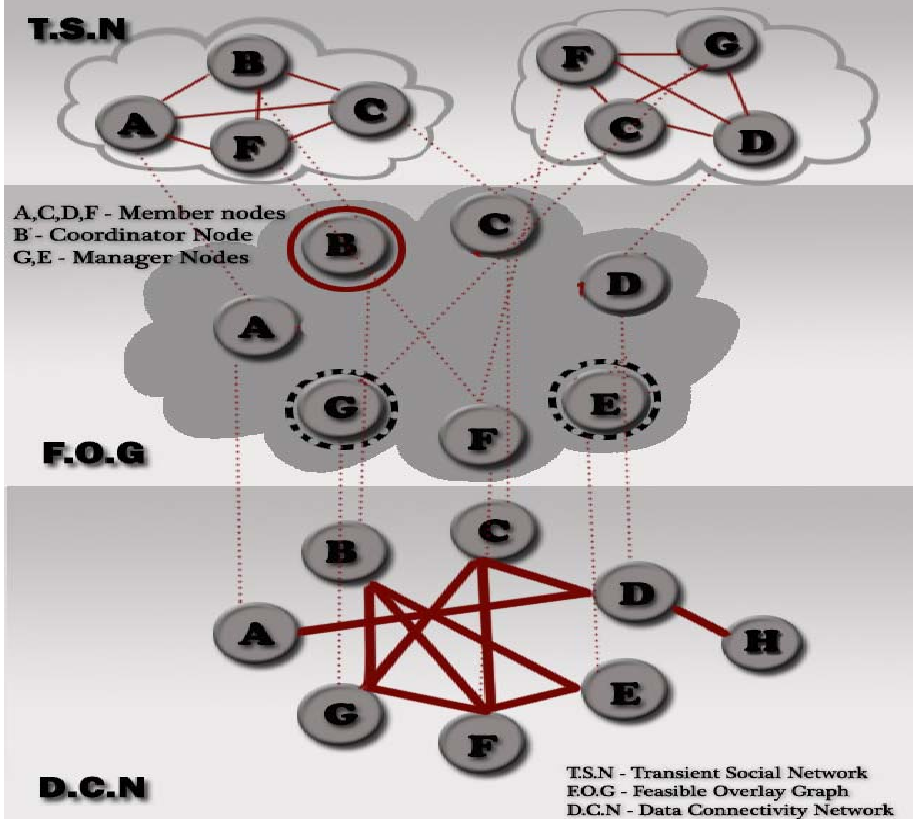 Figure 1: The hierarchical organization from physical connectivity to distinct social overlays.
Experimental Validation: Scalability and Churn
The authors implemented Micrograph on Android and tested it through extensive simulations. Two key metrics stand out:
1. Rapid Stabilization
In a "churn" test where 25% of the nodes were suddenly disconnected and then readmitted, Micrograph’s membership list stabilized in under 30 seconds. This is critical for environments like emergency responses where the network topology changes every time a volunteer rounds a corner.
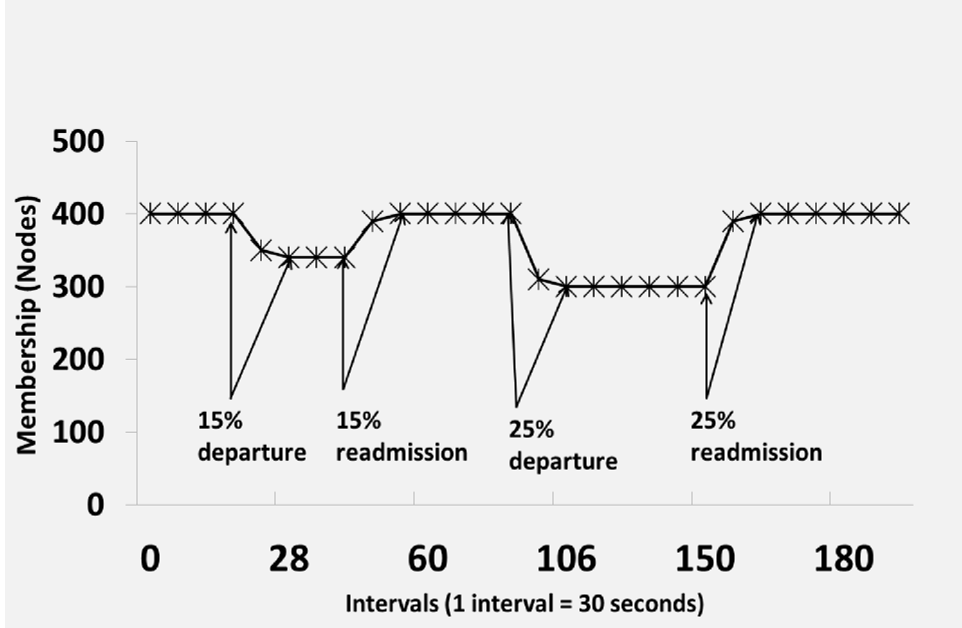 Figure 2: FOG membership evolution during massive node departure and reentry.
2. Linear Resource Overhead
A frequent failure of decentralized systems is "broadcast storms." Micrograph avoids this; both the admission delay and the bandwidth overhead grow linearly with the number of nodes. This means a community can grow from 100 to 5,000 members without the system collapsing under its own management traffic.
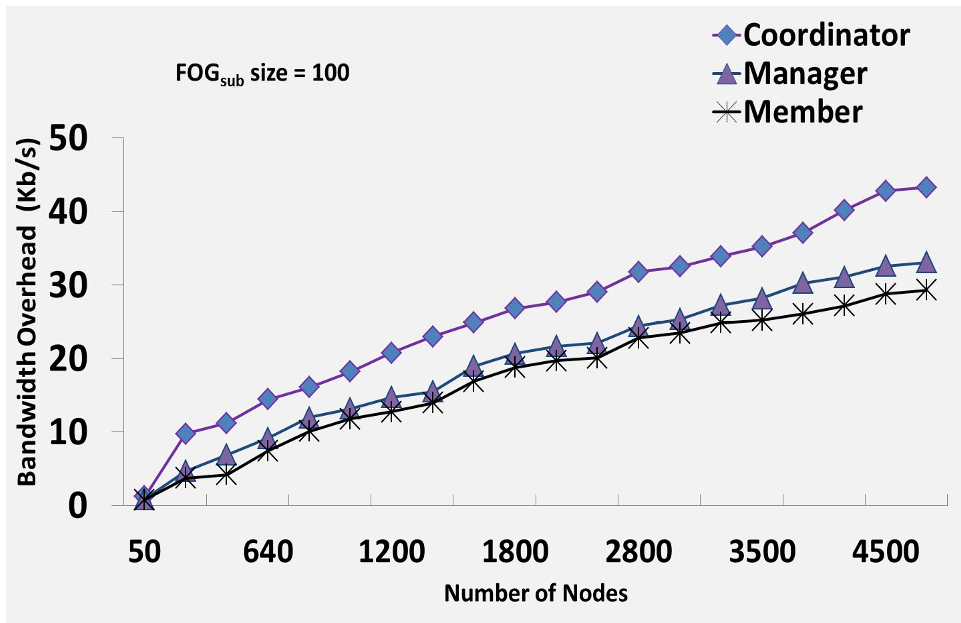 Figure 3: Bandwidth overhead remains manageable even as the network scales to thousands of participants.
Critical Insight & Practical Value
The brilliance of Micrograph lies in its Autonomic Management. It doesn't just connect phones; it manages the lifecycle of the community. If a group gets too large, it can split; if two groups with the same interests meet, they can merge—all without user intervention.
Why it matters: As we move toward a world of "Edge Computing" and IoT, we need ways for devices to collaborate without "phoning home" to a cloud server. Micrograph provides the blueprint for these "dark" social networks—networks that exist only for the duration of a specific event, protecting privacy through isolation and reducing the load on global cellular infrastructure.
Conclusion & Future Work
Micrograph successfully demonstrates that consistent group membership is possible in highly dynamic mobile environments. While the current work focuses on membership, the next frontier—as the authors note—is implementing Trust Models. In a network of strangers, how do you know the person bidding on your car is legitimate? Solving the "identity" problem in a "transient" world will be the final piece of the puzzle for decentralized social tech.