
Linking the Dots: An IoT Multi-Device Association Model for Smart Communities
Research and Application of Community Population Information Association Model Based on IoT Multi-device Mining
The paper introduces a community population information association model that leverages IoT multi-device data (WIFI, 4G micro-hotspots, and cameras). By utilizing an improved FP-Growth algorithm, the system identifies relationships between diverse data types like IMSI, MAC addresses, Face IDs, and License Plates to enhance urban management.
TL;DR
With the rise of the Internet of Things (IoT), urban areas are flooded with data, but connecting different "digital footprints"—like a phone’s MAC address to a car's license plate—remains a challenge. This paper presents a specialized association model using an improved FP-Growth algorithm to link multi-source IoT data (WIFI, 4G, Cameras) efficiently. By optimizing frequent pattern mining, the authors achieve high-speed data correlation that outperforms traditional methods like Apriori.
Background & Motivation: Beyond Manual Counting
In modern urban management, knowing "who is where" is critical for public safety. However, population data is no longer just a spreadsheet; it is a chaotic stream of IMSI numbers from mobile hotspots, MAC addresses from WIFI probes, and face/license plate IDs from cameras.
The core problem is data silos and computational complexity. Existing methods to find associations (e.g., "This device usually appears with this face") are often too slow. The classic Apriori algorithm, while foundational, is notoriously memory-hungry because it scans the database repeatedly and generates too many "candidates."
Methodology: High-Speed Mining with Improved FP-Growth
The researchers chose the FP-Growth (Frequent Pattern Growth) algorithm as their foundation because it compresses the database into a tree structure (FP-tree), avoiding expensive scans.
1. Data Fusion Pipeline
The system collects data from four primary sources:
- WIFI Probes: Terminal MAC addresses.
- 4G Micro-hotspots: IMSI and IMEI data.
- Smart Cameras: Structured Face IDs and License Plate characters.
2. The Improved Algorithm
The "Improvement" lies in how the model handles the specific constraints of population association:
- Binomial Mining: Unlike standard mining that finds large sets of co-occurring items, this model focuses on pairs (e.g., IMSI ↔ Face ID) to establish direct identity links.
- Confidence Calculation: They imported the confidence logic from Apriori into the FP-tree context to calculate the strength of the link ().
- Uniqueness Rule: To ensure accuracy, if an IMSI is associated with two different MAC addresses, the system applies a filter to choose the one with the highest confidence or discards ambiguous links.
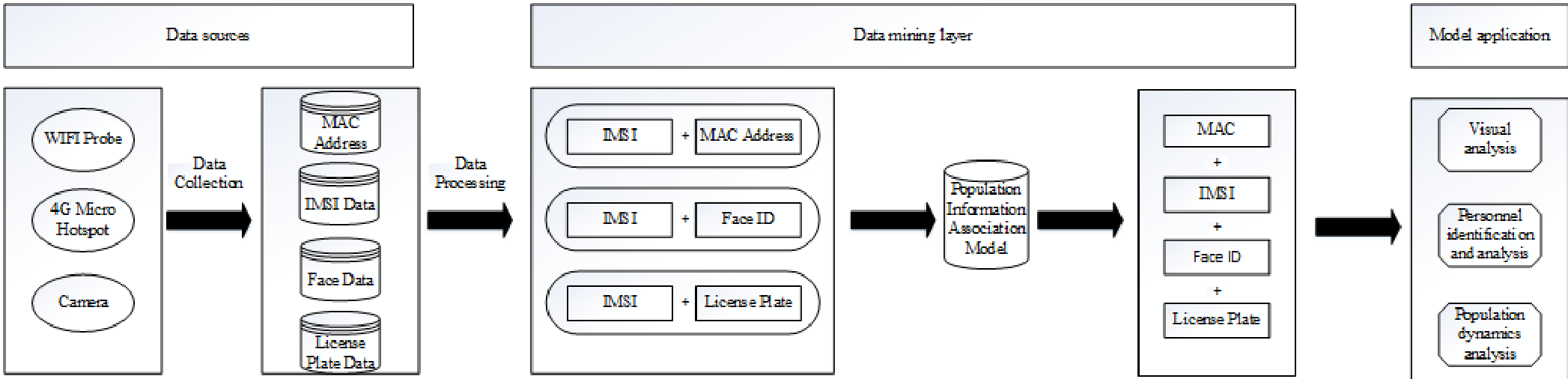 Figure 1: The proposed Population Information Association Model Framework
Experimental Results: Performance That Scales
The team deployed their system at a community gate in Wuxi, China. The most striking result was the runtime efficiency.
- Scalability: While the Apriori algorithm's runtime exploded as data grew, the improved FP-Growth model maintained a nearly linear growth curve.
- Reliability: By simulating "pre-arranged" individuals (known ground truth), the authors verified that as the IoT device "leakage rate" (missed detections) decreases, the association confidence scores increase significantly.
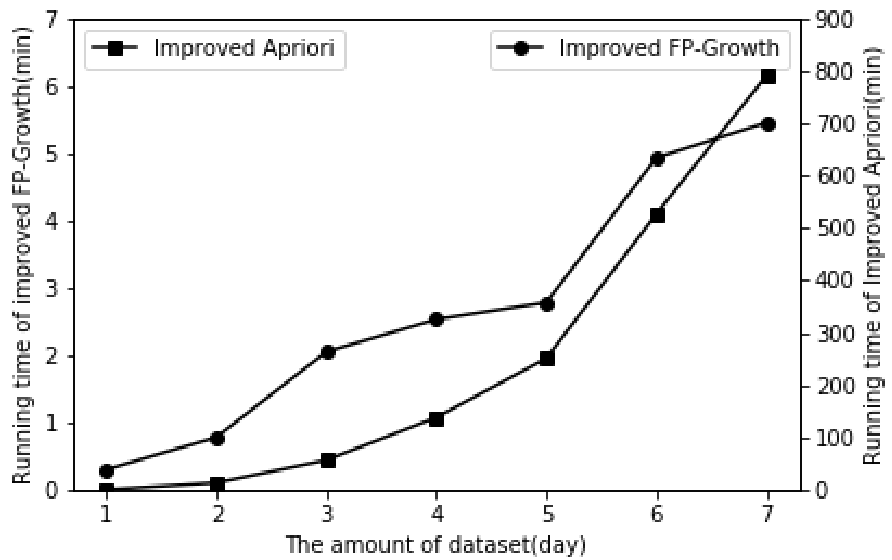 Figure 2: Runtime performance comparison—Improved FP-Growth vs. Apriori
Critical Insight & Future Outlook
The beauty of this approach is its inductive bias toward binomial pairs. By recognizing that population association is essentially a matching problem between two IDs, the authors stripped away the unnecessary complexity of the general FP-Growth algorithm.
Limitations: The model heavily relies on the physical deployment of hardware. If a "micro-hotspot" fails to capture an IMSI, the entire association chain for that person breaks. Future work could benefit from Temporal Smoothing, using historical data to "fill in the blanks" when a sensor misses a detection.
Conclusion
This study bridges the gap between raw IoT sensing and actionable intelligence. For public security and smart city governance, the ability to correlate disparate data points in near real-time is a significant step toward automated, reliable community management.