
Evolutionary vs. Memetic: Decoding Community Structures in Signed Social Networks
A comparative analysis of evolutionary and memetic algorithms for community detection from signed social networks
This paper presents a comparative study of two Evolutionary Algorithms (EA-SN, CSA-SN) and two Memetic Algorithms (EAHC-SN, CSAHC-SN) designed for community detection in signed social networks. The authors introduce improved versions of Modularity () and Modularity Density (-value) to handle negative links, achieving superior community partitioning across benchmark and large-scale synthetic networks.
TL;DR
Detecting "who belongs with whom" in a world of both friends and enemies is a computationally hard task. This paper introduces a robust framework using Memetic Algorithms (MAs)—evolutionary search paired with local refinements—to optimize improved metrics for signed networks. The results prove that while standard Modularity is popular, Modularity Density (-value) is the key to uncovering both large and small communities without losing resolution.
Background: The Problem of "Negative" Influence
Most community detection algorithms treat social links as purely positive. However, real-world networks are Signed Networks (SNs): they contain positive edges (+) for trust and negative edges (-) for distrust.
The challenge is twofold:
- Mathematical: Traditional Modularity () doesn't "understand" negative links.
- Structural: The "Resolution Limit" prevents standard algorithms from seeing small, tight-knit groups in the shadow of massive ones.
Methodology: Evolution Meets Local Intelligence
The authors propose four algorithms, but the stars are the Memetic Algorithms (EAHC-SN and CSAHC-SN).
1. The Power of Memetics
An Evolutionary Algorithm (EA) provides a global view, but it can be slow and "blind" to local optima. By integrating a Hill-Climbing (HC) strategy, the algorithm performs a local search after every mutation:
- Global Search: Explores the vast space of possible partitions.
- Local Search (HC): Takes a node and tests if moving it to a neighboring community improves the overall "happiness" (fitness) of the partition.
2. Multi-Resolution via D-Value
The paper extends the Modularity Density (-value). Unlike standard , the -value uses a tunable parameter . By adjusting , researchers can "zoom in" to find tiny cliques or "zoom out" to see the macro-structure of the network.
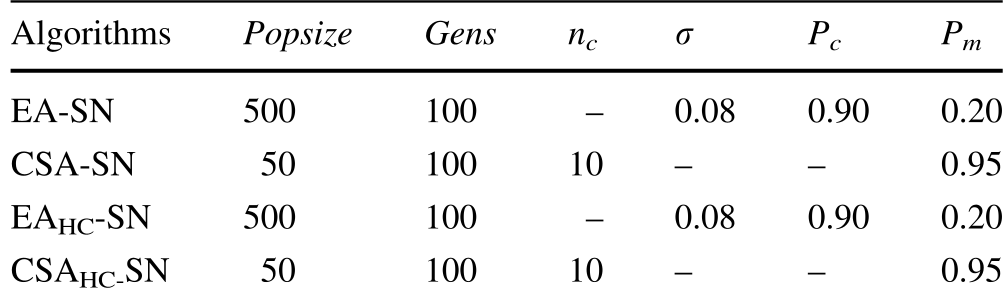 Table 2: Control parameters for the proposed EA and MA variants.
Experiments & Results
The authors tested their methods on legendary benchmarks: the Slovene Parliamentary Party and the Gahuku-Gama Subtribes.
Efficiency Gains
The inclusion of Hill-Climbing made a massive difference. In terms of generations required to reach the optimal partition:
- Standard EA: ~22 generations.
- Memetic EA (EAHC): ~13 generations.
- Clonal Selection MA (CSAHC): ~2-4 generations.
Overcoming the Resolution Limit
In large-scale test networks (1,000+ nodes), the improved Modularity () consistently missed smaller communities, merging them into larger ones. However, the -value optimization correctly identified the true number of communities (e.g., finding exactly 15 communities where only found 5-7).
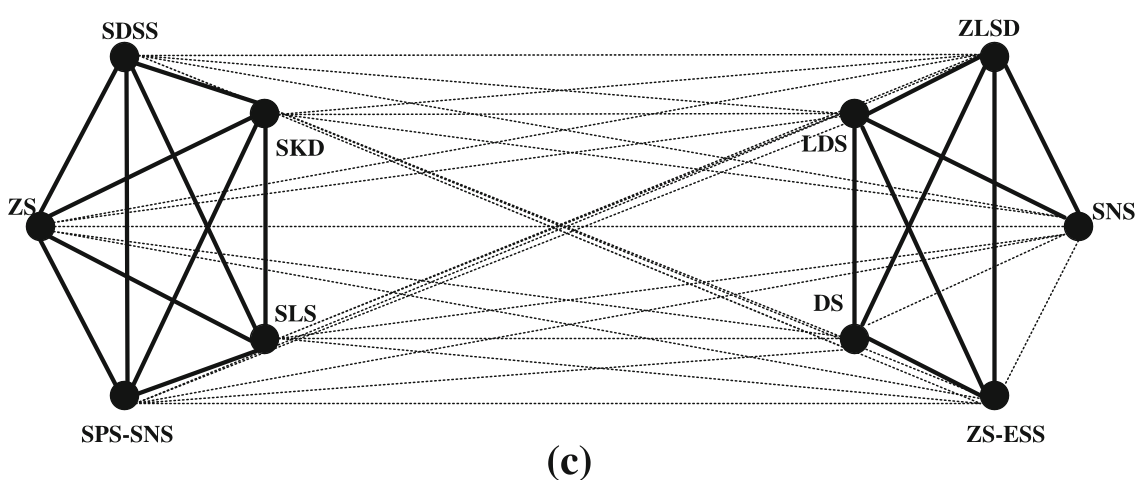 Figure 3: The Slovene Parliamentary Party network structure, showing clear clusters of political alliances.
Critical Insight & Conclusion
The true value of this work lies in the synergy between the objective function and the search heuristic.
- Takeaway 1: If you are dealing with a large-scale social network, don't use standard Modularity; you will likely miss the "small-scale" nuances of the group.
- Takeaway 2: Pure evolutionary approaches are too slow for real-time application. The "Memetic" hybrid—adding a simple local hill-climb—provides a near-instant boost in both speed and solution quality.
While the paper focuses on social networks, this approach has massive potential in biological protein-interaction networks or financial market correlation graphs where "negative" relationships (antagonism) are just as important as positive ones.