
Beyond Logic: Maximizing Marketing ROI with Fuzzy Target Selection
A comparative study of fuzzy target selection methods in direct marketing
This paper presents a comparative study of various fuzzy modeling techniques for target selection in direct marketing, specifically applied to charity donation data. Using Recency, Frequency, and Monetary (RFM) variables, the authors evaluate algorithms like Fuzzy C-Means (FCM), Gustafson-Kessel (GK), and Takagi-Sugeno (TS) models against traditional Logistic Regression.
TL;DR
In the world of direct marketing, "Who to mail?" is a million-dollar question. This study demonstrates that Takagi-Sugeno (TS) fuzzy models outperform traditional Logistic Regression and complex clustering (like Gustafson-Kessel) when identifying high-value charity donors. By leveraging RFM (Recency, Frequency, Monetary) variables, the authors prove that fuzzy models capture the nuances of human behavior better than "crisp" statistical boundaries, specifically in the 10%-40% mailing region where marketing budgets are typically allocated.
The "Precision vs. Interpretation" Dilemma
Direct marketing is a high-stakes filtering task. If you mail everyone, you waste money; if you mail too few, you miss potential revenue. Historically, marketers relied on:
- Statistical Regression: Stable, but often too rigid for non-linear behaviors.
- Decision Trees: Easy to read, but prone to overfitting.
- Neural Networks: Highly accurate, but complete "black boxes."
The authors argue that Fuzzy Modeling provides the perfect middle ground: the mathematical rigor to handle high-dimensional patterns and the linguistic transparency to tell a marketer why a customer was chosen.
Methodology: The Power of Fuzzy Clustering
The core of the paper lies in comparing how we group customers. Instead of saying a donor is "Active" or "Inactive," fuzzy logic says they are "80% Active" and "20% Inactive."
The RFM Framework
The researchers use three essential features:
- TIMELR: Weeks since the last response (Recency).
- TIMECL: Total months as a supporter (Loyalty).
- FRQRES: Fraction of mailings responded to (Frequency).
From Clusters to Scores
The authors test several architectures, but the Takagi-Sugeno (TS) model is the standout. They first cluster the data in high-dimensional space using Fuzzy C-Means (FCM). Then, they project these clusters onto individual variables to create "Rules."
- Rule Example: IF Recency is LOW and Frequency is HIGH, THEN Response Probability is 0.85.
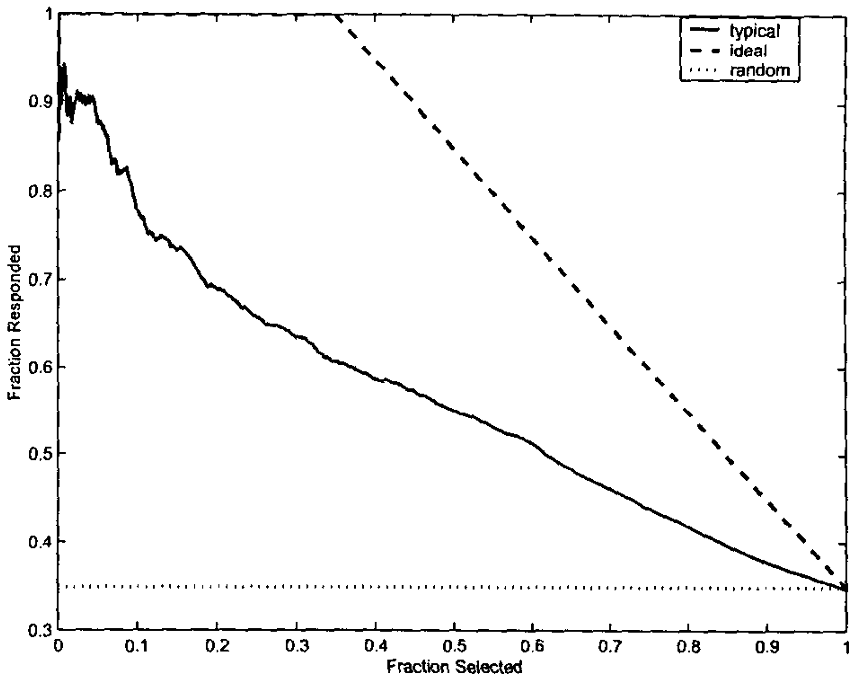 Fig 1: The Hit Probability Chart—the gold standard for measuring how much faster a model finds "hits" (donors) compared to random guessing.
Battle of the Algorithms: Experimental Results
The team used a 10-fold cross-validation technique on a database of 4,000 supporters. The results were telling:
- FCM vs. GK: The Fuzzy C-Means (FCM) algorithm (which looks for spherical clusters) unexpectedly outperformed the Gustafson-Kessel (GK) algorithm (which looks for ellipsoids). In the marketing context, simple spherical groupings were more robust.
- The TS Edge: The Takagi-Sugeno models (Item 4 & 5 in the paper) showed a significant performance boost in the 20% to 50% mailing deciles.
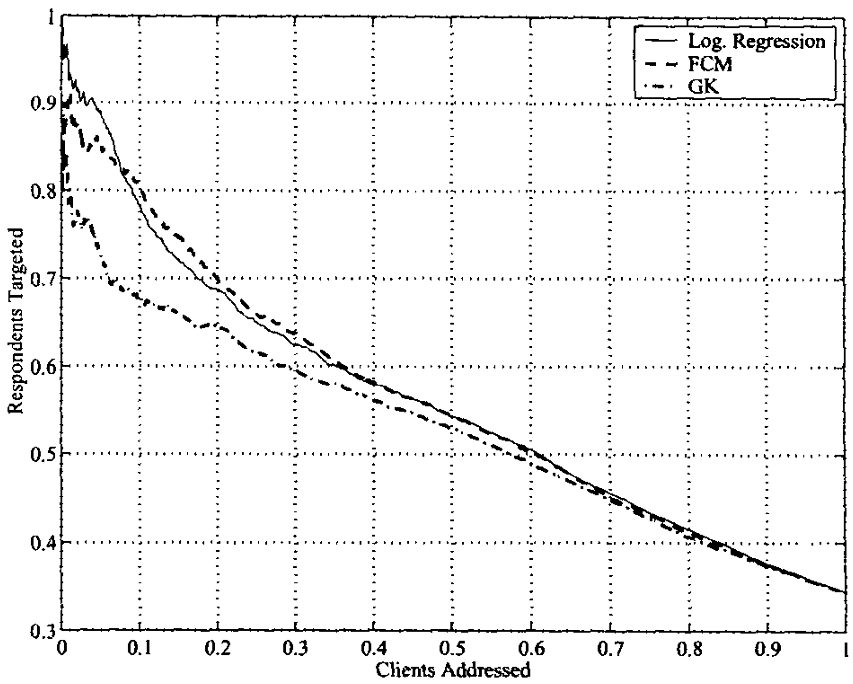 Fig 2: Mean performance of FCM vs. GK. Note how FCM (the best fuzzy candidate) overtakes the baseline in the crucial mid-range.
Stability vs. Accuracy
While Logistic Regression was the most "stable" (lowest standard deviation across different data folds), it was consistently less accurate than the TS-FCM models. For a charity, the slightly higher variance of the fuzzy model is a worthwhile trade-off for the significantly higher donation rate.
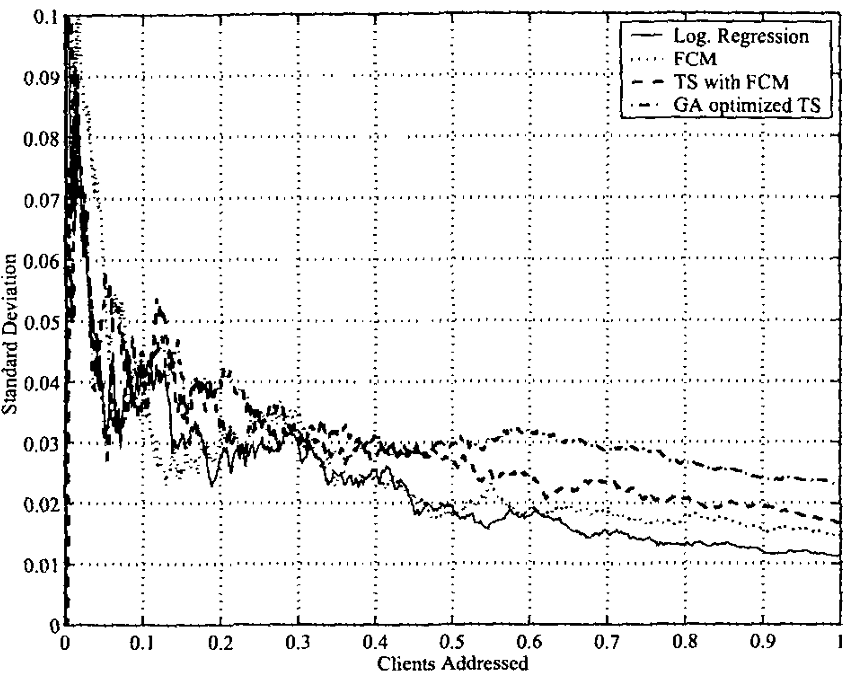 Fig 3: Standard deviation analysis. Logistic regression is "safer," but fuzzy models offer higher peaks.
Critical Insight & Conclusion
The paper’s most provocative finding is that Genetic Algorithm (GA) optimization—often touted as the ultimate tool for fine-tuning—offered only marginal gains over standard FCM initialization for TS models. Given the massive computational cost of GAs, the authors suggest that FCM-informed TS models are the most practical choice for enterprise-scale marketing.
The Takeaway: If you are still using basic regression for customer scoring, you are leaving money on the table. Moving to a fuzzy rule-based system can improve your "hit" rate in the 20% mailing segment, while finally giving your marketing team a set of linguistic rules they can actually understand and act upon.