
Decoding Social Fabric: A Comparative Anatomy of Network Models
A comparative study of social network models: Network evolution models and nodal attribute models
This paper provides a comprehensive comparative study of Network Evolution Models (NEMs), Nodal Attribute Models (NAMs), and Exponential Random Graph Models (ERGMs) within the context of social networks. By fitting these models to empirical data from Last.fm and email communications, the authors evaluate their capacity to replicate real-world structural properties like degree distributions, clustering spectra, and community formation.
TL;DR
How do the invisible threads of social networks form? This paper systematically evaluates whether social structures emerge from local evolution rules (meeting friends of friends) or nodal attributes (birds of a feather). By benchmarking these against real-world data from Last.fm and university emails, the study reveals that while homophily creates communities, local structural rules are essential for capturing the complex "clustering spectra" seen in reality.
Background: The Two Philosophies of Connection
In the study of complex networks, researchers generally fall into two camps:
- Network Evolution Models (NEMs): Focus on the process. Ties form through triadic closure (people introduce their friends to each other).
- Nodal Attribute Models (NAMs): Focus on the identity. Ties form because two people share similar traits or locations in a "social space."
This paper adds a third contender for comparison: Exponential Random Graph Models (ERGMs), the statistical powerhouse of sociology, checking if they can compete with the physics-based simulation models.
The Core Conflict: Structural Intuition vs. Attribute Reality
The authors identify a critical "signature" of real social networks: the Clustering Spectrum . In real life, as a person's number of friends (degree ) increases, their clustering coefficient (the probability that their friends know each other) usually decreases.
Methodology & Architecture
The researchers tested several specific models, including:
- KOSKK: A weighted model where strong ties reinforce the formation of new links.
- TOSHK: A growing model where newcomers link to "initial contacts" and their neighbors.
- WPR/BPDA: Spatial models where nodes are dropped into a coordinate system and link based on proximity.
 Figure 1: The taxonomy of models analyzed, separating structural dependence from attribute-based selection.
Key Findings: Why "Process" Beats "Identity"
The results reveal a stark contrast in how these models "behave" when pushed to match real data:
1. The Failure of Pure Homophily
Nodal Attribute Models (NAMs) produced "peaked" degree distributions. In NAMs, most people have roughly the same number of friends, which contradicts the "fat-tailed" distributions in real social networks where "super-hubs" exist. Furthermore, NAMs produced a flat clustering spectrum, failing to capture the hierarchical nature of social ties.
2. The Success of Triadic Closure
NEMs (like KOSKK and TOSHK) naturally produced the relationship. This happens because in these models, high-degree nodes serve as bridges between different groups, and their many neighbors are not necessarily connected to one another.
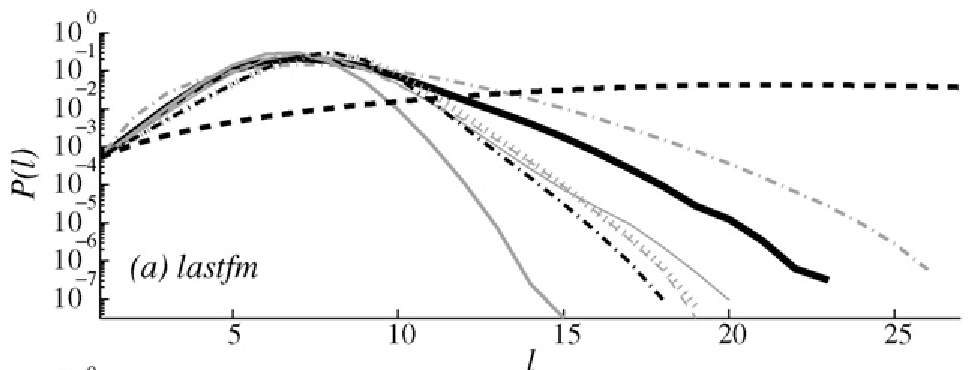 Figure 2: The clustering spectrum of NEMs (decreasing) vs NAMs (flat), compared against empirical Last.fm data.
3. The Fragility of ERGMs
While ERGMs are theoretically rigorous, the authors found them highly unstable (near-degenerate) for large datasets. A tiny tweak in parameters could cause the model to "explode" into a nearly complete graph or collapse into a sparse one, making them difficult to use for large-scale simulations.
Community Structure: The Overlap Test
To see which model truly captured "communities," the authors used the Edge Overlap metric. They discovered that NAMs and the KOSKK model create networks of dense clusters connected by "weak ties" (low overlap links). When these weak ties were removed, the NAM networks shattered, whereas other NEMs maintained a massive "core."
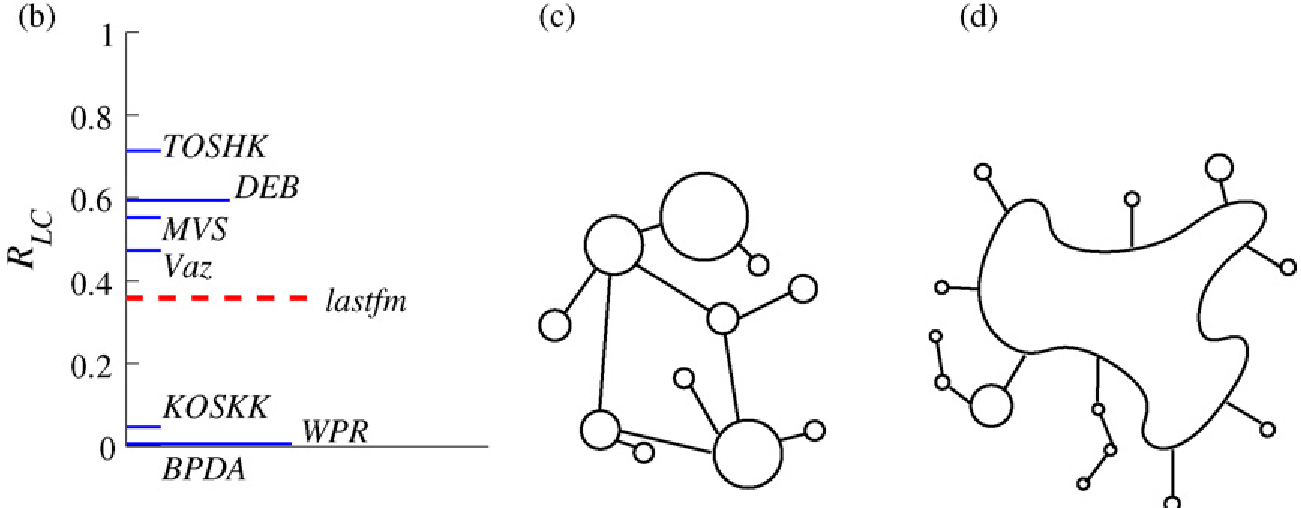 Figure 3: Impact of removing low-overlap links. NAMs (left) fragment easily, highlighting their modular nature compared to the robust core of NEMs.
Critical Insight & Conclusion
The paper concludes that neither model is perfect. Evolution models are great at getting the "statistics" right (degree distribution, clustering), while attribute models are great at getting the "topology" right (distinct, loosely connected communities).
The future of social network modeling likely lies in Hybrid Models: growth processes that are guided by nodal similarity. For practitioners, the takeaway is clear: if you want to simulate information spreading or viral marketing, a simple homophily-based model will likely give you the wrong results—you must account for the local evolutionary dynamics of how people actually meet.