
Deciphering Team Formation: A Benchmarking Journey Through Social Expert Networks
A Comparative Study of Team Formation in Social Networks
This paper presents a comprehensive comparative study of ten state-of-the-art Team Formation (TF) algorithms in social networks, categorizing them into four groups based on communication cost functions (Radius, Steiner, Sum of Distances, and Leader Distance). The authors develop a unifying benchmark and platform in C++ to evaluate these algorithms across four real-world datasets, including DBLP, IMDB, Bibsonomy, and StackOverflow.
TL;DR
Building the "dream team" isn't just about finding experts; it's about how they talk to each other. This study provides the first unified benchmark for Team Formation (TF) algorithms, comparing ten major approaches across four massive datasets. The verdict? The Sum of Distances (SD) metric is the most robust way to ensure a cohesive team, while current SOTA methods offer sharp trade-offs between speed, personal cost, and workload balance.
The "Skill vs. Synergy" Dilemma
In professional networks like LinkedIn or StackOverflow, finding a group that covers all required skills is trivial. The real challenge—an NP-hard one—is minimizing the "communication cost." Existing research was fragmented: some researchers prioritized the "leader" distance, others the "diameter" of the team, and experiments were conducted across inconsistent datasets (ranging from DBLP to IMDB).
The authors of this paper identify a critical gap: We don't know which metric actually works best because we haven't compared them on a level playing field.
Methodology: The Four Pillars of Communication
The study categorizes the TF landscape into four mathematical definitions of synergy:
- Radius Distance (): Minimizing the longest shortest path between any two members (ideal for decentralized groups).
- Steiner Distance (): Finding the minimum weight tree connecting all members (modeled as a network backbone).
- Sum of Distances (): The sum of all pairwise paths (measuring total "cohesion").
- Leader Distance (): The sum of paths from a designated leader to all members (hierarchical structures).
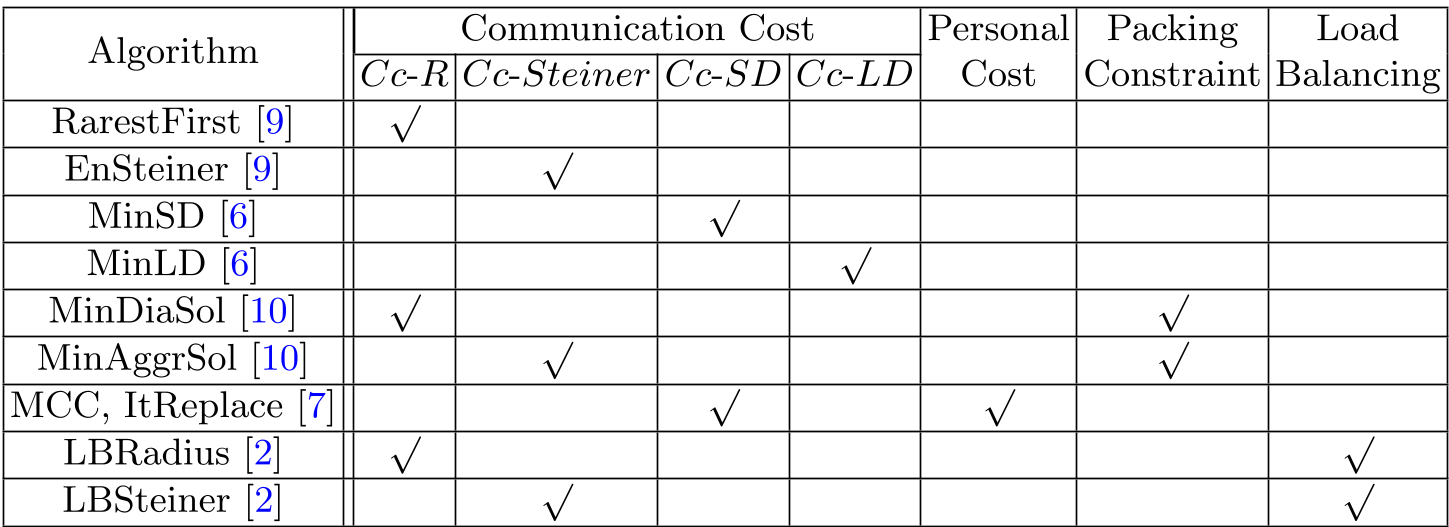 Table: Categorization of TF algorithms by cost functions and additional constraints like personal cost and packing.
Key Performance Insights
1. The Robustness of Sum of Distances (SD)
One of the most striking findings is that algorithms designed to optimize Sum of Distances (MinSD) perform consistently well across all other metrics. Unlike Radius or Steiner metrics, which are hyper-sensitive to the addition or removal of a single expert, SD acts as a stable proxy for overall team "closeness."
2. The Cost of Efficiency
When it comes to speed, there is a massive divide. MinDiaSol and RarestFirst are lightning-fast, making them suitable for real-time web applications. In contrast, MinLD (Leader Distance) and LBSteiner (Load Balanced) are computationally expensive because they require enumerating potential leaders or solving complex bi-objective optimization problems.
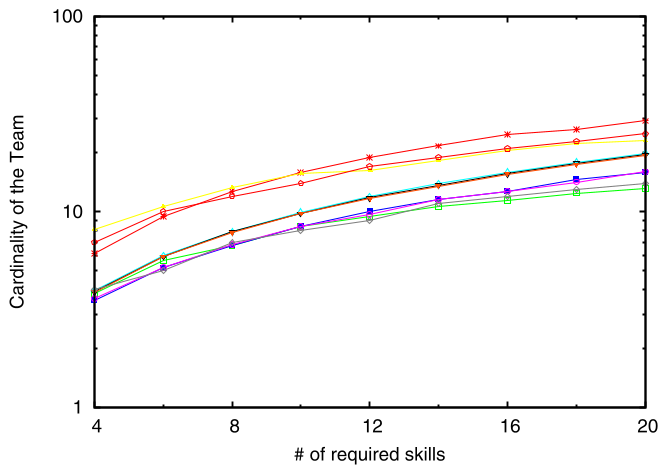 Figure: Comparison of team cardinality and computational time across different skill requirements.
3. Balancing the Load
The paper highlights a "hidden" cost: Expert Burnout. Algorithms like LBRadius and LBSteiner purposefully pick "under-utilized" experts to ensure long-term network health. Interestingly, the RarestFirst algorithm naturally achieves decent load balancing simply because it anchors the team around rare experts, who are inherently used less often than generalists.
Critical Analysis & Conclusion
This paper serves as the "Rosetta Stone" for team formation research. By re-implementing these algorithms in a single C++ framework, the authors stripped away the noise of different programming languages and hardware.
Takeaways for Practitioners:
- If you need a quick and dirty team for a simple task, RarestFirst is your best bet.
- If you are building a high-stakes project team where every interaction counts, use MinSD to ensure maximum cohesion.
- If you are managing a long-term platform (like a freelance marketplace), you must integrate Packing Constraints (via MinDiaSol) to avoid over-burdening your top experts.
Limitations: The study assumes a static social network. In reality, communication costs change as people work together. Future work should explore Dynamic TF, where the social graph evolves based on successful (or failed) past collaborations.
For more details, the authors have made their benchmark code and datasets available at: www.cse.ust.hk/~xwangau/TF.html