
Fibonacci Weighting: A Proverbial Breakthrough in Mandarin Emotion Recognition
A Comparative Study of Different Weighting Schemes on KNN-Based Emotion Recognition in Mandarin Speech
This paper presents a comparative study of weighting schemes for K-Nearest Neighbor (KNN) variants in Mandarin speech emotion recognition. It introduces the Fibonacci sequence as a novel weighting function, evaluates it against traditional linear, inverse, and rank-based methods across WKNN, WCAP, and WDKNN classifiers, and achieves a SOTA accuracy of 81.4% using the Fibonacci-weighted D-KNN.
TL;DR
Recognizing human emotion from speech is a non-trivial task due to the subtle variations in prosody. This paper proposes a novel weighting scheme for KNN-based classifiers using the Fibonacci sequence. By moving beyond simple linear weights, the authors achieved an 81.4% accuracy in Mandarin emotion recognition, significantly outperforming traditional KNN and standard distance-weighting methods.
Contextualizing the Problem
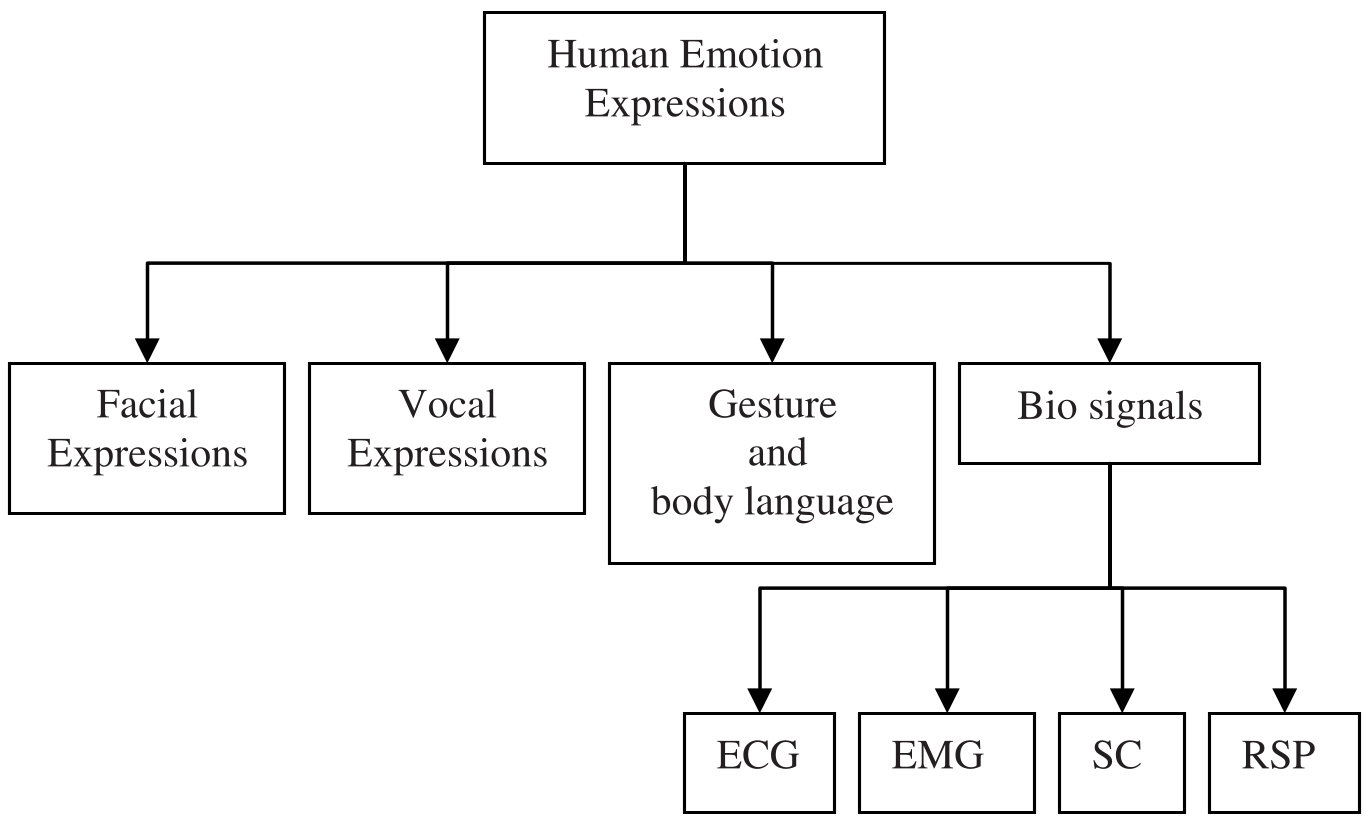
Human emotion is a multi-modal construct, but speech remains one of the most accessible and information-rich channels for HCI (Human-Computer Interaction). The core challenge lies in the classification layer. Traditional K-Nearest Neighbor (KNN) algorithms often fall short because they treat all neighbors as equal voters. In the high-dimensional latent space of acoustic features (MFCCs, LPCs), a neighbor that is slightly further away might actually be noise or a different emotion altogether.
The authors identify a critical gap: existing weighting functions—linear, inverse, or rank-based—do not capture the "confidence reinforcement" needed for complex emotion boundary detection.
The "Zhuge Liang" Insight: Methodology
The authors draw inspiration from a Chinese proverb: "Three cobblers with their wits combined exceed Zhuge Liang the master mind."
In technical terms, this suggests that the classification of a test sample should not just depend on the 1st nearest neighbor (the "Master Mind"), but rather be validated by the collective weight of subsequent neighbors (the "Cobblers"). The Fibonacci Weighting Function () perfectly encapsulates this: the weight of the -th neighbor is the sum of the next two.
The Architecture
The recognition system follows a standard pipeline:
- Feature Extraction: Extracting MFCC, LPC, and LPCC.
- Normalization: Min-Max normalization to ensure all dimensions contribute equally to the Euclidean distance.
- Classification: Comparing four architectures:
- KNN: Simple majority vote.
- WKNN: Weighted majority vote.
- WCAP: Distance to weighted average patterns.
- WDKNN: Minimizing the weighted sum of distances to the nearest neighbors of each class.
Experimental Validation
Experiments were conducted on a Mandarin corpus containing five emotions: Anger, Boredom, Happiness, Neutral, and Sadness. Using 570 utterances and Leave-One-Out (LOO) cross-validation, the results were definitive.
Performance Comparison
The baseline KNN accuracy sat at 72.5% (with ). However, when the Fibonacci sequence was applied to the Weighted Discrete-KNN (WDKNN), the performance jumped to 81.4%.
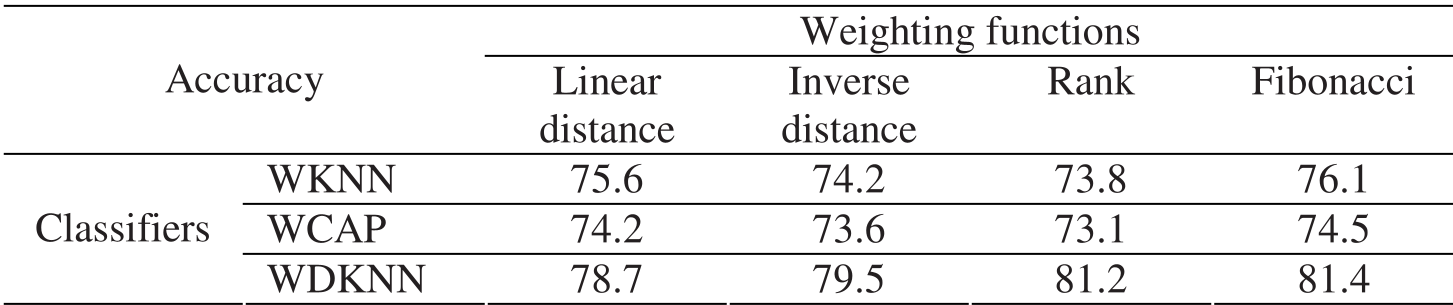
As shown in the table above, the Fibonacci sequence (last column) consistently yielded the highest accuracy across every classifier type, proving it is a more robust weighting kernel than linear or rank-based alternatives.
Critical Analysis & Conclusion
Why does Fibonacci work?
The Fibonacci sequence creates a steep but structured decay. Compared to linear decay (), Fibonacci gives significantly more "authority" to the very closest samples while ensuring that if the closest samples are split between classes, the "collective wits" of the 2nd and 3rd neighbors can effectively break the tie.
Limitations and Future Outlook
While the results are impressive for a 5-class problem, the corpus size (570 utterances) is relatively small by modern deep-learning standards. A logical next step would be to:
- Integrate Neural Features: Testing these weighting schemes on embeddings from Pre-trained models like Wav2Vec 2.0.
- Dynamic Weighting: Instead of a fixed sequence, using an attention-based mechanism to learn the optimal sequence for different emotional clusters.
This paper reminds us that even "simple" classical algorithms like KNN can be significantly enhanced by injecting intuitive, domain-specific heuristic structures like the Fibonacci sequence.