
Decoding the Pulse of Social Media: A Comparative Temporal Analysis of Content Lifetime
A Comparative Temporal Analysis of User-Content-Interaction in Social Media
This paper introduces a novel Hidden Markov Model (HMM) framework to define and quantify "content lifetime" across various social media platforms. By analyzing inter-event times of user interactions on Twitter, Facebook, and E-mail (Enron/HackingTeam), the study identifies four distinct universal time scales ranging from minutes to weeks.
TL;DR
How long does a Tweet or a Facebook post actually "live" before it vanishes into the digital abyss? This research moves beyond vague notions of social media "speed" to provide a rigorous mathematical definition of content lifetime. Using Hidden Markov Models (HMM), the authors uncover that across different platforms, human attention operates on four universal time scales, with Twitter consistently outpacing traditional communication like e-mail.
Problem & Motivation: The Lack of a "Digital Ruler"
We all know social media is "fast," but "fast" is not a metric. In academic and industrial contexts, understanding the temporal dynamics of content is crucial for everything from ad placement to disaster response.
Existing research often treats interactions as simple Poisson processes (events happening at a constant rate). However, human behavior is bursty—characterized by high-intensity activity followed by long silences. The authors argue that this burstiness is driven by the interaction between Collective Interest and Visibility (the platform's algorithm/UI). The challenge is that these two variables are "latent"—we see the clicks, but we don't see the underlying "activity state" of the content.
Methodology: High-Resolution Hidden Markov Models
To bridge this gap, the authors modeled interaction sequences as a Hidden Markov Model (HMM).
The Core Insight
Instead of viewing a post's life as a linear decay, the HMM views it as a series of transitions between discrete "Activity States."
- High Activity State: Content is top-of-feed; inter-event times are short (seconds/minutes).
- Low Activity State: Content is buried; inter-event times are long (days/weeks).
By fitting Gaussian emissions to these states, the model can predict the "Expected Lifetime"—the time it takes for a post to transition from a high-activity state into a "quiet" state from which it is unlikely to return.
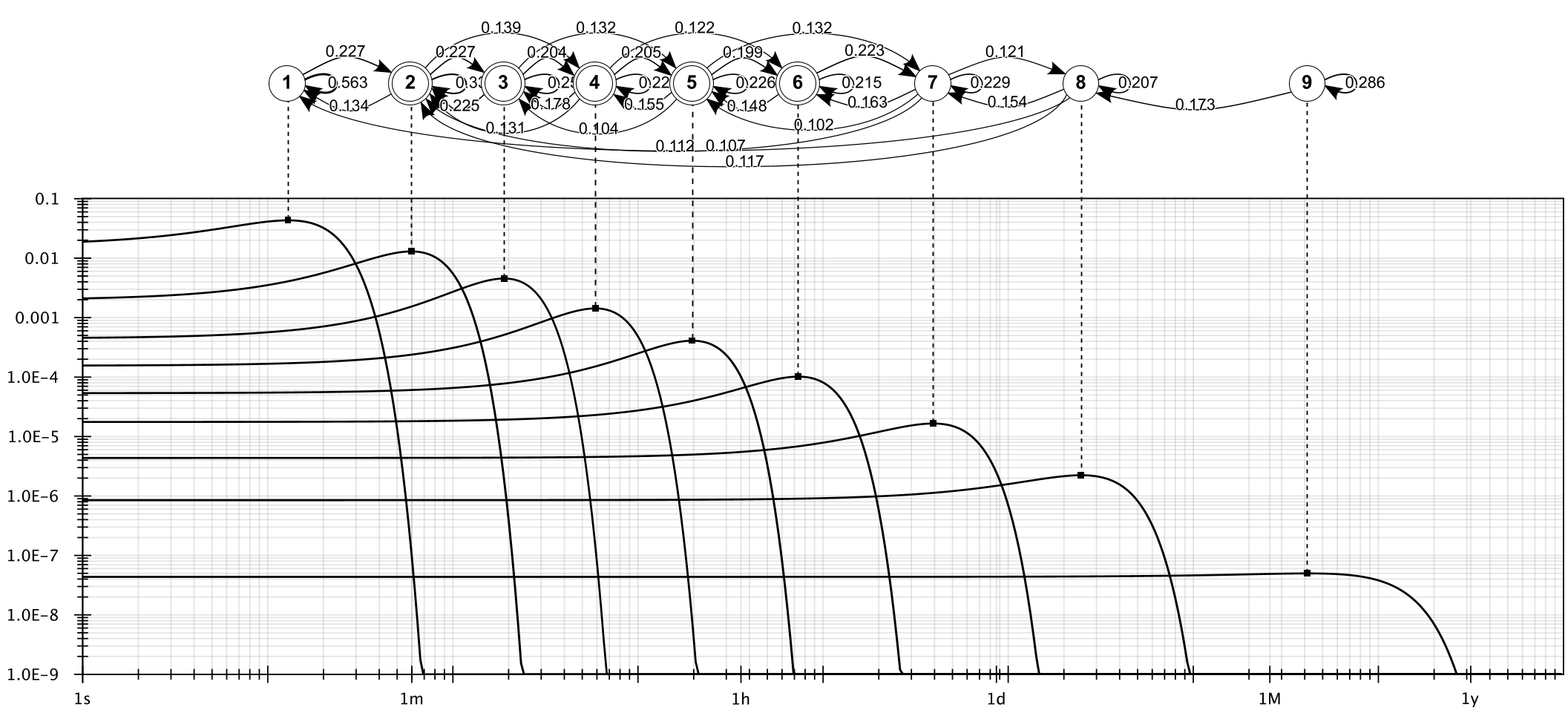 Figure 1: The Twitter HMM. Note the high probability of staying in high-intensity states (left) once an interaction occurs.
Experiments: Twitter vs. Facebook vs. E-mail
The study compared four massive datasets:
- Twitter: Public, fast-paced, high "sharing" (retweets).
- Facebook: Private-centric, slower feeds.
- Enron/HackingTeam E-mail: Traditional asynchronous communication.
Key Findings: The Four Time Scales
Regardless of the platform, the data converged on four specific "lifespans":
- The Transient (≤15 Min): Rapid-fire interactions, often driven by push notifications.
- The Hourly (1–1.5 Hours): The "lunch break" or "immediate response" window.
- The Daily (1–3 Days): Content that survives one or two sleep-wake cycles.
- The Persistent (2+ Weeks): Long-tail discussions or "search-driven" interactions.
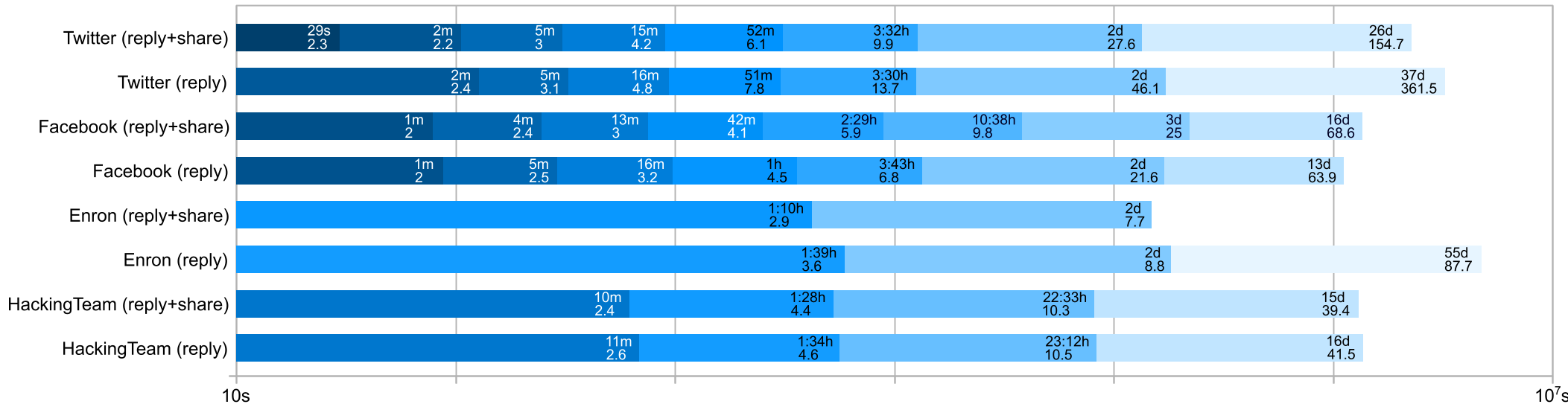 Figure 2: Lifetime (L) and Interaction Counts (C) per platform. Twitter shows significantly more interactions per unit of time compared to Facebook or E-mail.
Critical Analysis & Conclusion
Why it Works
The brilliance of this paper lies in its Inductive Bias. By assuming that visibility is tied to the "top-of-feed" mechanic, the HMM naturally captures the "resuscitation" effect—where an old post is brought back to life by a single new reply. This explains why social media engagement isn't just a smooth downward curve but a jagged series of bursts.
Strategic Takeaway
For developers and data scientists, this paper provides a "cheatsheet" for temporal quantization. If you are building an analytics dashboard for Twitter, your "time bins" should likely be 15 minutes or less to capture the highest-intensity state. For corporate e-mail tools, a 24-hour bin is more appropriate.
Limitations
The study acknowledges that "sharing" mechanics (like retweets) significantly distort these lifetimes. On Twitter, sharing creates a secondary burst of visibility that the model treats as a shorter inter-event time, effectively "speeding up" the perceived clock of the platform.
Future Work: As social media shifts from chronological feeds to purely algorithmic "For You" pages (like TikTok), the "visibility" latent variable will become even more complex, requiring deep-learning-based state space models to decode.