
DynDBA and DynAPO: Navigating the Trade-off Between Completeness and Reactivity in Dynamic DisCSP
Comparing two approaches to dynamic, distributed constraint satisfaction
This paper introduces two novel protocols, DynDBA and DynAPO, designed for Dynamic Distributed Constraint Satisfaction Problems (DynDCSP). By extending the Distributed Breakout and Asynchronous Partial Overlay algorithms to handle continuous constraint changes, the authors demonstrate competitive performance on dynamic graph coloring tasks.
TL;DR
The world is rarely static, yet most AI constraint solvers act as if it is. This paper bridges the gap by introducing DynDBA and DynAPO, two protocols designed to solve Distributed Constraint Satisfaction Problems (CSPs) where the constraints themselves are in a state of constant flux. The core finding? Completeness is a luxury of slow environments; reactivity is the necessity of fast ones.
The Problem: The "Frozen World" Assumption
Most Distributed CSP (DisCSP) research focuses on finding a static solution to a fixed problem. However, in applications like airspace management or dynamic scheduling, new variables and constraints appear and disappear continuously.
The authors highlight a critical gap:
- Prior Work often assumes change happens in episodes (static intervals).
- Reality features continuous changes that might occur while the solver is still thinking.
To address this, they introduce the parameter , representing the rate of constraint change relative to execution cycles.
Methodology: Two Philosophies of Coordination
The authors adapt two established protocols for these shifting sands:
1. DynDBA (Dynamic Distributed Breakout)
Based on the classic breakout algorithm, this is an incomplete, hill-climbing approach.
- Mechanism: It uses a strict two-mode cycle (Wait OK? and Wait Improve?).
- Adaptation: To prevent deadlocks when new neighbors appear, the authors implemented a "pending additions" queue to synchronize agents in different modes.
- Intuition: It doesn't care about the global optimum; it just wants to minimize local friction immediately.
2. DynAPO (Dynamic Asynchronous Partial Overlay)
A more sophisticated, complete search method based on "Cooperative Mediation."
- Mechanism: Agents build a "good list" of connected variables and act as mediators to solve subproblems centrally.
- Adaptation: Handling removals is the hardest part. The authors added a bi-directional "unlink request" system to ensure agents don't keep solving phantom constraints that no longer exist.
- Intuition: It tries to understand the "Why" of the conflict, making it more accurate but computationally heavier.

Performance: The "Velocity" Threshold
The researchers tested these protocols on 3-coloring problems with varying graph densities (2.0 to 2.5) and change rates ().
- In the Slow Lane (): DynAPO is the clear winner. Because it is a complete method, it finds higher-quality solutions and uses far fewer messages (quiescence) once it stabilizes.
- In the Fast Lane (): DynAPO collapses. The time it takes to "mediate" a subproblem (a 4-step process) is longer than the lifespan of the constraints it's trying to solve. DynDBA, with its simple 2-step reactive cycle, handles the chaos much better.
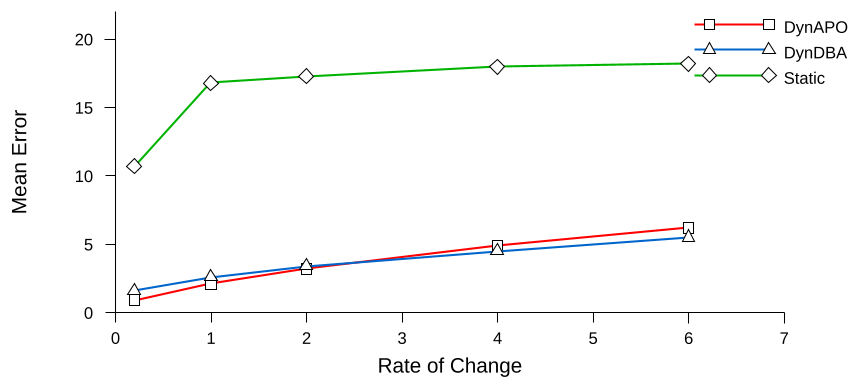 Figure: At density 2.0 (satisifiable), DynAPO maintains a lower error at low delta, but DynDBA becomes more robust as the rate of change accelerates.
Critical Insight: The Cost of Intelligence
The paper reveals a fundamental "Heisenberg Uncertainty Principle" for multi-agent systems: You can have a complete understanding of a static problem, or a shallow understanding of a fast-moving problem, but you cannot have both.
Limitations & Future Work
- Communication Overhead: DynAPO’s message count explodes as environments become more chaotic.
- Real-time vs. Logical Cycles: The study uses "execution cycles." In the real world, the computational cost of DynAPO’s Branch and Bound search would likely make its performance even worse compared to the lightweight DynDBA.
- Hybrid Solvers: The logical next step is a solver that senses the "velocity" of change and automatically switches from mediation (APO) to hill-climbing (DBA) as noise increases.
Conclusion
This work serves as a vital reminder that in distributed AI, "optimal" is a moving target. For practitioners, the takeaway is clear: if your environment changes faster than your coordination protocol can cycle, dump the "smart" mediation and stick to the "fast" local repair.