
Beyond Friendship: Decoding the Structural Divide Between Social Links and Real Interactions
Comparing Linkage Graph and Activity Graph of Online Social Networks
This paper presents a comparative analysis between "Linkage Graphs" (friendship links) and "Activity Graphs" (actual user interactions) in Online Social Networks (OSNs). By analyzing Flickr and Epinions datasets, the authors identify "Degree Correlation" as the primary structural distinction between these two graph types and propose a novel network generator incorporating reciprocity.
TL;DR
Not all social edges are created equal. This paper uncovers a fundamental structural divide: Linkage Graphs (who you follow) exhibit strong "rich-club" tendencies where influential people huddle together, while Activity Graphs (who you actually talk to) look surprisingly random in their connectivity patterns. The authors prove that Reciprocity is the secret sauce that makes social structures unique.
The "Invisible" Problem in Social Network Analysis
For years, researchers treated social networks as monolithic entities. If Alice "follows" Bob, we assume a social tie exists. However, there is a massive gap between a "friendship" and an "interaction."
The authors argue that existing models are flawed because:
- They often ignore the directed nature of social ties (treating them as undirected).
- They fail to distinguish between Linkage-based tasks (like information viral marketing) and Activity-based tasks (like trust inference).
The core mystery: Why does an application like SybilGuard work perfectly on a linkage graph but fail on an activity graph? The answer lies in the topology.
Methodology: The Hunt for a Distinguishing Feature
The team analyzed two massive datasets: Flickr (Linkage) and Epinions (Activity). They tracked them across time using snapshots to observe both static and dynamic properties.
1. The Similarities (The "What")
Both graphs look similar on the surface:
- Power-law distributions: A few "superstars" have most of the connections.
- Small-world effect: Short paths between any two people.
- Densification: Both networks get denser over time as more connections form.
2. The Great Divide: Degree Correlation (The "Why")
This is the paper's "Aha!" moment. Degree Correlation (or Assortativity) measures if high-degree nodes prefer connecting to other high-degree nodes.
- Linkage Graphs (Flickr): Highly Assortative. "Gregarious" people follow other popular people.
- Activity Graphs (Epinions): Neutral. Interaction seems more random and less driven by social status.
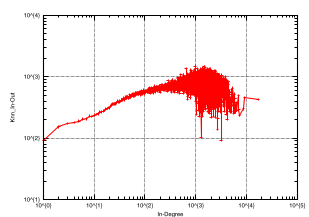 Note: The upward slope in the Flickr plots (left) confirms that high-degree nodes connect to other high-degree nodes, a trend absent in Epinions (right).
The Proposed Solution: A Reciprocity-Aware Generator
To prove that reciprocity is what creates these "rich-club" social structures, the authors modified the famous Forest Fire model.
Their generator uses two simple parameters:
- (Burning Probability): Simulates how we browse a friend's friend list (BFS-like discovery).
- (Symmetry Probability): Simulates the "follow back" culture. If v links to u, u links back to v with probability .
 The generated network (90k nodes) perfectly mimics Flickr’s specific assortativity () and shrinking diameter.
Deep Insights: Why Does This Matter?
Information Dissemination (Viral Marketing)
Because linkage graphs are assortative, high-degree nodes are clustered in a "core." If you only seed influencers, your message might get trapped in the "inner circle." To reach the "fringes" of a network, you must seed both high-degree core nodes and peripheral nodes.
Trust and Reputation
Trust should be inferred from Activity Graphs. Why? Because Linkage Graphs are heavily biased by social reciprocity (I follow you because you followed me), which doesn't necessarily imply trust. Activity Graphs, being more "neutral" and interaction-driven, provide a cleaner signal for reputation management.
Conclusion & Limitations
This paper provides a critical "sanity check" for graph theory: Reciprocity is the engine of social structure.
However, a limitation remains: the "Activity" data in this study (Epinions) is still quite old. In the era of algorithmic feeds (TikTok/Instagram), the interplay between Linkage and Activity is even more complex, as AI now mediates interactions that were once purely social. Future work should investigate if "Algorithmic Recommendations" are artificially inflating assortativity in activity graphs.