
Social vs. Interest Affinity: Deciphering the "Why" Behind Recommendation Performance
Comparing the Predictive Capability of Social and Interest Affinity for Recommendations
This paper presents a comprehensive empirical comparison between Social Recommendation (SR), based on social affinity, and Collaborative Filtering (CF), based on interest affinity, across six large-scale real-world datasets. The study utilizes a unified neighborhood-based framework to analyze how user and item attributes impact prediction accuracy (RMSE) and coverage.
TL;DR
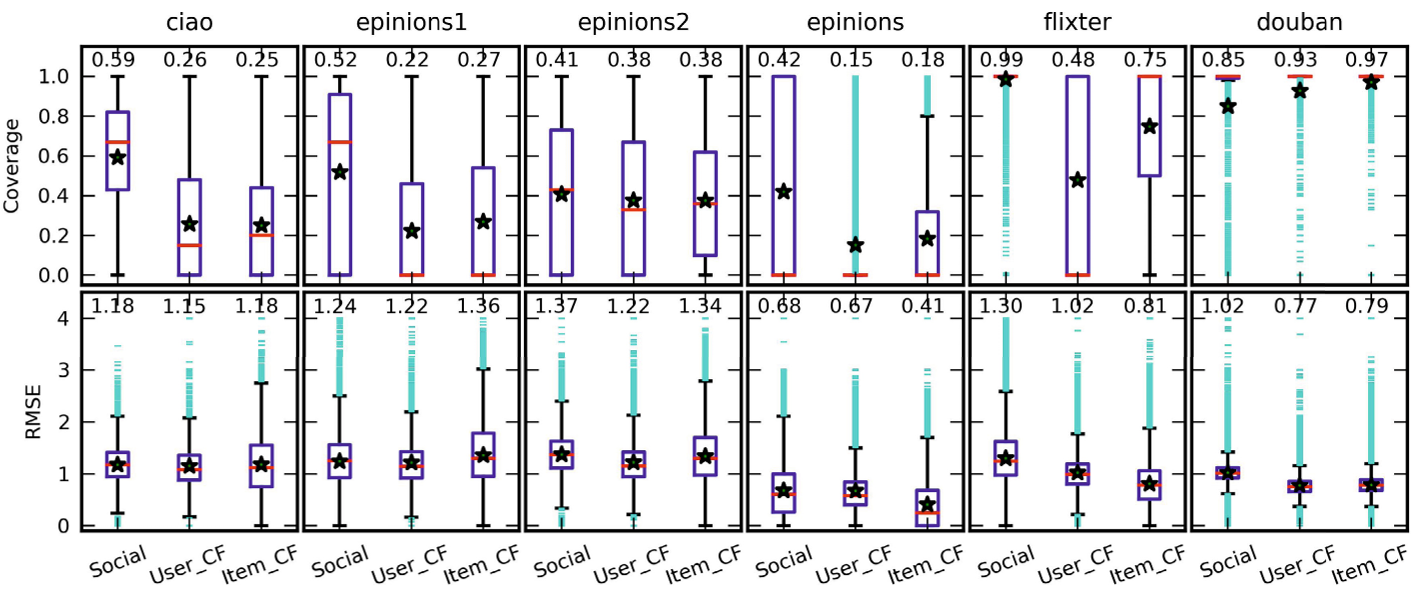
Is a recommendation from a friend better than a recommendation from a stranger who likes the same movies? This paper performs a massive "stress test" on six datasets (including Epinions, Flixster, and Douban) to compare Social Affinity (who you know) vs. Interest Affinity (what you like). The verdict: Social ties are great for finding anything to recommend (coverage), but "interest-based" algorithms still win on precision unless the social network is specifically built around shared tastes.
The "Global Metric" Trap
In the academic world of Recommender Systems, most researchers report a single RMSE (Root Mean Square Error) score. This paper argues that this is fundamentally flawed. A single average hides the fact that an algorithm might be brilliant for "power users" but a disaster for "newbies."
The authors identify two distinct flavors of affinity:
- Interest Affinity (CF): The algorithmic "black box" that finds users who rated the same items similarly.
- Social Affinity (SR): The explicit graph of friends, followers, or trusted peers.
Methodology: The Random Walk vs. Pearson Correlation
To keep the comparison fair, the authors used a unified neighborhood-based template for both approaches.
1. The CF Approach
Uses standard Pearson Correlation to build neighborhoods. If User A and User B both rated "The Matrix" 5 stars and "Inception" 4 stars, they have high Interest Affinity.
2. The SR Approach (Social Affinity)
Uses Random Walks on the social graph. To find a prediction for User on Item , the system "walks" through the friend network. The probability of reaching a user who has rated Item determines the "Social Affinity."

Key Insights: When Does Social Win?
1. The "Nature of the Network" Matters
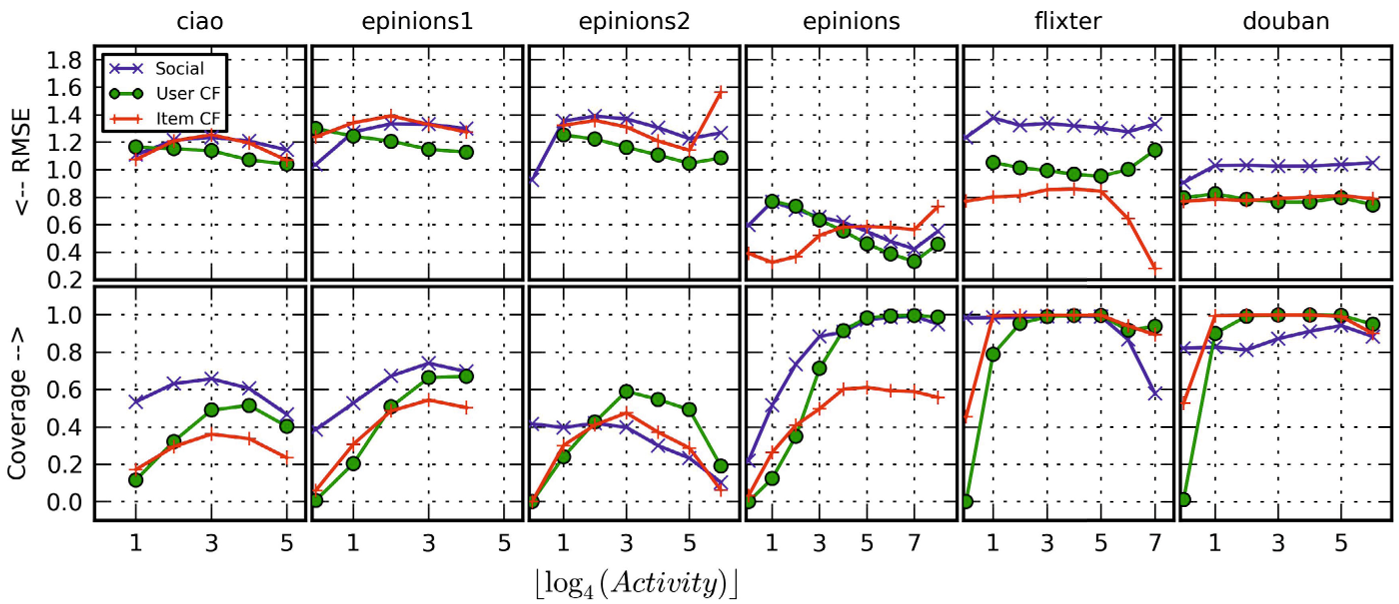
The most striking finding is the difference between Trust Networks (Epinions, Ciao) and Friendship Networks (Flixster, Douban).
- In Trust Networks, people follow others specifically for their reviews. Here, SR is competitive with CF.
- In Friendship Networks, your "friend" might have a drastically different taste in movies. Here, Social Affinity is a poor predictor of preference, and CF dominates.
2. The Cold-Start Savior
For users who have rated 0-5 items (the "Cold Start"), CF often fails because it has no data to correlate. SR shines here, providing high Coverage by leveraging the social graph.
3. User Selectiveness & Item Likeability
The authors discovered that:
- Indulgent Users (those who give high ratings to everything) are better served by Social Affinity.
- Selective Users (the hard-to-please critics) are better served by Interest Affinity.
- Item Likeability: Popular items that everyone likes are easier for CF to predict accurately.
SOTA Comparison
The paper confirms that while User-based CF is a strong baseline, its coverage is limited. Social Recommendation can bridge that gap but introduces "noise" if the user has too many social connections (degree > 5), leading to a plateau or even a drop in precision.
Conclusion & Future Outlook
The study concludes that there is no "one-size-fits-all" recommender. The real value lies in Hybrid Approaches that can:
- Use SR for cold-start users.
- Switch to CF once a user has enough history.
- Adjust weights based on whether the social tie is "interest-based" or just "plain friendship."
Takeaway: If you are building a recommendation engine, look beyond the global RMSE. Segment your users by their social degree and activity level—you’ll likely find that your "SOTA" algorithm isn't SOTA for everyone.