
Beyond Expert Ears: Comparing Iterative and Parallel Crowdsourcing for Speech Transcription
Comparing two methods for crowdsourcing speech transcription
2013-05-01
Summary
Problem
Method
Results
Takeaways
Abstract
This paper investigates crowdsourcing for speech transcription by comparing two distinct quality control frameworks: the iterative "Dual Pathway" method and the parallel "Gold Standard" method. Evaluated on German and Italian broadcast news, the study demonstrates that non-expert crowds can achieve high-quality transcriptions that approach expert-level accuracy.
## TL;DR
High-quality speech transcription has long been the domain of expensive experts. This study evaluates whether "the crowd" can match expert performance using two distinct strategies: an **iterative refinement process** (Dual Pathway) and a **redundancy-based parallel process** (Gold Standard). The results show that non-experts, guided by the right workflow, can reach Word Error Rates (WER) nearly identical to those of expert transcribers for a fraction of the cost.
## The Motivation: Cost, Quality, and Access
The appetite for transcribed speech data is growing, yet professional services remain prohibitively expensive (averaging $150 per hour of speech). While platforms like Amazon Mechanical Turk (AMT) offer a solution, two major hurdles remain:
1. **Quality Control**: How do you trust an anonymous, non-expert worker?
2. **Geographical Barriers**: Requesters outside the US often face payment and access restrictions on major platforms.
The authors leverage **CrowdFlower (CF)** to bypass regional restrictions and test which quality control mechanism provides the best "bang for the buck."
## Methodology: Two Paths to Accuracy
The researchers meticulously compared two workflows to ensure transcription integrity:
### 1. The Iterative Dual Pathway (Implicit Control)
This method is elegant because it requires **no prior expert transcriptions**.
- **The Logic**: Audio is sent to two separate paths (P1 and P2).
- **The Iteration**: Workers in S2 see the work from S1 and edit it.
- **Convergence**: Once two workers from P1 and two from P2 produce matching transcripts, the segment is considered "done."

### 2. The Gold Standard (Explicit Control)
This uses CrowdFlower’s native system.
- **The Logic**: Requesters pre-transcribe 10% of the data (the "Gold").
- **The Filter**: These units are hidden in the tasks. If a worker fails the gold units, they are banned.
- **Aggregation**: Multiple workers transcribe the same clip, and their results are merged using the **ROVER** (Recognizer Output Voting Error Reduction) algorithm.
## Experimental Breakthroughs
The study was conducted on Italian and German broadcast news, testing whether it's better to start from an ASR (Automatic Speech Recognition) draft or from scratch.
### Key Findings:
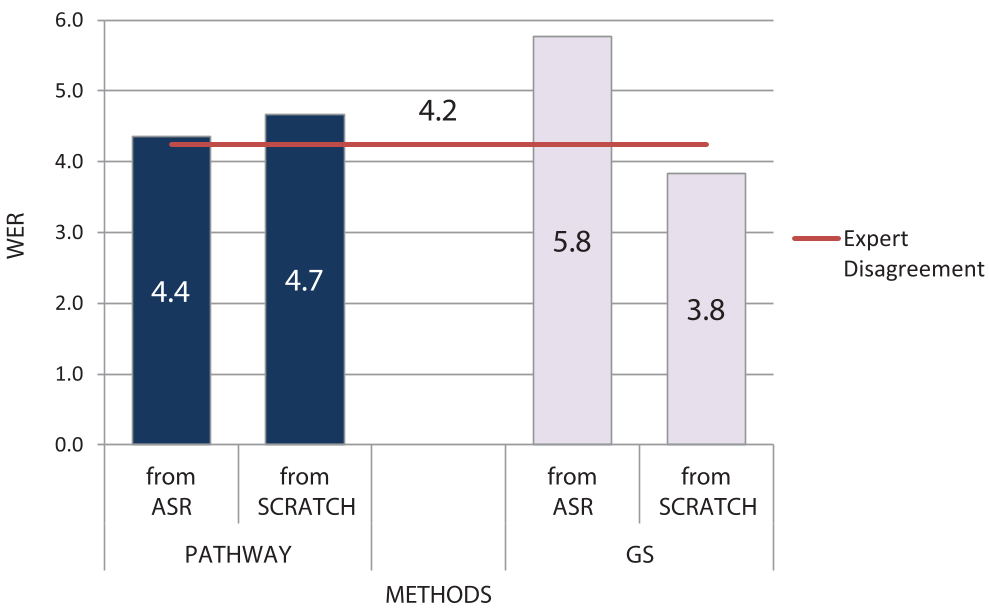
- **From Scratch is Better**: Paradoxically, starting from scratch often yielded better results than correcting ASR, as ASR errors sometimes "biased" the human workers.
- **Expert-Level Accuracy**: In Italian, the Gold Standard from scratch achieved a **2.9% WER**, extremely close to the expert disagreement rate of 2.4%.
- **Cost Efficiency**: Costs were slashed to between $30 and $75 per hour of speech—at least a **50% savings** over professional services.
| Language | Method | Setting | Global WER | Expert Disagreement |
| :--- | :--- | :--- | :--- | :--- |
| **German** | Gold Standard | Scratch | **3.8%** | 4.2% |
| **Italian** | Gold Standard | Scratch | **2.9%** | 2.4% |
## Strategic Insights & Analysis
The "Dual Pathway" method is the hidden gem of this research. While the Gold Standard is slightly more accurate, it requires experts to create the test units. In contrast, the Dual Pathway creates a self-correcting ecosystem. The convergence of two independent chains is a powerful **Inductive Bias** for truth; it is statistically improbable for two independent groups to make the exact same error from scratch.
However, the study notes a "bias" effect: when provided with an ASR transcript, workers tended to accept ASR errors as correct if the ASR was already high-quality, illustrating the "LLM/AI anchor bias" long before the term became mainstream in today's generative AI era.
## Conclusion
This research provides a blueprint for building high-quality speech datasets without deep pockets. Whether using iterative refinement (for new languages without gold data) or parallel voting (for maximum speed and accuracy), crowdsourcing has proven it can match the pros. For researchers outside the US, the success of the CrowdFlower-based workflow demonstrates that high-quality data collection is now a global possibility.