
Cross-Platform Toxic Personalities: Does the Social Network Make the Bully?
A Comparison of Common Users across Instagram and Ask.fm to Better Understand Cyberbullying
This paper presents a cross-platform comparative analysis of cyberbullying behaviors on Instagram and Ask.fm by examining "common users" who maintain profiles on both. Using a dictionary-based approach for negativity/positivity detection and LIWC for psychological categorization, the study identifies significant differences in toxic behavior patterns between semi-anonymous and non-anonymous social networks.
TL;DR
Is cyberbullying driven by a person's character or by a platform's features? By tracking 8,000 "common users" who use both Instagram (image-focused, non-anonymous) and Ask.fm (text-focused, semi-anonymous), researchers found that while Ask.fm breeds more negativity overall, the relationship between anonymity and bullying is far more complex than a simple "mask of cowardice."
The "Common User" Mapping Problem
Most academic studies on cyberbullying are siloed. If we study Twitter, we see text-based aggression; if we study Instagram, we see image-based harassment. However, we rarely know if the bully on Twitter is the same user being a "saint" on Instagram.
The authors leveraged a unique discovery: many Ask.fm users link their Instagram IDs in their bio. This allowed a within-subject design, enabling researchers to observe how the same person changes their communication style when moving from a public, image-centric identity (Instagram) to a semi-anonymous, Q&A environment (Ask.fm).
Methodology: Dictionary vs. Identity
The research team used two main toolsets:
- Sentiment Dictionaries: 3,000 words categorized into negative/positive clusters.
- LIWC (Linguistic Inquiry and Word Count): To map posts to psychological categories like "social," "anger," and "anxiety."
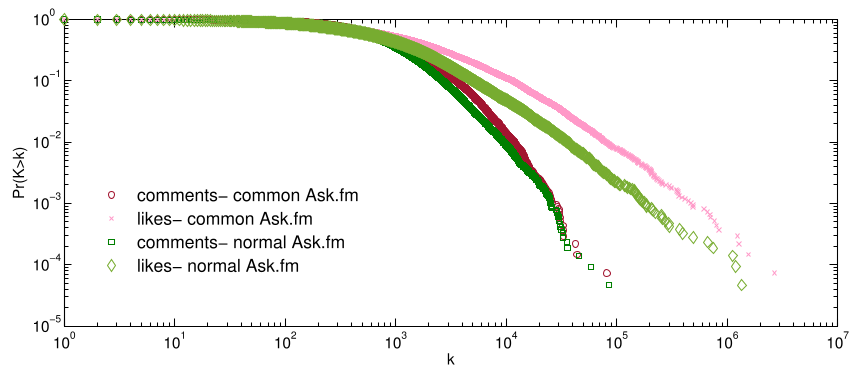 Fig 1: Activity levels (Likes/Comments) comparison between Normal and Common users on Instagram.
Key Insight 1: Ask.fm is Darker, but Positivity is Universal
The data confirms that Ask.fm has a higher percentage of negative posts than Instagram. However, across both networks, positivity still outweighs negativity. This suggests that while cyberbullying is a critical issue, it represents a loud minority of interactions.
Key Insight 2: The Anonymity Paradox
The most striking finding of the paper challenges the "Anonymity = Evil" trope. On Ask.fm, non-anonymous posts actually contained more negative words than anonymous ones.
Through qualitative analysis, the authors discovered two reasons for this:
- The Upstander Effect: Friends often post non-anonymously to defend a victim, using harsh language ("Leave her alone b*tch!") to attack the anonymous bully.
- Affectionate Profanity: Close friends often use "labels" or "curse words" as a form of non-standard bonding or slang-based affection.
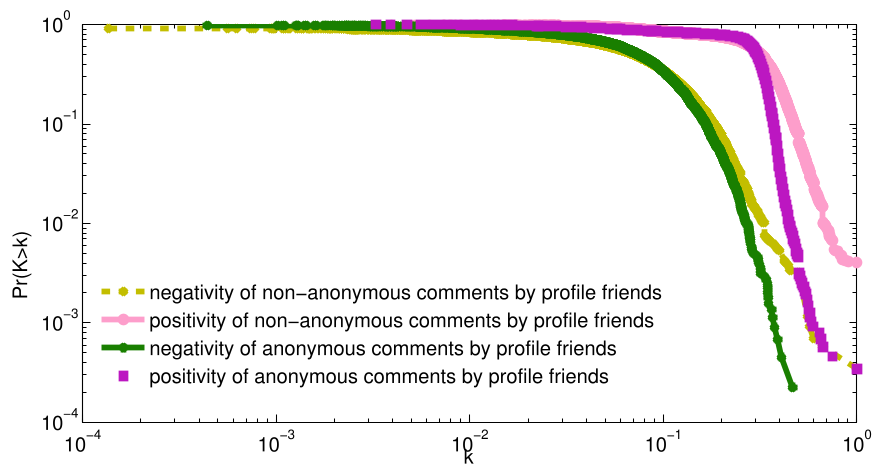 Fig 2: CCDFs of positive and negative posts on Ask.fm, showing the impact of anonymity.
Key Insight 3: Behavioral Consistency
Does a bully on one site act like a bully on another? The researchers found a correlation of approximately 0.4 between an owner’s negativity on Ask.fm and their negativity on Instagram. While not an absolute 1:1 match, it suggests that a person's innate "Online Disinhibition" level follows them across the web, though the platform's UI (User Interface) might dampen or amplify it.
Critical Analysis & Future Outlook
This paper successfully highlights that negativity is not a proxy for bullying. A keyword-based system would flag a friend defending a victim as a "bully" simply because they used foul language.
Limitations:
- The dictionary approach is "context-blind." It cannot distinguish between "You're a btch" (insult) and "You're my btch" (friendship).
- The data is limited to users who choose to link their accounts, which might introduce a selection bias toward more socially active or "influencer-lite" teenagers.
Future Work: To truly solve cyberbullying, AI models must move beyond word lists and toward Intent Detection. This requires labeled datasets that distinguish between "Supportive Aggression" and "Malicious Harassment."