
RVM vs. SVM: Which Machine Learning Champion Best Navigates Volatile Electricity Prices?
Comparisons of Machine Learning Methods for Electricity Regional Reference Price Forecasting
This paper evaluates and compares two kernel-based machine learning techniques—Support Vector Machine (SVM) and Relevance Vector Machine (RVM)—for electricity regional reference price forecasting. Conducted using data from the Australian National Electricity Market (NEM), the study identifies RVM as the superior model in terms of both prediction accuracy and computational efficiency.
Executive Summary (TL;DR)
Predicting electricity prices is a high-stakes challenge for market participants in deregulated grids. This paper investigates whether the Support Vector Machine (SVM)—the long-standing king of statistical learning—or the newer Relevance Vector Machine (RVM) is better suited for the task. Using data from the Australian National Electricity Market (NEM), the researchers demonstrate that RVM not only provides more accurate forecasts but does so with a model that is significantly leaner (fewer parameters) and nearly 20 times faster than SVM.
The Volatility Problem: Why Traditional Models Struggle
Electricity markets are unlike any other commodity market. Because electricity is difficult to store at scale, the regional reference price (RRP) is prone to extreme volatility and sudden "spikes." Traditional time-series models like ARIMA (Auto-Regressive Integrated Moving Average) often fail to capture these non-linear jumps. While machine learning methods like SVM were designed to handle such non-linearity, they often lead to "heavy" models that require many Support Vectors (SVs) and intense computation.
Methodology: Bayesian Sparsity vs. Structural Risk
The paper pits two distinct philosophies of statistical learning against each other:
1. Support Vector Machine (SVM)
SVM operates on Structural Risk Minimization. It maps data into a high-dimensional space and finds a hyperplane that handles regression within an -intensive zone. Its complexity is defined by the number of Support Vectors it retains from the training set.
2. Relevance Vector Machine (RVM)
RVM is a Bayesian alternative. It assumes a Gaussian prior over the weights, where each weight has its own hyperparameter. During training (using Type II Maximum Likelihood), many of these hyperparameters go to infinity, forcing the corresponding weights to zero. The result is a sparse model that only uses "Relevance Vectors."
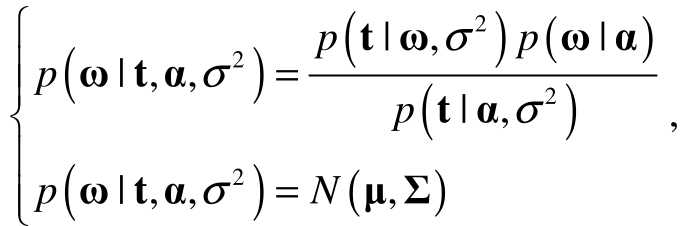 The Bayesian framework of RVM (Eq. 12) allows for the calculation of weight posterior distributions, providing a probabilistic foundation that SVM lacks.
Benchmark Insight: The Sinc Function
Before tackling market data, the authors tested both on a noisy sinc(x) function. RVM immediately showed its strength:
- Higher Accuracy: Lower Root Mean Square Error (RMSE).
- Greater Sparsity: It achieved the fit using far fewer basis functions (Relevance Vectors) than SVM's Support Vectors.
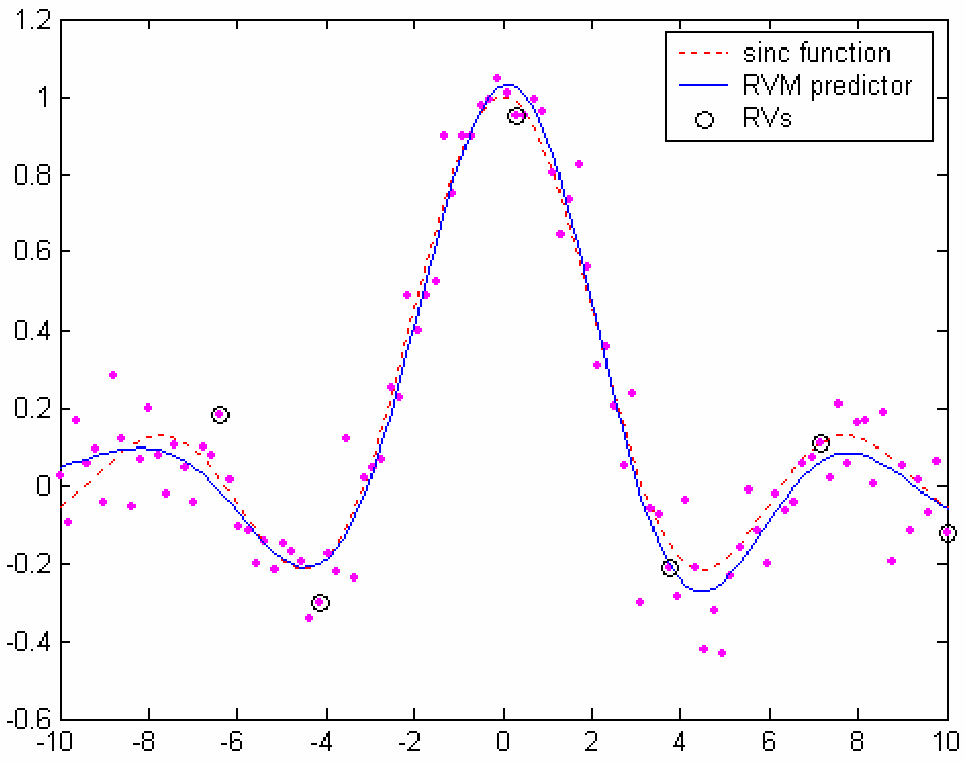
Case Study: Analyzing the Queensland (QLD) Electricity Market
The core of the study involved 4,416 price data points from the Australian NEM. The models were tasked with a 48-step day-ahead forecast (30-minute intervals).
Performance Comparison
The results in Table 2 are definitive regarding the efficiency gains of the Bayesian approach:
| Metric | SVM | RVM | Improvement |
|---|---|---|---|
| RMSE | 0.10391 | 0.07634 | ~26% Error Reduction |
| Time (seconds) | 75.2268 | 3.7724 | ~20x Faster |
| Vector Count | 55 (SVs) | 8 (RVs) | 85% Leaner |
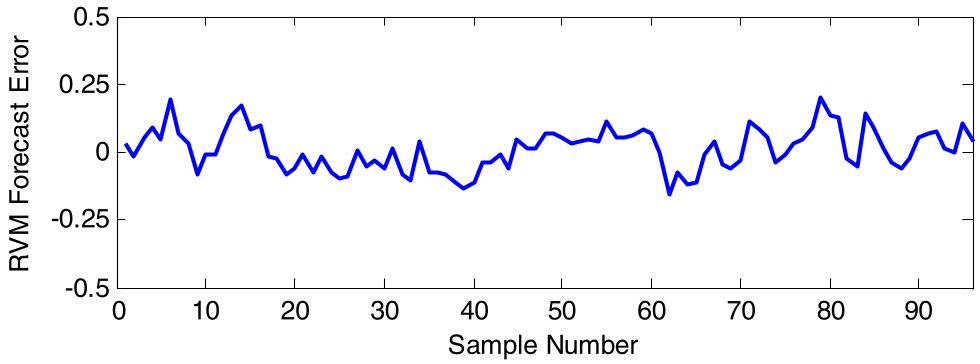 Visualization of RVM's ability to track the volatile price curve of the Queensland market.
Critical Insight & Conclusion
Why does RVM win? The secret lies in its probabilistic nature. While SVM focuses on a "hard boundary," RVM's Bayesian inference naturally leads to a sparser model by penalizing complexity through the prior distribution. This makes RVM less prone to over-fitting in the presence of the "noise" inherent in electricity prices.
Takeaway for Practitioners: If you are building real-time risk management tools where inference speed and model parsimony are critical, RVM is a vastly superior choice to standard SVM. However, it is important to note that both models still require careful tuning of kernel parameters (like RBF width) to perform optimally in different market conditions.
Future Outlook: While RVM proves its salt here, the next frontier involves hybridizing these sparse Bayesian methods with Deep Learning architectures to capture even longer-term temporal dependencies in global energy grids.